Pallet Film Gauge vs Micron: A Buyer's Conversion & Specification Guide

Gauge and micron are a straightforward conversion for most plastic film — except stretch film, where "true gauge" and "equivalent gauge" can describe genuinely different products at the same stated number. This guide explains the distinction, why suppliers often quote by weight instead, and what to ask for before comparing quotes.
Pallet film gauge vs micron are supposed to be straightforward unit conversions, but stretch film has a wrinkle that other plastic packaging categories don't: the same stated gauge number can describe films with meaningfully different actual thickness and cost, because of how some blown stretch film converters are permitted to label "gauge." Standard practice among Vietnamese manufacturers, including VietPhatPlas, is to spec and quote film directly in micron — a direct physical measurement with no equivalent-performance labeling involved. This guide is written for buyers who encounter "gauge" on a quote and want to know what's actually behind the number, as well as for buyers comparing a gauge-labeled quote against a straightforward micron-based spec sheet. For the basic unit conversions between mil, micron, and gauge, see our general plastic bag thickness guide.
Why Stretch Film Gauge Claims Need a Second Look
Gauge is technically a straightforward unit — one gauge equals 0.254 micron, so a film described as 80 gauge is nominally 20.3 micron thick. For most plastic film categories, that conversion is reliable and consistent between suppliers. Stretch film is the exception, because the resin formulations used to make modern high-performance stretch film are often engineered to perform like a thicker film while using less actual material — a legitimate manufacturing advancement, but one that has created two different, commonly used ways to state a film's "gauge."
This is why two rolls marketed at what looks like the same gauge number can have genuinely different actual material thickness, weight, and cost behind them. Buyers who compare stretch film purely on the gauge number stated in a quote, without asking which type of gauge is being quoted, can end up comparing two products that aren't actually equivalent.
True Gauge vs Equivalent Gauge: The Distinction That Changes Your Cost
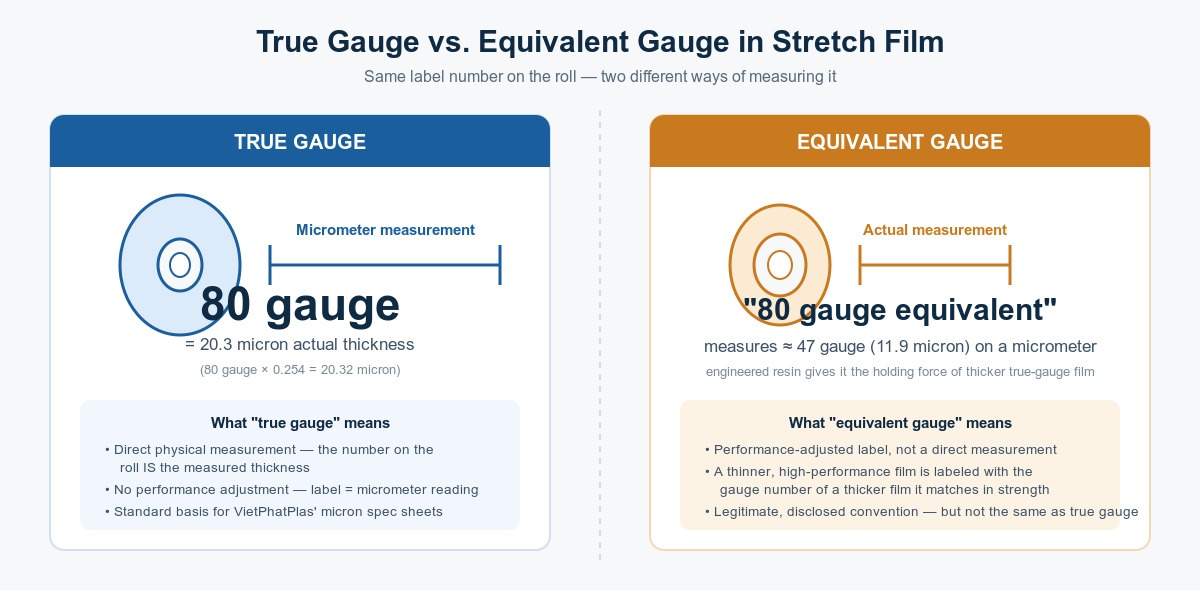
Actual vs equivalent thickness of stretch film comparison
True gauge is a direct physical measurement of the film's actual thickness, measured with a micrometer or gauge tool. It reflects exactly how much material is present, with no adjustment for performance.
Equivalent gauge (sometimes called "performance gauge") is a marketing and specification convention used for high-performance blown stretch film, where a thinner true-gauge film is labeled with the gauge number of a thicker conventional film it's engineered to match in performance — for example, a film that is physically 63 gauge (true) might be marketed as "80 gauge equivalent" because it delivers comparable containment force and puncture resistance to a conventional 80 gauge film, despite using meaningfully less actual material.
The practical implication: a buyer comparing a "63 gauge" quote against an "80 gauge equivalent" quote may be looking at rolls that perform almost identically, even though the numbers look very different — while a buyer comparing "80 gauge" (true) against "80 gauge equivalent" is actually comparing a heavier, more material-intensive film against a lighter one marketed to match its performance. Buyers who don't ask which convention a quote uses risk either overpaying for material they don't need, or unknowingly under-speccing performance by assuming two "80 gauge" quotes are identical products.
Why Suppliers Quote by Weight, Not Just Thickness
Because true gauge and equivalent gauge can diverge, many stretch film suppliers quote and price by weight (typically per kilogram or per pound) rather than by gauge alone — weight is a physical, unambiguous measurement that doesn't depend on which gauge convention a marketing team chose to use.
This is worth understanding as a buyer specifically because it changes what "cheaper" means in a quote comparison. A film priced lower per roll but using true-gauge-heavy resin, versus a film priced higher per roll but using engineered equivalent-gauge resin at lower actual weight, can yield very different real costs once pre-stretch percentage and yield per roll are factored in (see our pre-stretch percentage guide for how stretch ratio compounds this further). Comparing suppliers on price-per-kilogram alongside gauge type, rather than price-per-roll alone, gives a more reliable basis for comparison.
How to Ask for the Right Number When Requesting a Quote
When requesting a stretch film quote, ask specifically:
"Is this true gauge or equivalent gauge?" — a direct question that most legitimate suppliers will answer clearly, and one that immediately clarifies what you're comparing against a competing quote.
Request the roll weight alongside the gauge number — since weight is unambiguous, it's a useful cross-check against any gauge claim, true or equivalent.
Ask for the film's rated pre-stretch range alongside gauge, since yield per roll depends on both together, not gauge alone.
Request a physical sample and verify true thickness with a gauge tool if a quote's classification is unclear or if switching from a known supplier to a new one — this confirms the actual number behind whichever label the quote uses.
Why Sourcing Direct From a Vietnamese Manufacturer Sidesteps This Problem
The true-gauge-versus-equivalent-gauge ambiguity described above comes from how some converters and distributors are permitted to market gauge as a performance-adjusted figure rather than a direct measurement. It isn't how film is specified at the factory level under standard Vietnamese manufacturing practice. VietPhatPlas, like other established plastic manufacturers in Vietnam, specs and quotes stretch and pallet film directly in micron — a physical unit with no "equivalent" or performance-adjusted version to interpret.
For buyers, this matters practically: a quote that comes straight from a Vietnamese manufacturing facility in micron is already the "true gauge" answer, with no marketing convention layered on top of it. The gauge-conversion confusion mostly shows up further down the supply chain, when a distributor repackages or resells film and states its thickness using a converted or performance-adjusted gauge figure instead of the direct measurement. Buyers who source directly from the factory, and request specs in micron rather than converted gauge, remove a layer of ambiguity that a reseller relationship doesn't.
This doesn't mean every gauge-labeled quote is misleading — equivalent gauge is a legitimate, disclosed labeling convention, not a deceptive one, once a buyer knows to ask about it. But for a buyer weighing direct factory sourcing against a distributor relationship, knowing that a Vietnamese manufacturer's micron spec sheet is inherently the "true" number, not a marketing-adjusted one, is a relevant factor in that comparison.
Comparison: What Each Spec Actually Tells You
|
Spec |
What It Measures |
Reliability for Comparison |
|
True gauge |
Actual physical thickness |
Reliable, but doesn't reflect performance engineering |
|
Equivalent gauge |
Marketed performance-match to a thicker conventional film |
Useful for performance comparison, not raw material comparison |
|
Roll weight |
Physical material weight, unambiguous |
Best single cross-check across suppliers |
|
Micron / mil |
Direct unit conversion of true gauge |
Reliable for true gauge; doesn't apply to equivalent gauge claims |
For general mil-micron-gauge unit conversions applicable across plastic film categories, see the plastic bag thickness guide — this guide's comparison table is specific to the true-vs-equivalent gauge distinction unique to stretch film.
VietPhatPlas is a Vietnam-based manufacturer supplying pallet film with transparent micron-based specifications on request, helping buyers compare quotes against gauge-labeled alternatives on an apples-to-apples basis. For related specification factors, see our guides on cast vs blown pallet film and pre-stretch percentage.
FAQ
What's the difference between true gauge and equivalent gauge in stretch film? True gauge is a direct physical thickness measurement. Equivalent gauge is a marketing convention where a thinner, high-performance film is labeled with the gauge number of a thicker conventional film it's engineered to match in performance.
Why do two rolls with the same stated gauge cost different amounts? If one quote uses true gauge and the other uses equivalent gauge, the two rolls may have meaningfully different actual material thickness and weight despite the matching gauge number — always ask which convention is being used.
Why do some suppliers quote stretch film by weight instead of gauge? Weight is a physical, unambiguous measurement that doesn't depend on which gauge convention is used, making it a more reliable basis for comparing quotes across suppliers.
How can I verify whether a quoted gauge is true or equivalent? Ask the supplier directly, request the roll weight alongside the gauge number as a cross-check, and request a physical sample to measure true thickness with a gauge tool if the classification is unclear.
Does the true-vs-equivalent gauge distinction apply to other plastic film categories? It's most relevant to high-performance stretch and pallet film specifically, where resin engineering has advanced enough to create a meaningful performance-vs-thickness gap; it's less commonly seen in categories like standard trash bags, where gauge typically reflects direct thickness.
Do Vietnamese manufacturers quote pallet film in gauge or micron? Micron. Gauge is a legacy labeling convention used mainly by certain converters and distributors further down the supply chain. Vietnamese manufacturers, including VietPhatPlas, spec and quote film directly in micron, which avoids the true-versus-equivalent gauge ambiguity entirely.
Conclusion
Pallet film gauge and micron conversions are straightforward on paper, but stretch film's true-gauge-versus-equivalent-gauge distinction means the same stated number can describe genuinely different products. Buyers who ask which convention a quote uses, cross-check with roll weight, and verify with a physical sample avoid the two most common stretch film sourcing mistakes: overpaying for unneeded material, or under-speccing performance by assuming matching gauge numbers mean matching products.
If you're sourcing pallet film and want transparent, verifiable specifications, VietPhatPlas is a Vietnam-based manufacturer supplying pallet film specced directly in micron, with documentation available on request. Contact VietPhatPlas to compare your current supplier's spec against a transparent, factory-direct quote.
Sources:
-
Stretch and Shrink Film Market — Grand View Research