Pre-Stretch Percentage Stretch Film: How to Cut Pallet Film Costs Without Losing Load Containment

Pre-stretch percentage is the biggest lever for cutting pallet film cost per load, yet most buyers compare film by roll price instead. This guide explains why higher pre-stretch is usually a cost advantage rather than a quality compromise, where the containment-force trade-off kicks in, and how to calculate real yield per roll.
Pre-stretch percentage stretch film performance is the single biggest lever a facility has for cutting pallet film cost per load, yet it's the spec most buyers never ask about — they compare film by thickness and price per roll, while two rolls of identical thickness can wrap a completely different number of pallets depending on how much pre-stretch the film is engineered to hold. This guide explains what pre-stretch percentage means, why higher pre-stretch is usually a cost advantage rather than a quality compromise, and how to match it correctly to your load type.
What Pre-Stretch Percentage Actually Means
Pre-stretch percentage measures how much a roll of stretch film is elongated before it ever touches the pallet. Mechanical and automated wrapping equipment runs film between two rollers turning at different speeds, stretching it lengthwise by a set percentage before it's applied to the load — a 150% pre-stretch means a given length of film is stretched to 2.5 times its original length before wrapping.
This matters because stretched film covers more surface area per roll than unstretched film of the same starting length. A roll pre-stretched to 250% wraps significantly more pallets than the same roll applied at 100% (no stretch), even though both started as identical film. This is the mechanism behind "yield" — the practical number of pallets a single roll can wrap — and it's why comparing stretch film purely on price per roll, without accounting for pre-stretch capability, is comparing the wrong number.
Why Higher Pre-Stretch Usually Means Better Value, Not Weaker Film
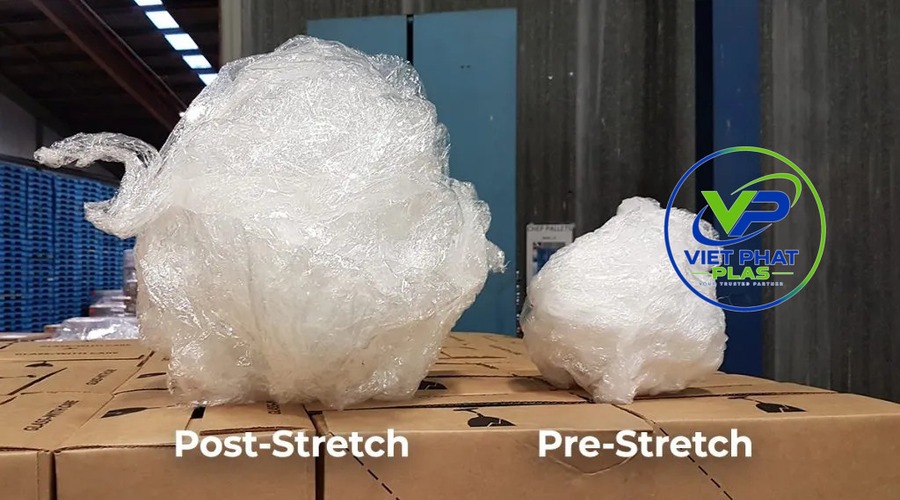
Stretch film roll before and after pre-stretching
The common assumption is that stretching film thinner must weaken it, but this misunderstands what pre-stretch does to the material. Polyethylene stretch film is engineered to be pulled — the stretching process aligns its polymer chains, which actually increases the film's tensile strength and puncture resistance up to a point, rather than degrading it. This is why premium stretch film is typically rated for higher pre-stretch percentages than basic film: it's designed specifically to be stretched further while holding its containment properties, delivering more coverage per roll without a proportional loss in strength.
The result is that a higher-pre-stretch-capable film, even at a higher price per roll, frequently costs less per pallet wrapped than a cheaper roll that can only be stretched to a lower percentage before it tears or loses grip. Buyers evaluating stretch film purely by roll price are the ones most likely to overpay per pallet in practice. This cost-efficiency angle is a broader trend across the industry: resin innovation and downgauging (using less material while holding the same or better performance) are cited as key drivers of the global stretch and shrink film market, which was valued at USD 19.5 billion in 2025 and is projected to reach USD 28.9 billion by 2033 (Grand View Research) — the same underlying mechanics that make higher pre-stretch film a genuine cost advantage rather than a compromise.
The Containment Force Trade-Off: Where More Stretch Stops Helping
Pre-stretch percentage isn't a "more is always better" number — every film has an optimal range beyond which additional stretching reduces the force it applies back against the load, known as containment force. Past a film's engineered limit, further stretching thins the material past the point where it can hold its recovery tension, so the roll covers more area but grips the load more weakly, increasing the risk of load shift in transit.
This is the trade-off buyers need to balance deliberately: pushing pre-stretch percentage higher cuts material cost per pallet, but only within the range the specific film is rated for. Operating outside that range to chase further savings risks the exact failure — load shift, box crush, or product damage in transit — that stretch film exists to prevent. The right approach is matching pre-stretch level to the film's rated range and the load's actual containment needs, not maximizing stretch percentage in isolation.
How to Calculate Real Yield From Pre-Stretch Percentage
Yield — the number of pallets a roll can realistically wrap — is the number that actually determines cost per load, and it's calculated directly from pre-stretch percentage:
Stretched length = original film length × (1 + pre-stretch percentage)
For example, a 1,500-foot roll pre-stretched to 200% yields roughly 4,500 feet of applied film (1,500 × 3), before accounting for overlap and machine settings. Comparing two rolls on this basis — rather than roll price alone — often reveals that a roll costing more upfront delivers a lower true cost per pallet wrapped, because its higher rated pre-stretch percentage stretches further before losing containment force.
Buyers evaluating a new film supplier should request the film's rated pre-stretch range directly, run a side-by-side yield calculation against their current film, and confirm the containment force holds at the pre-stretch level they intend to run — not just accept a lower roll price as evidence of savings.
Matching Pre-Stretch Level to Load Type
The right pre-stretch level depends on what's being wrapped, not a single default setting across every load:
Stable, uniform loads (boxed goods, palletized cartons with consistent shape) can typically run at the higher end of a film's rated pre-stretch range, since the load itself provides structural stability and the film's primary job is dust/moisture protection and light unitization.
Irregular or unstable loads (mixed cartons, loose or unevenly stacked goods) need lower pre-stretch settings to preserve maximum containment force, since the film is doing more of the structural work to hold the load together during transit.
Heavy, dense loads need containment force prioritized over yield — running these at maximum pre-stretch to save film cost risks exactly the load-shift failure the film is meant to prevent.
Automated wrapper vs hand-wrap application also affects achievable pre-stretch: automated wrappers can typically run higher, more consistent pre-stretch percentages than hand application, which is one of the practical cost differences covered in our machine vs hand stretch film guide.
Comparison Table: Pre-Stretch Range by Application
|
Load Type |
Typical Pre-Stretch Range |
Priority |
|
Stable boxed/carton loads |
200–300% |
Maximize yield |
|
Mixed or irregular loads |
100–150% |
Preserve containment |
|
Heavy, dense pallets |
100–200% |
Balance containment and yield |
|
Hand-wrap application |
50–150% (operator-dependent) |
Consistency over maximum stretch |
|
Automated wrapper, standard loads |
200–300% |
Maximize yield with consistent tension |
Ranges vary by specific film formulation and equipment — always confirm against the manufacturer's rated range for the film in use.
VietPhatPlas supplies pallet film engineered for higher-pre-stretch applications, helping buyers cut material cost per pallet without compromising containment force. For related film selection factors, see our guides on cast vs blown pallet film and high slip vs cling stretch film.
FAQ
What is a good pre-stretch percentage for pallet wrapping? It depends on load type: stable, uniform loads can often run 200–300% pre-stretch, while irregular or heavy loads should run lower, typically 100–150%, to preserve containment force.
Does stretching film thinner make it weaker? Not within the film's rated range — pre-stretching aligns the polymer chains in the film, which can increase tensile strength and puncture resistance up to the film's engineered limit. Beyond that limit, further stretching does reduce containment force.
How do I calculate how many pallets a roll of stretch film can wrap? Multiply the roll's original film length by (1 + pre-stretch percentage) to get total applied length, then divide by the film length used per pallet based on your wrap pattern and machine settings.
Can hand-wrap achieve the same pre-stretch as machine wrap? Generally not to the same degree or consistency — automated wrappers can sustain higher, more even pre-stretch percentages than manual application, which is one reason machine-wrapped pallets often use less film per load.
Does higher pre-stretch always mean lower cost per pallet? Only within the film's rated pre-stretch range. Pushing beyond that range increases yield but sacrifices containment force, risking load shift that can cost more in damaged goods than the film savings are worth.
Conclusion
Pre-stretch percentage is the spec that actually determines cost per pallet wrapped, not roll price alone — film engineered for higher pre-stretch typically delivers more coverage per roll without sacrificing containment force, up to its rated limit. The right approach is matching pre-stretch level to load type and confirming a film's rated range before assuming higher stretch always means savings.
If you're sourcing pallet film and want to cut material cost without risking load containment, VietPhatPlas supplies pallet film engineered for a range of pre-stretch applications. Contact VietPhatPlas to discuss your load types and get a yield-matched quote.
Sources:
- Stretch and Shrink Film Market — Grand View Research