Plastic Bag Thickness Guide: Micron, Mil and Gauge

Compare plastic bag thickness in microns, mils and gauge. Learn how material, seals and testing affect strength, pricing and B2B purchase specifications.
Plastic bag thickness is one of the first specifications buyers compare, yet it is also one of the easiest to misunderstand. A quotation may list thickness in microns, mils, millimeters, or gauge. Two bags with the same nominal thickness can also perform differently because resin type, film formulation, seals, dimensions, and handling conditions all affect strength.
This plastic bag thickness guide explains how to compare units, choose a practical starting range, and write a clearer request for quotation (RFQ). It is designed for importers, distributors, retailers, food processors, and industrial packaging teams sourcing wholesale plastic bags or custom polyethylene packaging.
Plastic bag thickness units: micron, mil, millimeter and gauge
International buyers commonly use microns, while many North American buyers specify mils. Millimeters appear in technical drawings, and gauge is still used by some suppliers. The word mil does not mean millimeter: one mil is one-thousandth of an inch.
| Unit | Definition | Useful conversion |
|---|---|---|
| Micron (µm) | One-thousandth of a millimeter | 1 µm = 0.001 mm |
| Mil | One-thousandth of an inch | 1 mil = 25.4 µm |
| Millimeter (mm) | Metric length unit | 0.05 mm = 50 µm |
| Gauge | Legacy film-thickness unit | 100 gauge = 1 mil = 25.4 µm |
For quick conversions, multiply mil by 25.4 to obtain microns. Divide microns by 25.4 to obtain mil. For example, a 2 mil bag is approximately 50.8 microns, and a 75-micron bag is approximately 2.95 mil.
Why thickness alone does not determine bag strength
It is tempting to compare quotations by thickness only. That approach can lead to a bag that is either under-specified and prone to failure or unnecessarily heavy and expensive. A complete comparison should include the following factors.
Resin and film formulation
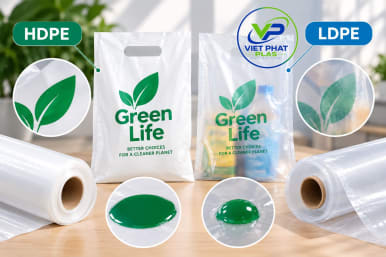
HDPE film can provide good stiffness and tensile performance at a relatively low thickness, which is useful for lightweight liners and many retail applications. LDPE is softer, clearer, and flexible, while LLDPE is often selected when puncture resistance and stretch are important. Blends can balance cost, clarity, stiffness, sealability, and toughness. See our plastic bag materials guide for B2B buyers before comparing thickness across different resin systems.
Bag dimensions and construction
A larger bag places more stress on the film and seals than a smaller bag carrying the same product. Side gussets, bottom gussets, handle cut-outs, drawstrings, perforations, and vent holes can change how forces are distributed. Seal type and seal consistency are equally important because a strong film can still fail at a weak bottom or side seam.
Product shape and handling conditions
Sharp corners, frozen edges, metal parts, irregular waste, and repeated handling create different risks from smooth, lightweight products. Storage temperature, transport vibration, filling equipment, pallet pressure, and exposure time should be included in the specification. This is why there is no reliable universal formula that converts product weight directly into one correct film thickness.
Typical plastic bag thickness ranges by application
The ranges below are practical starting points for discussion, not guaranteed load ratings. Final thickness should be confirmed with the exact material, bag design, packed product, and performance tests.
| Starting range | Approximate mil | Common applications | Main checks |
|---|---|---|---|
| 13-25 microns | 0.5-1.0 mil | Light produce bags, lightweight liners, short-term covers | Tear initiation, perforation consistency, opening performance |
| 25-50 microns | 1.0-2.0 mil | Apparel, retail goods, general storage, lightweight shipping | Seal strength, print quality, product corners |
| 50-75 microns | 2.0-3.0 mil | Freezer bags, medium-duty packaging, reusable retail bags | Low-temperature flexibility, puncture, closure performance |
| 75-100 microns | 3.0-4.0 mil | Hardware, industrial parts, heavy-duty liners | Abrasion, sharp edges, drop and handling tests |
| 100-150+ microns | 4.0-6.0+ mil | Demanding industrial protection and heavy or irregular contents | Full pack trial, seal design, puncture and long-term storage |
For waste collection, browse our garbage bag range. For protective inner packaging and industrial containment, review PE liners. Buyers requiring printed dimensions, colors, additives, or special construction can start with our custom plastic bag solutions.
How to choose the right PE bag thickness
1. Define the packed product
Record the maximum product weight, dimensions, number of items per bag, and any pointed or abrasive surfaces. A representative physical sample is more useful than a general description such as “medium duty.”
2. Describe the complete use cycle
Explain whether the bag is filled by hand or machine, heat-sealed or tied, carried by a handle, stacked in cartons, frozen, stored outdoors, or reused. Include the expected storage period and transport method. The most severe point in the use cycle should guide the test plan.
3. Select material before optimizing thickness
Compare HDPE, LDPE, LLDPE, recycled-content blends, or another suitable formulation based on stiffness, clarity, flexibility, puncture resistance, sealing, print, and regulatory needs. Reducing thickness may be possible with a stronger formulation, but only after sample validation.
4. Test more than one sample option
Ask the manufacturer for two or three sample constructions when cost and performance must be balanced. Test them with the actual product under realistic filling, sealing, handling, stacking, and transport conditions. Our guide on how to test plastic bag strength provides a useful starting checklist.
5. Lock the approved specification
After approval, record the material or blend, nominal thickness, agreed tolerance, finished bag dimensions, seal style, printing, color, additives, packing method, and acceptance tests. Reference the approved sample and revision number in the purchase order.
Plastic film tests buyers can request
Visual inspection is useful but cannot replace measurable quality criteria. Depending on the application, a buyer may request thickness measurement, tensile properties, impact resistance, tear resistance, puncture resistance, coefficient of friction, seal strength, or a finished-bag load test.
Widely recognized ASTM methods include ASTM D882 for tensile properties of thin plastic sheeting. ASTM also identifies methods used in plastic film testing for thickness, drop impact, propagation tear, puncture, haze, and friction. The correct test set depends on the product and failure risk; not every order requires every test.
For a custom project, agree on the sampling plan and acceptance criteria before mass production. “No tearing” is too vague unless the test load, duration, temperature, bag dimensions, and test method are defined.
What to include in a plastic bag thickness RFQ
A complete RFQ helps suppliers quote the same construction and reduces time lost to clarification. Include:
- Bag type and finished dimensions, including gussets, flap, lip, or handle;
- Material preference: HDPE, LDPE, LLDPE, blend, recycled content, or performance-based option;
- Thickness in microns or mil, and whether it is specified per wall;
- Expected tolerance and measurement method;
- Maximum packed weight and product description;
- Sharp edges, freezing, outdoor storage, moisture, or chemical exposure;
- Seal type, perforations, closure, vent holes, and printing requirements;
- Quantity per size, annual demand, packing format, and destination port;
- Required samples, test data, certificates, or regulatory documents.
Thickness affects resin consumption and therefore price, but it should be compared together with dimensions, material, printing, packing, order volume, and test requirements. For a broader commercial comparison, read our plastic bag MOQ and pricing guide.
Common plastic bag thickness mistakes
- Confusing mil with millimeter: 1 mil is 0.0254 mm, not 1 mm.
- Comparing different materials by thickness alone: equal thickness does not guarantee equal performance.
- Ignoring per-wall terminology: confirm whether the stated thickness applies to one film wall or a folded measurement.
- Ordering by product weight only: shape, sharpness, bag size, seal design, and handling can be more important than weight.
- Skipping production tolerance: define how thickness is measured and what variation is acceptable.
- Approving an empty-bag sample only: conduct a packed-product trial before mass production.
Frequently asked questions
How many microns are in 1 mil?
One mil equals 25.4 microns. Multiply mil by 25.4 to convert a specification to microns.
Is a thicker plastic bag always stronger?
Not necessarily. Thickness usually adds material, but resin formulation, film orientation, bag dimensions, seals, perforations, and product shape also control real-world performance.
What is the difference between 50 microns and 2 mil?
They are nearly equivalent: 2 mil equals 50.8 microns. Confirm the supplier's tolerance and whether the thickness is measured per wall.
Can a supplier calculate thickness from load weight alone?
Load weight is only one input. The supplier also needs the product shape, bag dimensions, resin, seam design, handling, storage, and required safety margin. A packed-product test is the safest confirmation.
Should an RFQ use micron or mil?
Either unit is acceptable when it is clearly defined. Listing both units can reduce confusion in international procurement.
Request a thickness recommendation and sample
Viet Phat Plas manufactures custom polyethylene packaging for wholesale and export orders. Send us your bag dimensions, packed product, target quantity, destination, and current specification. Our team can review the application, recommend a practical material and thickness range, and prepare samples for validation.
Contact Viet Phat Plas for a plastic bag quotation and include the RFQ checklist above to receive a more accurate comparison.