Global Plastic Bag Regulations 2026: What Exporters and Importers Need to Know
Plastic bag regulations 2026 aren't one global rule — they're five separate regimes reaching enforcement in the same year, from California's checkout-bag rewrite to Vietnam's own domestic ban and the EU's PPWR, which just took effect this month. This guide breaks down what actually changed, what's still pending, and the compliance checklist exporters need before their next shipment.
Plastic bag regulations 2026 is less a single global rule than five separate regimes that happen to be reaching enforcement in the same twelve months — a coincidence of timing that matters more to exporters than any one country's headline ban. California closed its own checkout-bag loophole on January 1. The UAE's fourth and final phase of single-use plastic restrictions took effect the same day. Vietnam's own domestic threshold on non-biodegradable bags started on January 1 too. And the EU's Packaging and Packaging Waste Regulation began applying across the bloc on August 12 — four days before this guide was written. For a manufacturer or distributor shipping the same bag SKU into more than one of these markets, treating compliance as a single checklist rather than five separate ones is how orders get rejected at customs.
This guide is written for the buyers who compare plastic bag materials and sourcing options across multiple export destinations, not for consumers tracking their local grocery store's bag policy. It covers what actually changed in each market, what's still pending despite headlines suggesting otherwise, and a practical checklist for reviewing your own product line against each regime.
Plastic Bag Regulations 2026: Why This Year Is a Turning Point
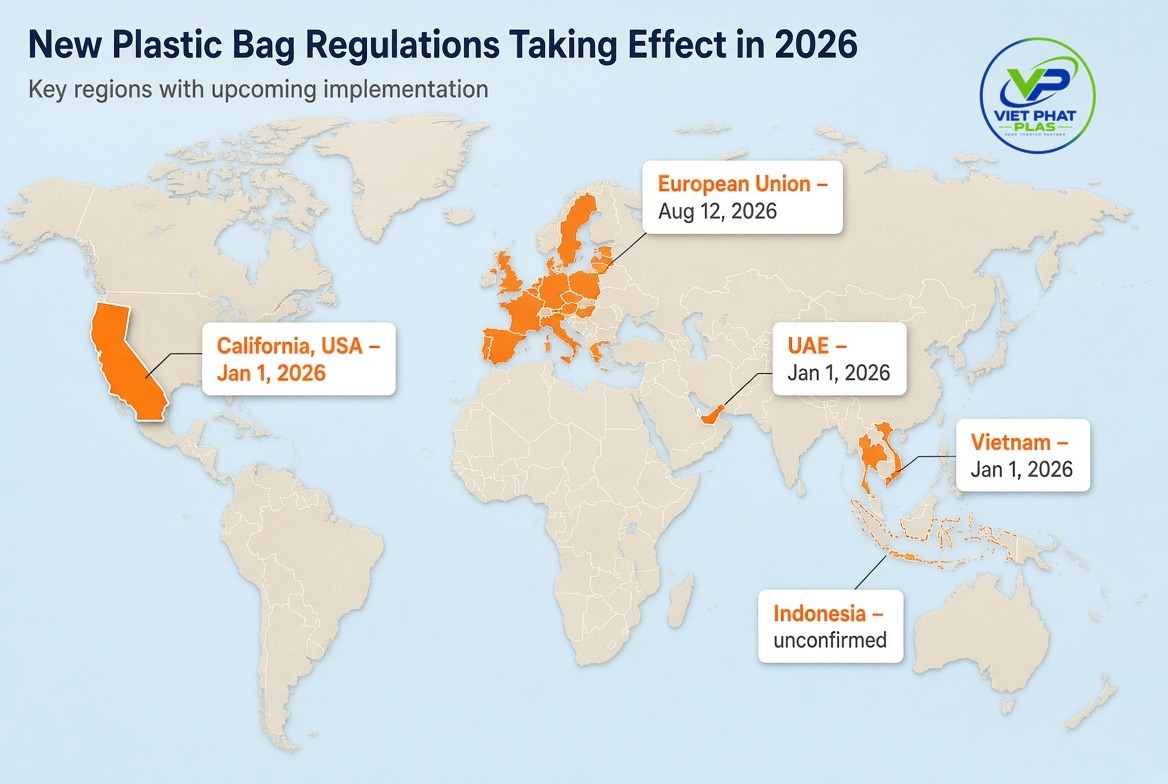
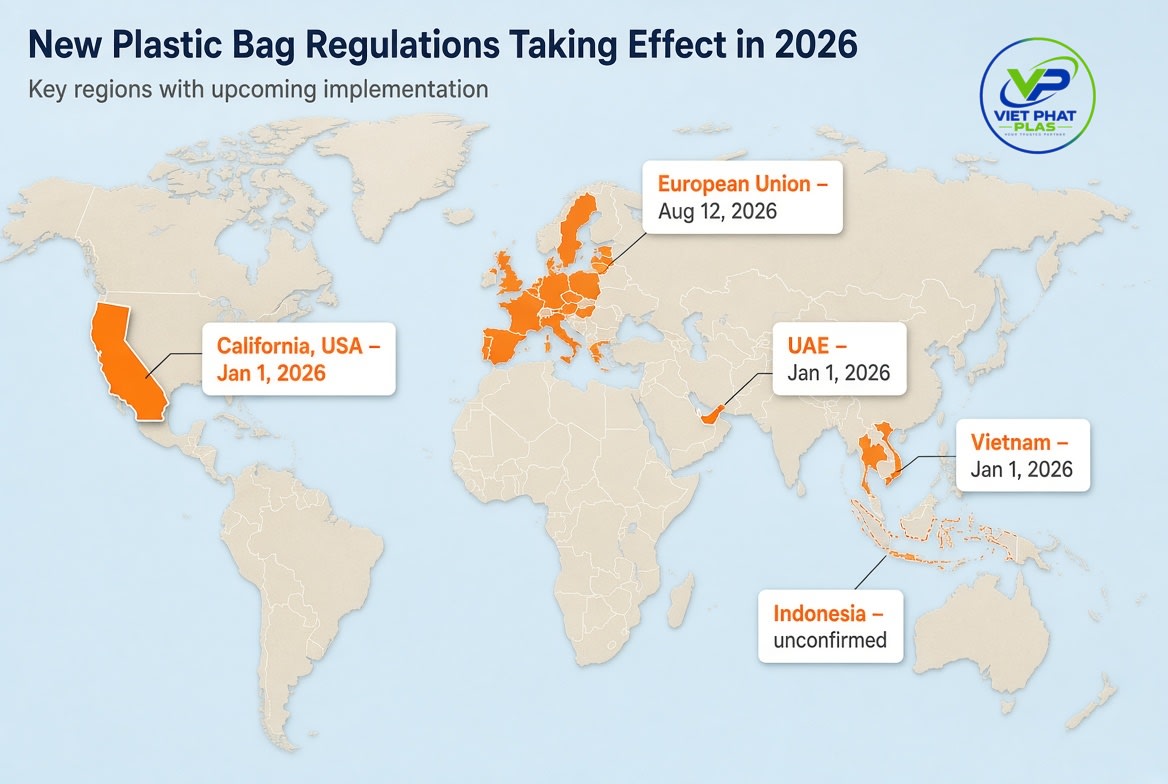
World map highlighting regions with new plastic bag regulations taking effect in 2026
Plastic bag regulation has been building for a decade across dozens of jurisdictions, but 2026 is unusual because several major regimes are landing enforcement dates within months of each other rather than spread across years. California's SB 1053 took effect January 1. The UAE's fourth phase of Cabinet Resolution No. 380 of 2022 also took effect January 1. Vietnam's Decree No. 08/2022/ND-CP set its own bag-specific threshold for January 1. The EU's Packaging and Packaging Waste Regulation began applying August 12. Indonesia remains the outlier — widely cited as targeting a 2026 nationwide ban, but without a specific enforceable deadline behind that claim, as the section below explains.
The practical consequence for exporters: a bag specification that clears one market's rules this year can still fail a different market's rules on the same shipment date, because "banned," "restricted," and "phased out" mean different things in each of these five regimes — different product scope, different size and thickness thresholds, and different allowed alternatives. Treating 2026 as one compliance deadline rather than five is the most common sourcing mistake buyers make when reading generic single-use plastic bans by country roundups that compress all of this into a single "the world is banning plastic bags" headline.
United States: California's SB 1053 Closes the "Reusable Bag" Loophole
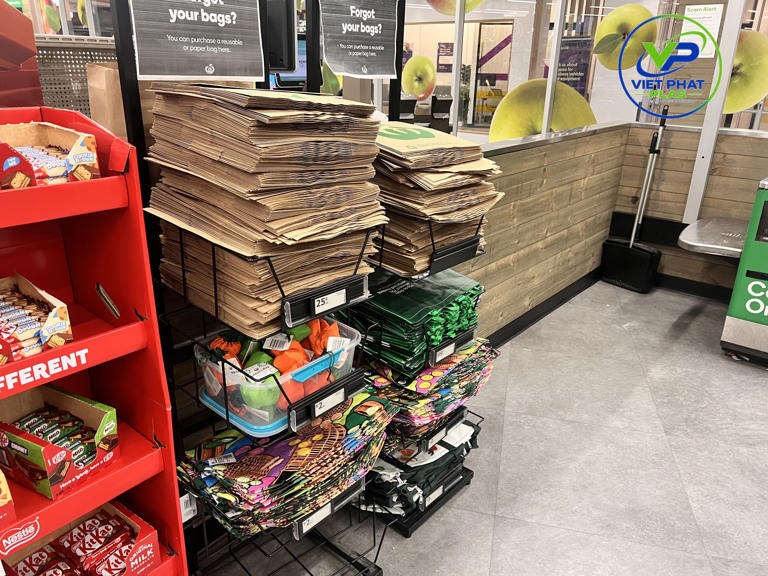
US grocery store checkout counter with recycled paper bags replacing plastic
California's original 2014 bag ban (SB 270) allowed stores to sell thicker plastic bags labeled "reusable," an exemption that produced exactly the outcome critics predicted: thick plastic bags that were rarely reused and that most municipal recycling facilities won't accept. SB 1053, signed in September 2024 and reported in detail by Packaging Dive, closes that loophole starting January 1, 2026. As of this year, California grocery stores, pharmacies, and other retail checkouts — including self-checkout, curbside pickup, and home delivery — cannot offer any plastic bag at checkout, regardless of thickness or a "reusable" label.
The only bag option retailers can still charge for is a recycled paper bag, priced at a minimum of $0.10, made from at least 40% postconsumer recycled material. That threshold rises to 50% two years in. Certified compostable bags remain an option under the law as well. One clarification worth flagging for B2B buyers: SB 1053 governs checkout and carryout bags specifically — it does not ban plastic bags as a category across every use case in California, so product lines like trash bags, zipper storage bags, or bulk food packaging sold on-shelf rather than handed out at checkout fall outside its scope. For exporters supplying US retail chains, the actionable shift is on checkout-bag SKUs specifically: either move that line to compliant recycled paper or exit it for California-bound orders, while other bag categories continue under separate rules.
Middle East: The UAE's 2026 Phase Adds a Bag-Thickness Floor Alongside New Item Restrictions
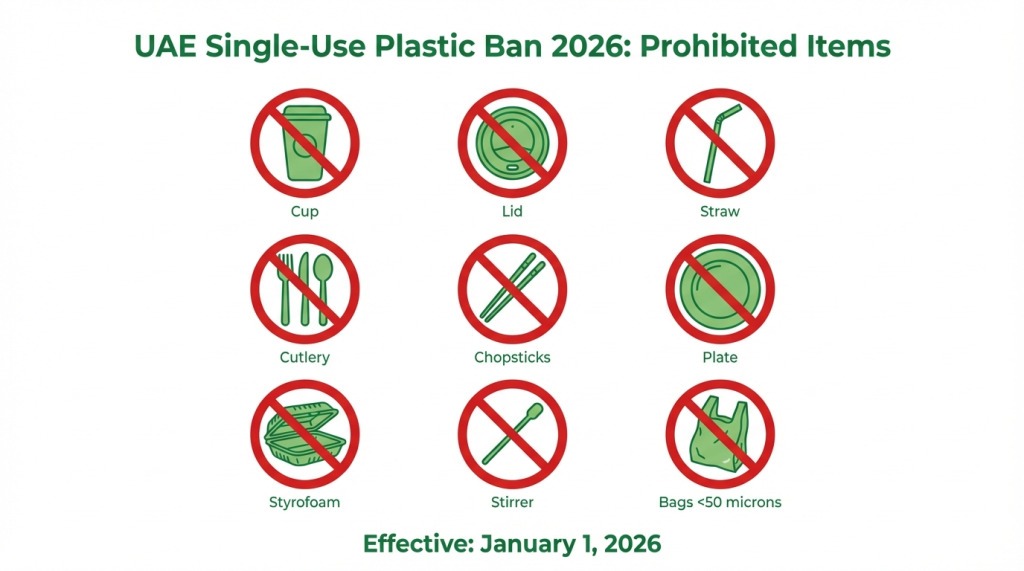
Single-use plastic products restricted in the UAE — cups, straws, foam containers
The UAE's single-use plastics restrictions, under federal Cabinet Resolution No. 380 of 2022, have rolled out in phases rather than as a single ban. Abu Dhabi banned single-use plastic bags locally from June 1, 2022, and a UAE-wide prohibition on single-use plastic bags followed from January 1, 2024. The phase that took effect January 1, 2026 — reported by Khaleej Times and The National — does two things at once: it extends restrictions to a new set of product categories (beverage cups and lids, cutlery, plates, straws, stirrers, and foam food containers and boxes), and it separately tightens the bag rule itself, establishing a nationwide ban on single-use bags under 50 microns thick regardless of what material they're made from. Exemptions apply to products made for export, bags made domestically from recycled material, medicine and refuse bags, thin wraps used for fresh food, and large shopping bags for clothing, electronics, and toys; products made from plant-based PLA remain excluded from the restriction generally.
The implication for exporters: UAE-bound bag orders now need to clear two thresholds rather than one — the 2022/2024 restrictions on single-use plastic bags specifically, and the new January 2026 floor banning any single-use bag under 50 microns regardless of material, unless it falls under one of the stated exemptions. A bag that was compliant in 2024 or 2025 isn't automatically compliant now if it falls under that thickness floor. Buyers shipping bags into the UAE should confirm current gauge against the 50-micron threshold directly, rather than assuming the "UAE plastic ban 2026" only affects non-bag product categories.
Southeast Asia: Vietnam's Own 2026 Deadline and Indonesia's Uneven Rollout
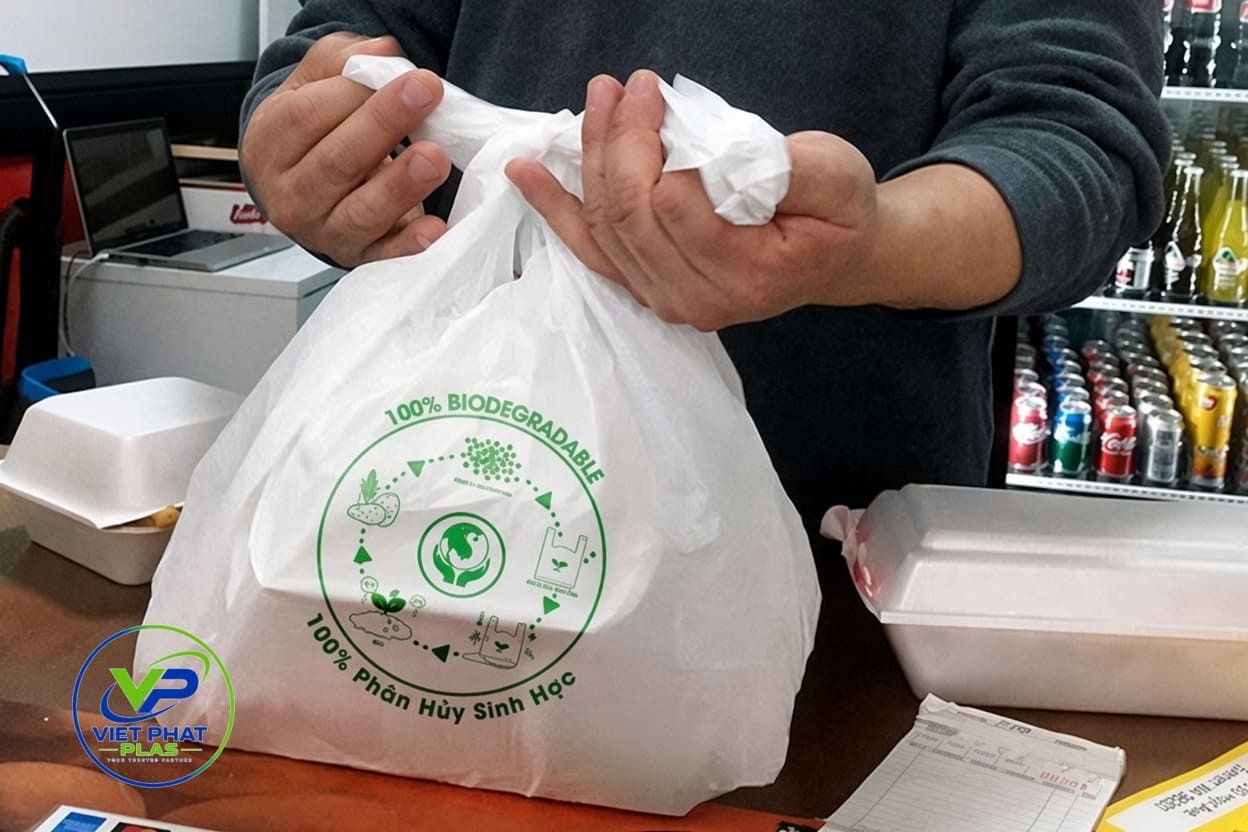
Vietnamese supermarket transitioning to biodegradable bags instead of standard plastic bags
Vietnam has its own bag-specific deadline landing in 2026, which is directly relevant for any buyer sourcing from Vietnamese manufacturers rather than just reading about it secondhand. Under Decree No. 08/2022/ND-CP — confirmed via VietnamNet and Vietnam's own Ministry of Industry and Trade — from January 1, 2026, Vietnam no longer permits the domestic production or import of non-biodegradable plastic bags smaller than 50cm × 50cm and thinner than 50 microns. Shopping malls, supermarkets, hotels, and tourist areas also face restrictions on circulating single-use plastic products and hard-to-decompose packaging under the same decree, with a full stop on production and import of single-use plastics, non-biodegradable packaging, and microplastic-containing goods set for after December 31, 2030.
For export buyers, this matters in two ways. First, it means Vietnam's own domestic market is moving in the same direction as the export markets described above — biodegradable and compostable bag production is becoming the compliant default inside Vietnam, not just an export requirement imposed from outside. Second, it's a useful data point for buyers evaluating a Vietnamese manufacturer's production capability: a factory already producing to Vietnam's own 2026 biodegradable-bag threshold has a head start on meeting comparable requirements elsewhere.
Indonesia is frequently cited alongside these deadlines as planning a comprehensive single-use plastic ban by the end of 2026, but that claim doesn't trace back to a specific, currently enforceable nationwide law. Indonesia's officially stated long-term target — under Ministry of Environment and Forestry Regulation No. 75 of 2019 — is a national phase-out of single-use plastics by 2030, not 2026. In practice, plastic bag restrictions in Indonesia exist mainly at the city level (Jakarta and parts of Bali among the earlier adopters), and independent reporting from Asia News Network and WRI Indonesia has found enforcement inconsistent even where local bans are on the books. Buyers should treat "Indonesia bans plastic bags in 2026" as an unconfirmed claim circulating in secondary sources rather than a compliance deadline to plan around, and should verify current requirements at the specific city or province level for any Indonesia-bound shipment.
Europe: The EU's PPWR Restricts PFAS in Food-Contact Packaging as of This Week
The EU's Packaging and Packaging Waste Regulation, Regulation (EU) 2025/40, entered into force in February 2025, and its rules apply on a phased basis starting August 12, 2026 — a date that had passed only four days before this guide was written. According to the European Commission's own announcement, the specific measure taking effect on that date is a restriction on PFAS ("forever chemicals") in food-contact packaging: from August 12, food-contact packaging containing PFAS above set limits can no longer be placed on the EU market, covering categories like takeaway containers, fast-food wrappers, microwave popcorn bags, bakery paper, and pizza boxes. The measures more commonly associated with PPWR headlines — a harmonized packaging labeling system, a cap on empty space in e-commerce parcels, mandatory recycled-content minimums, and full-recyclability design requirements — are not yet in effect: labeling harmonizes from 2028, and the empty-space, recycled-content, and recyclability requirements apply from 2030, confirmed directly by the Commission's announcement rather than the earlier (and, on this point, inaccurate) assumption that the empty-space rule was already live.
For bag exporters, the immediate relevance of the August 12, 2026 milestone is narrower than many regulation roundups suggest: it's a food-contact-safety restriction, not yet a packaging-design or void-fill rule. A food bag shipped into the EU now needs PFAS-compliant materials if it makes food-contact claims, but the e-commerce empty-space limit that would affect bags used as parcel void-fill doesn't apply for several more years. Buyers with a broader EU compliance question beyond this specific measure should treat this section as a starting point rather than a complete PPWR breakdown as part of a wider plastic bag export compliance review; a full compliance guide covering the regulation's phased DoC and EPR requirements in more depth is available separately.
Comparison Table & A Practical Compliance Checklist for Exporters
|
Market |
Effective Date |
What Changed |
Allowed Alternative |
Risk if Non-Compliant |
|
California, US (SB 1053) |
Jan 1, 2026 |
All checkout/carryout plastic bags banned, including thick "reusable" bags |
Recycled paper bag (≥40% postconsumer, min. $0.10) or certified compostable |
Retailer penalties; rejected checkout-bag orders |
|
UAE (Cabinet Resolution 380/2022, Phase 4) |
Jan 1, 2026 |
New items restricted (cups, cutlery, plates, straws, stirrers, foam containers); NEW nationwide ban on single-use bags under 50 microns (any material), tightening 2022/2024 bag rules |
PLA-based alternatives; exempted categories (export, recycled-content, medicine/refuse, thin fresh-food wraps, large shopping bags) |
Import/trade restrictions on covered items |
|
Vietnam (Decree 08/2022/ND-CP) |
Jan 1, 2026 |
No domestic production/import of non-biodegradable bags under 50cm×50cm and 50 microns |
Biodegradable/compostable bags |
Production and import restrictions |
|
Indonesia |
No confirmed nationwide date |
City-level bans only (e.g. Jakarta, Bali); national target is 2030, not 2026 |
Varies by city/province |
Inconsistent local enforcement; verify per destination |
|
EU (PPWR, Regulation 2025/40) |
Aug 12, 2026 |
PFAS restricted in food-contact packaging. NOT yet in effect: empty-space cap, recycled-content minimums, recyclability rules (all apply from 2030); labeling from 2028 |
PFAS-free food-contact materials now |
Market access issues for non-compliant food-contact packaging |
A short checklist turns this table into an actual review process rather than a reference chart:
Map each SKU to its destination market's specific rule, not a generic "plastic bags are being banned" assumption — a checkout bag, a zipper storage bag, and e-commerce void-fill packaging can sit under entirely different rules even within the same country.
Confirm the allowed alternative's actual specification, not just its category — "recycled paper bag" in California has a minimum recycled-content percentage and price floor; "biodegradable bag" in Vietnam has a specific size and thickness threshold that determines whether the ban even applies.
Request compliance documentation per shipment rather than assuming a supplier's general capability covers every order — material composition, thickness, and recycled or biodegradable content can vary by production run. Building this into the RFQ stage, rather than after samples arrive, is the same discipline covered in VietPhatPlas's B2B plastic bag sourcing guide.
Track phased rollouts, not just headline years — the UAE example shows a single date can bring both a genuinely new restriction and a tightened version of an old one at once, and the EU example shows a regulation's application date doesn't put every provision into effect simultaneously; confirm which specific measure is live now versus scheduled for a later phase (2028, 2030) before assuming a headline date covers everything written about it.
Re-verify unconfirmed claims before planning around them — Indonesia's case shows that secondary sources sometimes repeat a deadline that doesn't trace back to an enforceable law.
FAQ
What kinds of plastic bags can California retailers still offer in 2026? None. As of January 1, 2026, SB 1053 prohibits offering any plastic bag — regardless of thickness or a "reusable" label — at checkout, self-checkout, curbside pickup, or delivery. The only paid option is a recycled paper bag with at least 40% postconsumer content (rising to 50% within two years) at a minimum price of $0.10, or a certified compostable bag.
What specific plastic products does the UAE's 2026 ban cover? The phase that took effect January 1, 2026 covers two things at once: new restrictions on beverage cups and lids, cutlery, plates, straws, stirrers, and foam food containers, and a new nationwide rule banning single-use bags under 50 microns thick regardless of material — tightening, not replacing, the earlier 2022/2024 restrictions on single-use plastic bags. Exemptions apply for export products, recycled-content bags made domestically, medicine and refuse bags, thin fresh-food wraps, and large shopping bags.
Has Indonesia officially banned plastic bags nationwide? Not as of this writing. Plastic bag restrictions in Indonesia exist mainly at the city or provincial level, with inconsistent enforcement even where they're in place. Indonesia's officially stated national target for phasing out single-use plastics is 2030, under Ministry of Environment and Forestry Regulation No. 75 of 2019 — not a confirmed 2026 nationwide deadline, despite that date circulating in some secondary sources.
What plastic bag rule is changing inside Vietnam itself in 2026? Under Decree No. 08/2022/ND-CP, from January 1, 2026, Vietnam no longer permits domestic production or import of non-biodegradable plastic bags smaller than 50cm × 50cm and thinner than 50 microns, with malls, supermarkets, hotels, and tourist areas also restricted from circulating single-use plastic and hard-to-decompose packaging.
What should an exporter do to avoid a shipment being rejected at port? Confirm the destination market's current rule for the specific bag category being shipped (not a general regional summary), request current compliance documentation from the manufacturer for that production batch, and re-verify any deadline that seems to apply broadly across multiple countries — the UAE case above shows a headline date can cover more than expected (a new bag-thickness floor alongside new item categories), while the EU case shows it can cover less than expected (only a PFAS restriction so far, not the empty-space or recycled-content rules widely associated with the regulation).
Conclusion
Plastic bag regulations 2026 isn't a single global shift — it's five separate regimes reaching different milestones in the same calendar year, each with its own product scope, size and thickness thresholds, and compliance path. California closed a decade-old loophole. The UAE both extended its restrictions to new product categories and tightened its own bag rule with a new thickness floor. Vietnam set its own domestic threshold. The EU's PPWR began applying a PFAS restriction this month, well ahead of the empty-space and recycled-content rules more commonly associated with the regulation. And Indonesia's widely repeated 2026 deadline doesn't hold up against its own government's stated 2030 target. Buyers who verify each market's specific rule — rather than working from a compressed headline — are the ones who avoid a shipment getting held up over a bag specification that was compliant somewhere else.
VietPhatPlas is a Vietnam-based manufacturer producing plastic and biodegradable bags for B2B buyers exporting into multiple regulatory environments, including HDPE and LDPE bags and biodegradable formats built to current thickness and size specifications. Contact VietPhatPlas to review your bag specifications against your specific destination market before your next order.
Sources:
-
California SB 1053 — Packaging Dive
-
UAE single-use plastics phased ban — Khaleej Times, The National
-
Vietnam Decree 08/2022/ND-CP — VietnamNet (Vietnamese edition), Ministry of Industry and Trade
-
Indonesia plastic policy — Asia News Network, WRI Indonesia
-
EU PPWR — European Commission