Antidumping Duty on Vietnamese Plastic Bags (PRCB): A US Importer's Guide

Antidumping duty on Vietnamese plastic bags is a phrase that covers a much narrower product scope than it sounds like — a specific antidumping and countervailing duty order on polyethylene retail carrier bags (PRCBs), not every plastic bag made in Vietnam. This guide breaks down the exact scope Commerce, and the ITC actually wrote into the order, what's explicitly excluded, and how importers confirm their product's real duty exposure before placing an order.
Antidumping duty on Vietnamese plastic bags sounds like it applies to anything made of plastic that ships from a Vietnamese factory, and that assumption causes real sourcing mistakes. The actual order covers one specific product — polyethylene retail carrier bags (PRCBs), the printed grocery- and checkout-style bags with handles that retailers give out at the register — not garbage bags, not zipper bags, not every poly bag with "Made in Vietnam" on the carton.
This guide is written for US importers, buyers, and procurement teams researching US import duty plastic bags questions before sourcing from Vietnam, who need to know whether their specific product falls inside or outside this order's scope before placing an order. Getting this wrong at the sourcing stage is far cheaper to fix than finding out at the port.
Antidumping Duty on Vietnamese Plastic Bags: What "PRCB" Actually Means
The order most people mean when they say "antidumping duty on Vietnamese plastic bags" covers polyethylene retail carrier bags Vietnam exports to the United States — also called t-shirt sacks, merchandise bags, grocery bags, or checkout bags, the kind a store hands a customer free of charge to carry a purchase out the door. The U.S. Department of Commerce found that PRCBs from Vietnam were being sold in the United States at less than fair value, and issued this PRCB antidumping order — along with a companion countervailing duty order — effective May 4, 2010, following final determinations published in the Federal Register on April 1, 2010.
A companion countervailing duty Vietnam plastic bags order covers the same PRCB scope, addressing subsidies rather than dumping margins, and the two orders are reviewed and continued together. Those orders haven't lapsed. Under the sunset review process required by the Tariff Act, Commerce and the International Trade Commission are required to revisit AD/CVD orders every five years and decide whether to continue or revoke them. The second sunset review concluded in October 2021, with both agencies determining that revoking the orders would likely lead to a continuation or recurrence of dumping, subsidies, and injury — so the orders were continued, effective October 27, 2021. That notice states Commerce intends to initiate the next five-year sunset review no later than 30 days before the fifth anniversary of that continuation date — the anniversary itself falls on October 27, 2026, which puts the initiation deadline around late September 2026, roughly a month out from this article's publication. That makes this a genuinely live compliance question for importers right now, not a settled historical footnote.
PRCB Defined: The Exact Product Scope of the Order
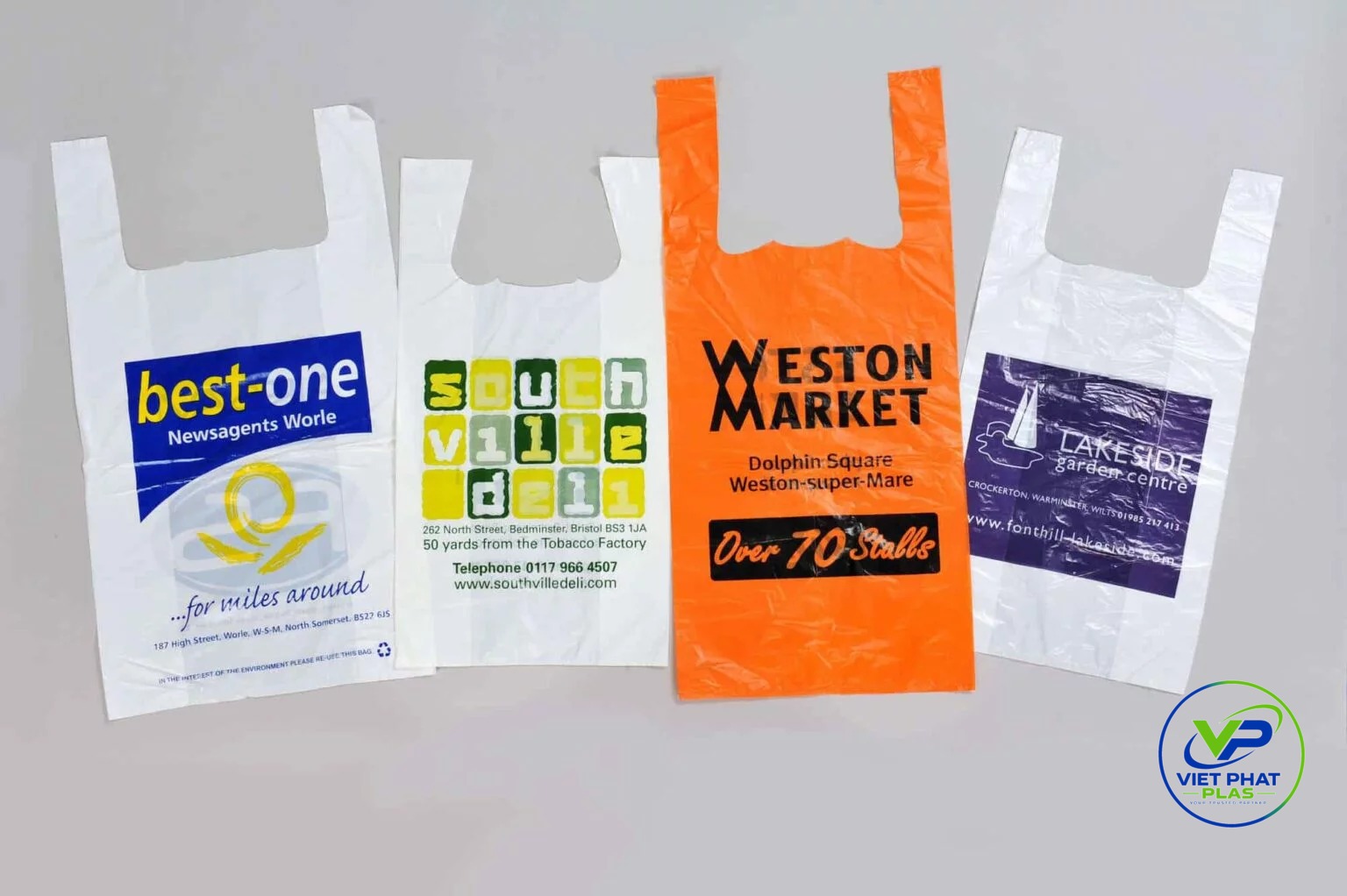
Example of a printed polyethylene retail carrier bag with handles, illustrating the type of bag covered by the order
The written scope Commerce published is dispositive — meaning it controls over any tariff code or general product description — and it's worth quoting closely rather than paraphrasing loosely, since the exact wording is what determines duty exposure. The order covers non-sealable sacks and bags with handles (including drawstrings), without zippers or integral extruded closures, with or without gussets, with or without printing, made of polyethylene film with a thickness no less than 0.00035 inch (0.00889 mm) and no greater than 0.035 inch (0.889 mm), with length or width no shorter than 6 inches (15.24 cm) and no longer than 40 inches (101.6 cm). Depth follows a slightly different rule: it may be shorter than 6 inches, but not longer than 40 inches (101.6 cm).
In plain terms: this is the classic single-use grocery or retail carrier bag — a plain or printed HDPE or LDPE bag with handles, given away free at checkout to carry purchased merchandise, without any resealable closure. For customs purposes, subject merchandise is currently classifiable under HTSUS statistical category 3923.21.0085, but Commerce is explicit that this HTSUS subheading is provided for convenience only — the written scope description, not the tariff code, is what actually determines whether a specific shipment is covered.
What's NOT Covered: Why Garbage Bags, Zipper Bags, and Unprinted Drawstring Bags Are Excluded
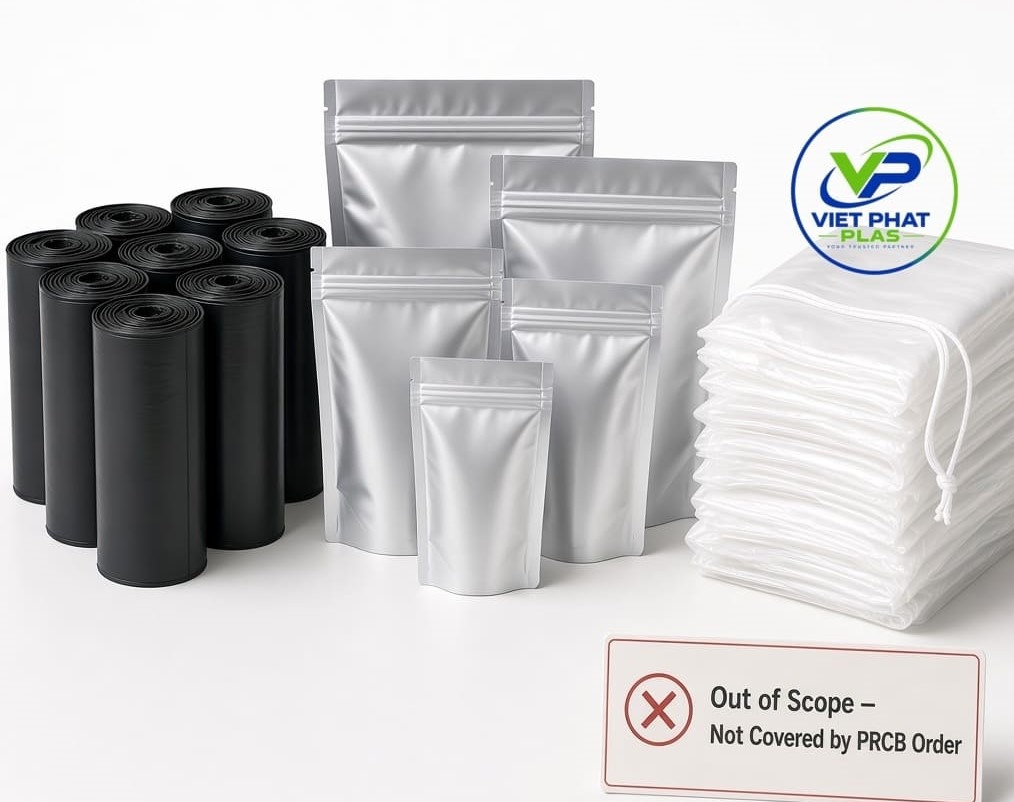
Garbage bags, zipper storage bags, and plain drawstring bags displayed together as products excluded from the PRCB order
The scope explicitly carves out two categories that matter a great deal to buyers sourcing broader plastic bag ranges from Vietnam. First, polyethylene bags that are not printed with logos or store names and that close with a polyethylene drawstring are excluded — meaning a plain, unprinted drawstring bag sits outside the order even if it otherwise resembles a PRCB in size and material. Second, polyethylene bags packed in consumer packaging and printed with wording that refers to a specific end use other than carrying retail merchandise are excluded, with the order naming garbage bags, lawn bags, and trash-can liners as examples of exactly this kind of exclusion.
There's a third practical exclusion buyers should understand even though it isn't phrased as one: the scope only covers bags "without zippers or integral extruded closures." A resealable zipper or slider bag — the kind used for food storage, household organizing, or product packaging — falls outside the PRCB definition by construction, regardless of size, thickness, or country of origin, because it has the closure mechanism the scope explicitly excludes. This is why an importer sourcing Vietnamese garbage bags, zipper bags, or unbranded drawstring bags for household or industrial use is working with product categories the order was never written to reach, while an importer sourcing printed, handle-style grocery or checkout bags for retail carry-out is working squarely inside it.
How Importers Confirm Their Product's Duty Exposure
Because the written scope — not a product's marketing name or its HTSUS code — is dispositive, the safest way to confirm exposure is to compare the actual bag against every element of the scope description: material (polyethylene), construction (non-sealable, with handles, no zipper or integral extruded closure), thickness range, and dimension range, then check whether it falls under either of the two explicit exclusions. Commerce also offers a formal scope ruling process for genuinely ambiguous cases, where an importer or exporter can request a written determination on whether a specific product is covered — a more reliable path than guessing from a product description alone when real duty exposure is on the line.
This is informational guidance on how the scope is defined, not legal or customs advice for a specific shipment — importers should confirm classification and duty exposure for their own transactions with a licensed customs broker or trade counsel before relying on it for an actual import.
Comparison Table: In-Scope vs Out-of-Scope Vietnamese Plastic Bags
Comparison chart of in-scope and out-of-scope Vietnamese plastic bag products under the PRCB antidumping order
|
Product Type |
Typically In Scope? |
Why |
|
Printed HDPE/LDPE T-shirt or checkout bag with handles |
Yes |
Matches PRCB definition: handles, no zipper, printed, within thickness/size range |
|
Plain (unprinted) polyethylene bag with a PE drawstring |
No |
Explicitly excluded regardless of size/material match |
|
Garbage bags, lawn bags, trash-can liners in consumer packaging |
No |
Explicitly excluded as a named non-retail end use |
|
Zipper or slider closure bags (food storage, household, product packaging) |
No |
Excluded by construction — order covers bags without zippers/integral extruded closures |
|
Printed retail bag outside the 6"–40" length/width or 0.00035"–0.035" thickness range |
No |
Falls outside the dimensional and thickness scope of the order |
Actual duty exposure depends on the precise construction and dimensions of a given SKU — this table is a starting reference, not a substitute for checking a specific product against the full written scope.
Working With a Supplier on Duty-Compliant Sourcing
VietPhatPlas is a Vietnam-based manufacturer producing across the categories this order treats very differently — printed T-shirt and retail carrier bags, which typically fall inside PRCB scope, alongside garbage bags and zipper bags, which fall outside it by explicit exclusion. Working with a supplier that can document material, thickness, dimensions, and construction clearly for each SKU — rather than a generic "plastic bags" quote — gives an importer's customs broker what's actually needed to classify a shipment correctly and estimate landed cost before goods are on the water. For HDPE and LDPE material selection or wholesale pricing across either category, share the exact specification rather than the product name alone.
Contact VietPhatPlas to review your product specification against PRCB scope before placing your next US-bound order — and confirm final duty classification with your customs broker before the shipment ships.
FAQ
Does this antidumping duty apply to all Vietnamese plastic bags? No. It applies specifically to polyethylene retail carrier bags — printed or unprinted handle-style bags without zippers, within a defined thickness and size range, of the kind given away free at retail checkout. Many other Vietnamese plastic bag categories fall outside this scope entirely.
Are Vietnamese garbage bags or zipper bags covered by this duty? No. Garbage bags, lawn bags, and trash-can liners are explicitly excluded from the scope by name, and zipper or slider closure bags are excluded by construction, since the order only covers bags without zippers or integral extruded closures.
How do I confirm whether my product falls within PRCB scope? Compare the bag's material, construction, thickness, and dimensions against the written scope description point by point, since the scope language — not the HTSUS code or the product's marketing name — is what's legally dispositive. For genuinely ambiguous products, Commerce's scope ruling process provides a formal written determination; a licensed customs broker or trade counsel should confirm classification for any specific shipment.
Is this antidumping duty order still in effect? Yes. It was continued following a second five-year sunset review in October 2021, and a third sunset review is due to be initiated by late 2026 under the statutory five-year review cycle. Absent revocation through that process, the order — and the related countervailing duty order — remain in effect.
What are the actual duty rates for Vietnamese PRCB imports? In the original 2010 final determination, Commerce assigned a 52.30 percent antidumping margin to Vietnamese exporters that qualified for a separate rate, and a 76.11 percent margin to the Vietnam-wide entity covering all other exporters, alongside a companion countervailing duty order. Rates for specific producers and exporters can be updated through periodic administrative reviews, so current cash-deposit rates for a specific company should be confirmed directly rather than assumed from the original determination.
Conclusion
Antidumping duty on Vietnamese plastic bags is a real and continuing obligation, but it reaches a specific product — printed or unprinted handle-style polyethylene retail carrier bags without zippers, within a defined size and thickness range — not the entire category of plastic bags manufactured in Vietnam. Garbage bags, zipper bags, and unbranded drawstring bags sit outside the order by explicit exclusion or by construction, which matters directly to importers building a sourcing plan across multiple bag categories from the same country.
VietPhatPlas is a Vietnam-based manufacturer supplying both in-scope and out-of-scope bag categories to B2B importers and distributors, with clear specifications to support accurate customs classification. Contact VietPhatPlas to discuss your product mix and confirm which categories apply to your next US-bound shipment.
Sources: