EU PPWR Compliance Guide for Non-EU Exporters: Packaging and Packaging Waste Regulation Explained
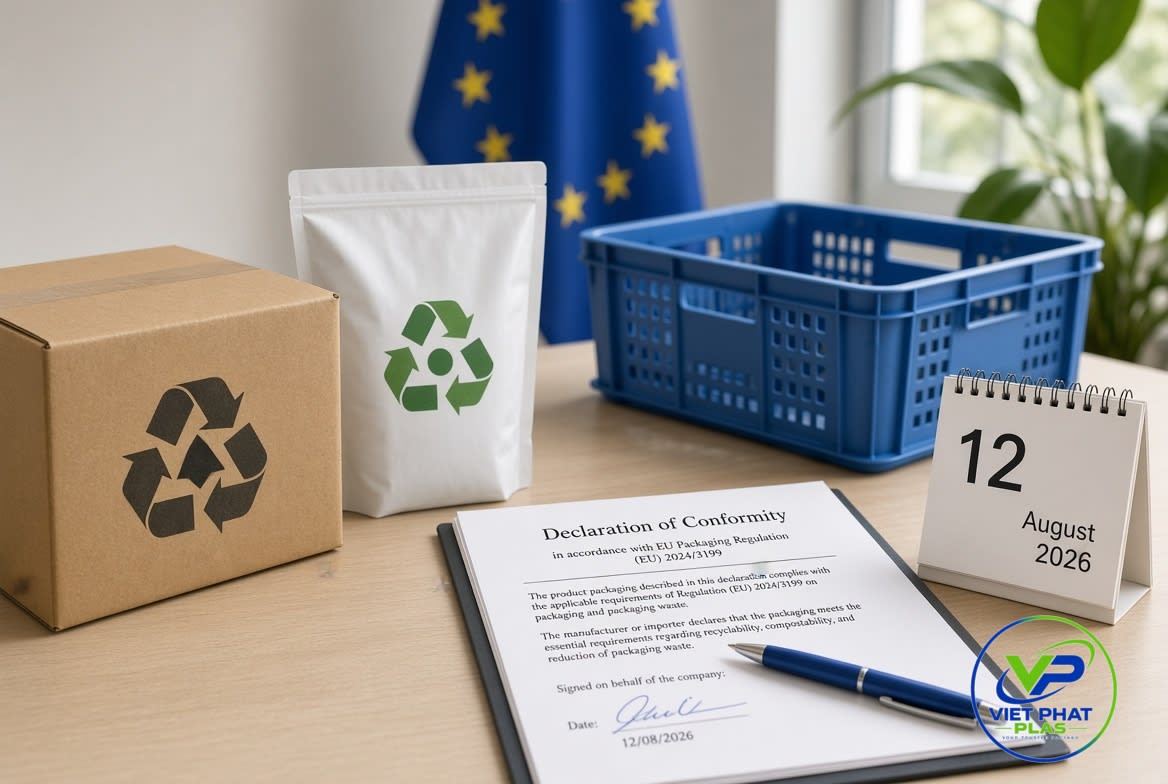
The EU PPWR compliance guide most non-EU exporters need starts with one date: 12 August 2026, when Regulation (EU) 2025/40 made several packaging obligations directly enforceable across the bloc. This guide separates what's due this month — Declaration of Conformity, restricted-substance limits, authorised representative rules — from what's still ahead in 2028 and 2030, plus a practical checklist for Vietnam-based exporters shipping packaged goods into the EU.
This EU PPWR compliance guide is written for non-EU exporters — Vietnam-based manufacturers, brand owners, distributors, and the procurement teams that buy from them — shipping packaged goods into the European Union now that Regulation (EU) 2025/40 is largely in force. If your product ships in a bag, pouch, box, or wrap and any part of that shipment ends up on an EU shelf or in an EU customer's hands, this regulation now applies to your packaging, not just your product.
The confusing part isn't whether PPWR applies — for most exporters selling into the EU, it does. The confusing part is timing: some obligations became enforceable this month, others don't land until 2028 or 2030, and mixing up which is which leads either to panic over rules that aren't due yet or, worse, missed deadlines on the ones that are. This guide separates the two.
EU PPWR Compliance Guide: What Changed on 12 August 2026
Regulation (EU) 2025/40 — the Packaging and Packaging Waste Regulation, or PPWR — was adopted on 19 December 2024 and entered into force on 11 February 2025, but the date that actually matters for exporters is 12 August 2026, when most of its initial obligations became directly applicable across all 27 EU member states. According to the UK government's own trade guidance for exporters, "it is important that UK exporters review PPWR requirements and ensure that they are compliant with the relevant requirements prior to 12 August 2026" — advice that applies equally to any non-EU exporter, not just UK-based ones. Unlike the 1994 Packaging and Packaging Waste Directive it replaces, PPWR is a regulation, not a directive — it applies as a single, uniform rulebook rather than something each member state transposes into its own national law with its own variations.
For most exporters, the PPWR 2026 deadline is really three separate deadlines rolled into one moment: a Declaration of Conformity now required per packaging type, new limits on restricted substances in food-contact packaging, and an authorised representative requirement for anyone selling packaged goods directly to EU end customers. The regulation applies to all businesses placing packaging on the EU market — manufacturers, importers, distributors, and retailers — and covers every packaging category: primary (the bag or pouch touching the product), secondary (retail cartons), tertiary (pallet wrap and shipping cases), and service packaging used at point of sale.
Who Needs to Comply: Producer, Importer, and Authorised Representative Roles Explained
PPWR obligations don't automatically fall on whoever manufactured the packaging — they fall on whoever qualifies as the "producer," a role defined by who first places the packaged goods on the EU market, not by who made the bag. In practice, this is usually the business whose name or brand is on the packaging. If a Vietnam-based exporter sells packaged goods to an EU-based importer or distributor who then resells them under that importer's own brand, the importer typically holds producer status and carries the Declaration of Conformity and Extended Producer Responsibility (EPR) obligations.
That changes if the exporter sells directly to EU end customers — through its own e-commerce store, a marketplace account, or a direct retail relationship without an EU-based intermediary taking title to the goods. In that case, the exporter itself is the producer, and Article 45 of Regulation (EU) 2025/40 requires appointing an authorised representative established in every EU member state where its packaging first reaches the market, effective from 12 August 2026. Without one, placing that packaging on the EU market isn't legally permitted. The authorised representative registers the exporter with national EPR schemes, reports packaging volumes, and manages the associated fees on the exporter's behalf — but the exporter still needs to know whether this obligation applies to their specific sales channel before it becomes a problem at customs.
The Declaration of Conformity: What Every Packaging Type Now Needs
From 12 August 2026, every packaging type placed on the EU market needs its own Declaration of Conformity — a written, self-certified statement that the packaging meets PPWR's essential requirements under Articles 5 to 12. This is a packaging-specific document, separate from any product-level EU declaration of conformity packaging manufacturers may already prepare for CE-marked goods, and it isn't optional: without a valid DoC on file, the packaging cannot legally enter the EU market, and importers are required to verify one exists and keep a copy on record, typically for five to ten years per packaging type.
The producer signs the DoC and holds legal responsibility for its accuracy, but the underlying data has to come from somewhere — usually the packaging supplier. Before shipping, exporters should request material composition, thickness and weight specifications, and recyclability information for each packaging SKU directly from their manufacturer, along with third-party test data for restricted substances rather than a verbal assurance that the material is "food-safe" or "compliant." VietPhatPlas supplies this documentation as batch-specific test reports from independent labs such as SGS rather than an in-house certification, which is the standard most EU importers are now asking suppliers to meet.
Restricted Substances: PFAS and Heavy Metal Limits That Apply This Month
Alongside the Declaration of Conformity, 12 August 2026 also brought new substance limits into force. Food-contact packaging can no longer exceed set PFAS (per- and polyfluoroalkyl substance) thresholds: 25 parts per billion for any single PFAS compound, 250 parts per billion combined across all PFAS identified through targeted analysis, and 50 parts per million for total organic fluorine. Separately, all packaging materials — food-contact or not — must keep combined heavy metal content (lead, cadmium, mercury, and hexavalent chromium) at or below 100 parts per million.
These limits sit on top of, not instead of, the food-contact packaging restrictions that already came up in EU regulatory coverage this year — PFAS in particular has been the substance drawing the most scrutiny for food bags, wraps, and pouches shipped into the bloc. For exporters, the practical takeaway is the same as for the Declaration of Conformity: request batch-level test data confirming these thresholds are met, especially for any food-contact packaging line shipping to the EU, rather than relying on a general "PFAS-free" claim with no test report behind it.
What's Coming Next: Labelling in 2028 and the Empty-Space Rule in 2030
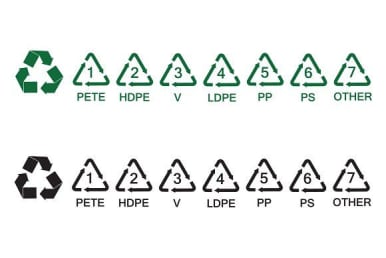
Not every PPWR obligation is due this month, and treating a 2028 or 2030 requirement as urgent right now can lead to unnecessary tooling changes. From 12 August 2028, harmonised recycling and material-composition labels become mandatory on packaging across the EU, giving consumers a standardised way to read what a package is made of and how to dispose of it. From 1 January 2030, packaging must be assigned a Design-for-Recycling performance grade to remain marketable — Grade A for packaging that's at least 95% recyclable by weight, Grade B for at least 80% — and the PPWR e-commerce packaging rule on empty space takes effect the same year, capping unoccupied internal volume (including filler like air cushions and bubble wrap) at 50% of a parcel's total volume, with exemptions where extra space is genuinely needed to protect goods in transit.
Two corrections are worth flagging here, since both figures have circulated inaccurately: the e-commerce empty-space threshold is 50%, not the 40% figure from an earlier draft of the regulation that's still widely repeated online, and neither the labelling nor the empty-space rule is enforceable yet — both are 2028 and 2030 obligations, not part of what changed this August. That said, packaging formats and tooling take real lead time to redesign, sample, and approve, so exporters planning new custom packaging specifications this year have a practical reason to build 2028 and 2030 requirements into that process now rather than waiting until enforcement is imminent — including looking at compostable and recyclable-by-design formats for product lines where the 2030 recyclability grade will matter most.
PPWR Compliance at a Glance: Comparison Table and Pre-Shipment Checklist
|
PPWR Requirement |
Applies From |
Who's Responsible |
Action for Exporters |
|
Declaration of Conformity per packaging type |
12 August 2026 |
Producer (signs); importer (verifies and retains) |
Request material and recyclability data from your supplier now |
|
PFAS and heavy metal limits |
12 August 2026 |
Producer, backed by supplier test data |
Request batch-level third-party test reports (e.g. SGS) |
|
Authorised representative (Article 45) |
12 August 2026 |
Non-EU producer selling direct to EU end customers |
Confirm whether you or your EU buyer holds producer status |
|
Harmonised labelling (material and sorting) |
12 August 2028 |
Producer |
Plan label redesign into upcoming tooling and artwork changes |
|
Design-for-Recycling grade + e-commerce empty-space cap (50%) |
1 January 2030 |
Producer |
Start specifying right-sized, mono-material formats in new RFQs |
This is the packaging waste regulation exporters shipping into the EU this quarter actually need to act on, in order: confirm whether your business or your EU buyer holds producer status for Declaration of Conformity and EPR purposes before the next shipment leaves the factory; if you sell direct to EU end customers, appoint an authorised representative in each destination member state; work these documentation requirements into your next RFQ or sourcing plan rather than treating them as a separate step; collect a signed Declaration of Conformity template and independent test data for restricted substances from your packaging supplier, SKU by SKU; and keep that documentation on file for five to ten years, since importers are required to be able to produce it on request. None of this requires redesigning packaging that already meets these substance and documentation standards — it requires having the paperwork to prove it does.
FAQ
Does the EU PPWR apply to businesses based outside the EU? Yes. PPWR applies to any business placing packaging on the EU market, regardless of where that business is headquartered. A Vietnam-based exporter shipping packaged goods into the EU is subject to the same Declaration of Conformity, restricted-substance, and (where applicable) authorised representative requirements as an EU-based company.
What is a PPWR Declaration of Conformity, and who is responsible for signing it? It's a written, self-certified statement that a specific packaging type meets PPWR's essential requirements, required for every packaging type placed on the EU market from 12 August 2026. The producer — generally whoever's brand is on the packaged goods when they first reach the EU market — signs it and holds legal responsibility, though the underlying material and recyclability data typically comes from the packaging supplier.
Do exporters need to appoint an EU Authorised Representative if they sell only through an EU-based importer? Not necessarily. If an EU-based importer or distributor takes title to the goods and resells them under its own brand, that importer generally holds producer status and the associated obligations. The authorised representative requirement under Article 45 applies specifically to non-EU producers selling packaged goods directly to EU end customers without that kind of intermediary.
What packaging substances are restricted starting 12 August 2026? Food-contact packaging is now capped at 25 parts per billion for any single PFAS compound, 250 parts per billion combined, and 50 parts per million for total organic fluorine. All packaging materials, food-contact or not, must also keep combined heavy metal content (lead, cadmium, mercury, hexavalent chromium) at or below 100 parts per million.
Is the 50% empty-space rule for e-commerce packaging already enforced? No. That requirement, along with the Design-for-Recycling performance grades, doesn't take effect until 1 January 2030. It's worth planning for in new packaging specifications now, but it isn't part of what became enforceable on 12 August 2026.
Conclusion
The PPWR 2026 deadline that mattered this August wasn't a single sweeping requirement — it was three narrower ones: a Declaration of Conformity for every packaging type, tighter PFAS and heavy metal limits, and an authorised representative rule for exporters selling direct to EU customers. The labelling and empty-space rules that get the most attention online aren't due until 2028 and 2030, which gives exporters real lead time to plan for them without treating every headline as an immediate deadline.
VietPhatPlas is a Vietnam-based manufacturer producing food bags, zipper bags, industrial garbage bags, pallet wrap film, and other plastic packaging items for B2B exporters shipping into the EU and other markets, and supplies batch-specific third-party test reports rather than in-house certification so buyers have the documentation their EU Declaration of Conformity actually needs. Contact VietPhatPlas to review your current packaging specifications against PPWR's restricted-substance limits before your next EU-bound shipment.
Sources: