Wholesale Plastic Bag Manufacturer

Plastic bag manufacturer vs. wholesaler isn't really about price alone — it's about minimum order quantity, lead time, and who answers for a bad batch. This guide breaks down what actually changes when a B2B buyer sources custom plastic bags directly from a factory versus through a distributor or trading company, with real pricing and MOQ examples from independent sourcing guides, plus VietPhatPlas's own real production standards for buyers considering a direct order.
Plastic bag manufacturer vs wholesaler sounds like a simple price question, but for a buyer placing a recurring bulk order it's really three separate questions: wholesale plastic bag MOQ, bulk plastic bag pricing tiers, and who takes responsibility when a batch doesn't match the sample. Buying plastic bags direct from manufacturer sources and going through an intermediary diverge on all three — and for an international buyer sourcing custom-printed bags from overseas, the more accurate framing is often plastic bag factory vs trading company rather than manufacturer vs. a generic wholesaler.
This guide works through what actually changes with each model — pricing, minimum order quantities, lead times, and accountability when something goes wrong — using real examples from independent B2B sourcing guides, not a single vendor's sales pitch, plus VietPhatPlas's own verifiable production standards for buyers weighing a direct order.
Why "Manufacturer vs. Wholesaler" Is Really "Factory vs. Trading Company"
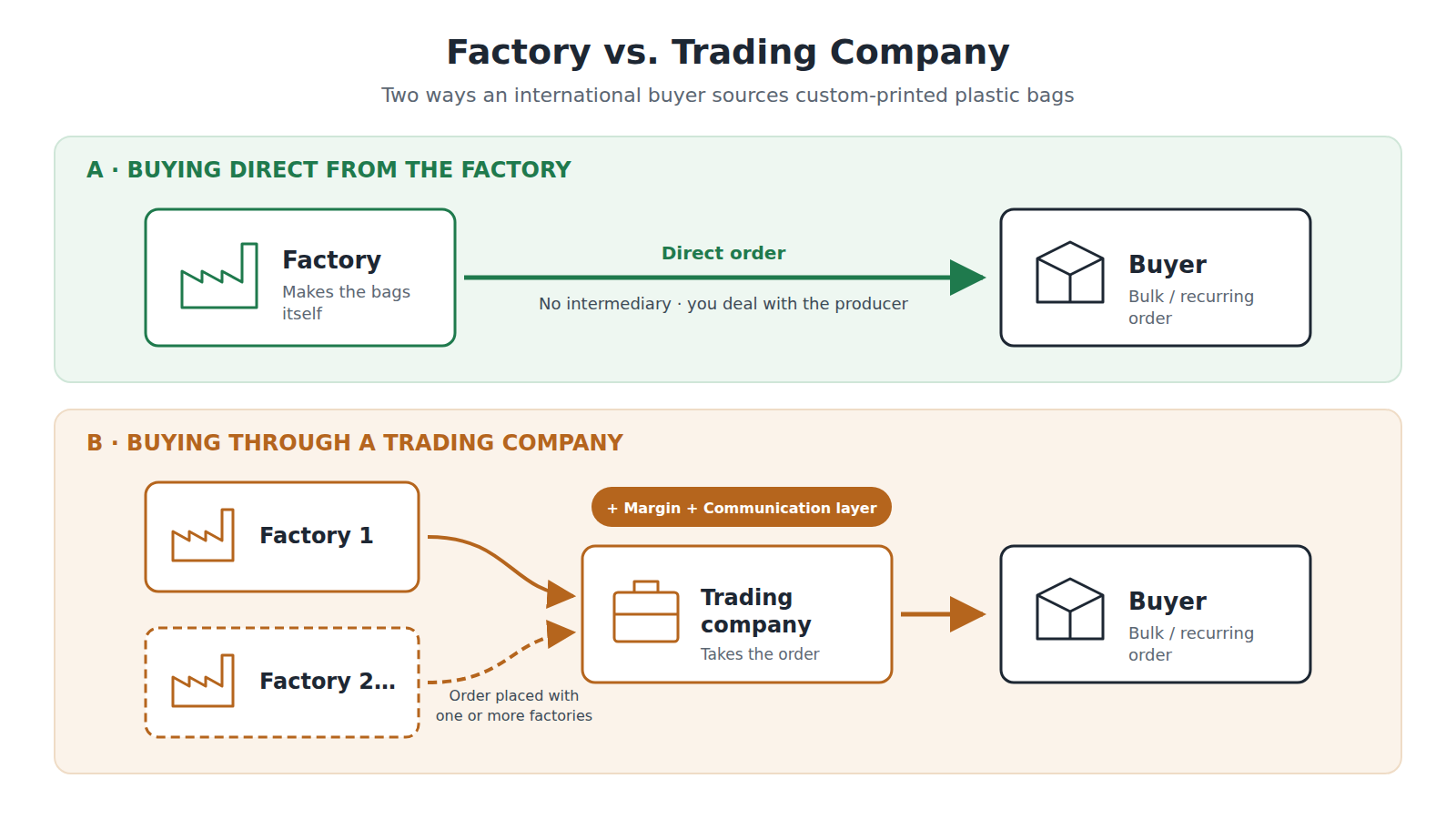
Supply chain diagram showing factory, trading company, and buyer
In a domestic market, a "wholesaler" is often just a distributor holding stock of standard items close to the buyer, ready to ship fast. That model barely applies to custom-printed plastic bags sourced internationally. For a B2B buyer importing from Vietnam or another manufacturing hub, the real choice is between a factory that makes the bags itself and a trading company that takes the order, places it with one or more factories on the buyer's behalf, and adds its own margin and communication layer in between. The tradeoffs below are written with that international sourcing situation in mind, since it's the one most buyers evaluating a bulk plastic bag order are actually facing.
1. Pricing: What a Markup Actually Costs You
A sourcing cost breakdown published by Custom Packaging Products put real numbers on this for bulk bag orders: distributor pricing averaging $52 per bag against $44 per bag at the manufacturer — an 18% markup — which on a 28,000-bag annual order works out to roughly $224,000 paid to the intermediary before counting any delay or quality costs on top. A separate sourcing guide focused on custom bags from Chinese factories (gzdreamway.com) reports trading-company markups typically in the 10-30% range. These figures come from sourcing consultancies and suppliers who have a natural interest in steering buyers toward direct sourcing, so they're worth treating as a directional range rather than an audited industry benchmark — but two independently published examples landing in the same 10-30% band is a reasonable signal that the gap is real and usually isn't trivial.
What the lower per-unit price doesn't automatically include, though, is everything a buyer takes on by removing the intermediary: communicating specs directly in a factory's second language, managing payment terms and documentation the trading company used to handle, and absorbing the risk if a shipment issue has no one else positioned to resolve it. A sourcing comparison from Inline Plastics makes this point well outside the bag industry specifically — in one example they cite, an 8% per-unit saving from buying direct turned into a 3% total cost *increase* once warehousing, inventory software, and working capital were added back in. The lesson isn't "always go direct" — it's that the per-unit price difference is the start of the comparison, not the end of it.
2. MOQ and Lead Time: The Real Tradeoff for Custom Orders
On minimum order quantity, the pattern runs the opposite direction from price: a sourcing guide for custom bags (gzdreamway.com) reports factories commonly requiring 200+ units for a custom bag order, against roughly 50-100 units through a trading company that aggregates smaller orders across multiple buyers. The same guide reports factory production running about 20-35 days with a 35-50 day sample-to-delivery total, versus 25-45 days production and a 45-70 day total through a trading company — because the order still has to go through an underlying factory, with the trading company's own communication and consolidation steps added on top rather than replaced. For a buyer who can commit to the higher minimum, going direct is usually both cheaper and faster for a custom order; for a buyer who needs a smaller trial run or mixed-product shipment, a trading company's lower minimum can be the only practical option even at a worse per-unit price.
3. Quality Control: Who's Actually Accountable When a Batch Fails
This is the tradeoff that rarely shows up in a pricing comparison but matters most when something actually goes wrong. Custom Packaging Products' sourcing breakdown frames it plainly: going direct to the manufacturer means "complete control over quality" and "direct accountability for problems," while sourcing through a distributor or trading company often means quality control "depends on the manufacturer" with the intermediary able to point back at the factory rather than resolve the issue itself. That doesn't make a trading company a bad choice by default — a competent one adds its own inspection step — but it does mean a buyer going that route should ask specifically who re-inspects the goods and who is contractually on the hook for a failed batch, rather than assuming the markup already covers that risk.
4. Bulk Pricing Tiers: How Volume Changes Your Per-Unit Cost
Both manufacturers and trading companies typically price plastic bags in volume tiers rather than a flat per-unit rate — the question is how steep the curve is. One published pricing example for wholesale plastic roll bags illustrates the shape of this:
|
Order Volume |
Price per Unit (illustrative) |
Note |
|
1,000 – 5,000 units |
~$0.10 |
Entry tier; typical minimum order quantity for this bag type starts around here |
|
5,001 – 10,000 units |
~$0.08 |
Mid tier — a noticeable per-unit drop from the entry tier |
|
10,001+ units |
~$0.05 |
Volume tier — about half the entry-tier price per unit |
Those exact figures are illustrative — they come from one supplier's published example for wholesale plastic roll bags, not VietPhatPlas's own price list, and material, printing, and bag format all shift the real numbers. But the pattern they show (a meaningful per-unit drop at each volume threshold, with customization raising the entry MOQ) holds across most plastic bag sourcing, direct or through an intermediary. A buyer comparing two quotes should always ask where the volume breakpoints actually sit rather than comparing a single quoted unit price.
5. When a Trading Company Still Makes Sense
None of this makes a trading company the wrong choice in every case. It's usually the more practical option for a buyer who needs several different bag types or packaging categories consolidated into one shipment, who can't yet commit to a factory's minimum order on a new product line, or who values a single point of contact handling language and logistics across multiple suppliers. The honest framing is that a trading company trades a markup and (for custom orders) usually a longer timeline for lower minimums and consolidated convenience — a fair trade for some buyers and not for others, depending on order size and how many different products are involved.
Behind Every Bulk Order: VietPhatPlas's Real Production Standards
A buyer weighing a direct order should be able to verify exactly who is accountable for a batch, not just compare a quoted price — VietPhatPlas provides an independent third-party SGS test report for each production batch rather than a self-reported defect rate, so a buyer ordering direct knows precisely which facility and which run a bag came from. That traceability is only possible because it comes from a single Vietnam-based factory — 8,000 m², 500 tons/month capacity — rather than a rotating pool of subcontracted shops a trading company might quietly shift orders between; the same facility has handled export orders for over 10 years across more than 20 countries, which is also what makes those SGS reports consistent from one order to the next. For the mechanics of actually requesting a quote once you've decided to go direct, our B2B sourcing guide covers RFQ preparation and MOQ by material and print option, and our wholesale pricing guide covers the specific factors that move a quote up or down.
Manufacturer vs. Wholesaler at a Glance
|
Factor |
Direct From Manufacturer/Factory |
Through Wholesaler/Trading Company |
|
Typical price |
Lower per unit |
10-30% markup reported across sourcing guides |
|
Typical MOQ (custom order) |
Higher (~200+ units per published examples) |
Lower (~50-100 units per published examples) |
|
Lead time (custom order) |
Usually faster — no added consolidation step |
Usually slower — order still routes through a factory |
|
Quality accountability |
Direct, traceable to one factory's batch records |
Depends on the intermediary's own inspection process |
|
Best for |
Recurring volume, single product line, cost-per-unit priority |
Smaller/trial orders, mixed product shipments, consolidated logistics |
Request a Quote
If a recurring bulk order of custom or standard plastic bags is what you're planning, our team can walk through actual MOQ and pricing tiers for your specific material, size, and print requirements rather than a generic rate card. Contact VietPhatPlas with your target volume and we'll reply with a quote and lead time based on your actual order, not an illustrative example.
FAQ
Is it always cheaper to buy plastic bags directly from a manufacturer?
Usually cheaper per unit, but not automatically cheaper overall. Published sourcing comparisons report intermediary markups commonly in the 10-30% range, but buyers who go direct also take on communication, documentation, and quality-verification work an intermediary would otherwise handle — which has its own cost.
What MOQ should I expect for a custom plastic bag order?
Published sourcing guides for custom bags report factory minimums commonly starting around 200+ units, against roughly 50-100 units through a trading company that can spread a smaller order across its own supplier network. Actual minimums vary by material, bag format, and printing setup.
Is a trading company always slower than ordering direct from a factory?
For custom orders, usually yes, since the order still has to go through an underlying factory with the trading company's own steps added on top — published examples show roughly 35-50 days factory-direct versus 45-70 days through a trading company, sample to delivery. For standard stocked items from a domestic distributor holding inventory, the opposite can be true.
Who is responsible if a bulk order arrives with a quality problem?
Ordering direct from the manufacturer makes accountability clearest, since there's one party responsible for the batch. Through a trading company, the response depends on that company's own inspection and contract terms — worth confirming before ordering, not after a problem shows up.
Does VietPhatPlas sell through trading companies or only direct?
VietPhatPlas works directly with B2B buyers and distributors placing their own orders; we don't have a public list of authorized third-party resellers at this time.
Conclusion
Plastic bag manufacturer vs. wholesaler isn't a question with one right answer — it comes down to order size, how much minimum-order flexibility you need, and whether cost-per-unit or consolidated convenience matters more for a given order. What should drive the decision is a real comparison of MOQ, lead time, and who's accountable for a batch, not a single quoted price.
VietPhatPlas manufactures plastic bags directly in Vietnam with batch-level SGS test reports and transparent MOQ by material and print setup. Contact VietPhatPlas to compare a direct quote against what you're currently paying through an intermediary.
Sources