Trash Bag Size and Load Guide for Commercial Buyers

Choose commercial trash bags by container dimensions, waste type, load, thickness, material and seal design instead of relying on gallon capacity alone.
Commercial buyers often order trash bags by gallon capacity, then discover that the liner is too narrow, too short, unnecessarily thick or unable to handle the actual waste. Container capacity is helpful, but it does not describe the opening shape, rim, height, load distribution or sharpness of the contents.
A reliable trash bag specification combines container dimensions, waste type, expected load, film material, thickness, seal design and packing format. This trash bag size and load guide helps facility managers, distributors and importers prepare a more accurate wholesale request.
Why gallon capacity is not enough
Two containers with the same stated capacity can have different shapes. One may be tall and narrow, another short and wide. A rectangular cart, round bin and slim office can also need different flat bag widths even when their volume is similar. Rim thickness, handles and lid hardware add further variation.
Measure the actual container at its widest opening and from the base to the point where the liner will be tied or folded. If possible, send the manufacturer a container drawing, model number or sample liner that already fits correctly.
How to measure a round trash can
For a round container, measure the outside diameter at the widest point and the container height. The minimum flat bag width must cover half the circumference of the opening. A practical starting calculation is:
Flat bag width = container diameter x 1.57, plus fitting allowance
Bag length must cover the container height, the bottom radius or fold required to reach the base, and enough material to fold over the rim or tie the bag. A commonly used starting point is container height plus approximately half the diameter, followed by the required overhang or closure allowance.
These formulas create a trial size, not a universal final specification. Tapered cans, wheels, thick rims and unusual bases may need more allowance. Test a sample on the actual container before mass production.
How to measure a rectangular container
Measure the outside length and width of the opening, then the height. The minimum flat bag width must cover half the opening perimeter, so a useful starting calculation is:
Flat bag width = container length + container width, plus fitting allowance
For length, include the container height, enough film to reach and conform to the base, and the fold-over or tie allowance. Rectangular containers with rounded corners, tapered walls or a stepped rim should be sampled because the theoretical flat width may fit tightly in practice.
Always state whether quoted bag dimensions are internal or external and whether gussets are included. Our plastic bag size guide explains these conventions in more detail.
Match the liner to the waste, not only the bin
Volume determines fit, but waste determines performance. Light office paper can fill a large bag without creating a heavy load. Food waste, wet cleaning waste, glass, metal offcuts and construction debris can produce much higher stress in a smaller volume.
| Application | Typical risk | Specification focus |
|---|---|---|
| Office and restroom | Light, soft waste | Fit, dispensing efficiency and cost per liner |
| Kitchen and food service | Wet, dense waste and leakage | Seal integrity, puncture resistance and reliable closure |
| Hospitality and housekeeping | Mixed waste and frequent handling | Tear resistance, odor control options and consistent roll perforation |
| Warehouse and factory | Heavy or irregular waste | Load test, puncture resistance and heavy-duty film structure |
| Outdoor collection | Dragging, weather and rough surfaces | Tough film, secure closure and suitable storage conditions |
| Sharp or regulated waste | Puncture and safety risk | Purpose-specific compliant system, not a generic liner |
Do not use ordinary trash bags for regulated medical, hazardous or other controlled waste unless the complete product and labeling meet the rules for the destination market and end use.
Choose film material by use condition
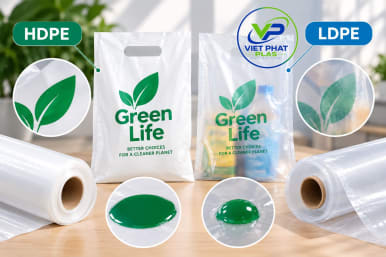
HDPE can be efficient for lightweight, non-sharp waste because it provides useful carrying performance at a thin gauge. LDPE and LLDPE-rich structures are often selected for heavier, wet or irregular waste where stretch and puncture resistance matter. Recycled-content film can be suitable for many commercial liners when color, odor, contamination and mechanical performance are controlled.
The material decision should be tested with the real waste stream. Read our LDPE vs HDPE buyer guide for a detailed comparison.
How much thickness does a trash bag need?
There is no single thickness for light, medium and heavy duty across all manufacturers. Film formulation and bag design affect performance, so marketing labels alone are not a technical specification. State the target micron or mil, how it will be measured and the functional test the liner must pass.
Light office liners may use a thin HDPE structure. General commercial waste often needs a tougher blend. Wet, dense or puncture-prone contents can require a thicker LDPE or LLDPE-rich film. The most economical option is the lowest material weight that consistently passes the agreed use test, not simply the thinnest bag.
Use our micron, mil and gauge guide when comparing quotations from different suppliers.
Seal design affects load and leakage
Star seal
A star-sealed bottom uses multiple folds converging at the base. It can conform well to round containers and distribute wet contents without square corner pockets. Production quality and film formulation still determine actual leak and load performance.
Flat seal
A flat bottom seal is simple and efficient for many liners. The bag lies flat, but the seal can carry concentrated stress when dense contents settle at the bottom. Seal width, temperature control and film cleanliness are important.
Gusset seal
A gusset can provide additional volume and a more shaped fit. Buyers should define whether gusset width is included in the overall bag width and inspect the gusset folds for seal consistency.
Closure and dispensing options
- Loose packed: useful for large or specialty liners and simple carton dispensing.
- Perforated roll: efficient for high-volume facilities when perforations separate cleanly.
- Coreless roll: can reduce packaging components and storage space.
- Drawstring: supports convenient closure and carrying but adds material and conversion steps.
- Tie flap or included ties: offers an alternative closure for selected programs.
Specify bags per roll, rolls per carton, perforation direction, core requirement and carton weight limits. Facility users should be able to dispense one liner without tearing the next bag.
Load tests should reproduce real handling
A supplier cannot validate a statement such as “heavy duty” without a defined test. Describe the maximum working load and how workers remove, lift, carry, drag or drop the bag. A practical test may include filling with representative contents, conditioning for a set time, lifting by the neck or closure, carrying a defined distance and performing a controlled drop.
Wet load tests should evaluate leakage and seal integrity. Puncture tests should use a representative shape or controlled probe. Record temperature, load, duration, sample count and pass criteria. Production inspection can then repeat the same method.
Do not oversize every liner
An oversized bag can slip into the container, bunch around the rim, consume excess resin and increase freight cost. A liner that is too tight can tear during installation or pull away from the rim when loaded. The best size provides enough fitting and closure allowance without unnecessary film.
For multi-site purchasing, audit the actual container models before consolidating SKUs. A small set of correctly selected sizes can reduce inventory complexity, but one universal liner rarely fits every bin efficiently.
Wholesale trash bag RFQ checklist
- Container shape, opening dimensions, height and stated capacity.
- Required flat bag width and length, including dimensional convention.
- Waste type, maximum load, moisture and sharp-edge risk.
- Material preference or required functional performance.
- Thickness target, tolerance and measurement rule.
- Bottom seal, gusset, color, opacity, closure and odor requirements.
- Roll or loose packing, bags per roll, rolls per carton and perforation direction.
- Printing, warnings, labels, carton marks and language.
- Recycled content, documentation and destination-market requirements.
- Annual volume, order quantity per SKU, destination and delivery terms.
Attach photographs, a drawing and a current sample whenever possible. A complete RFQ reduces sampling rounds and allows suppliers to compare material structures against the same performance target.
Quality checks before shipment
- Measure width, length, gusset and thickness profile.
- Inspect bottom seals, perforations, drawstrings and roll winding.
- Perform agreed load, drop, puncture and leak tests.
- Verify bag count, roll count, carton weight and labels.
- Confirm color, odor, print and recycled-content documentation where required.
- Fit samples on the intended container.
Define sampling and defect classifications in advance using our plastic bag quality inspection checklist.
Frequently asked questions
How do I know what trash bag size to buy?
Measure the actual container opening and height, calculate a starting flat width, add fitting and closure allowance, then test a sample. Do not rely only on gallon capacity.
What is the best material for commercial trash bags?
HDPE can suit light, soft waste. LDPE or LLDPE-rich structures are often better for wet, heavy or irregular loads. The correct choice depends on a defined performance test.
Does a thicker bag always carry more weight?
Not necessarily. Resin blend, film consistency, dimensions, seal quality and load shape all matter. Thickness should be evaluated together with finished-bag testing.
Which bottom seal is best for a round can?
A star seal often conforms well to round containers, but fit and leakage should still be tested with the proposed film and actual can.
Can commercial garbage bags contain recycled material?
Yes for many applications, provided the formulation meets performance, odor, appearance, traceability and destination-market requirements. Suitability depends on end use.
Request commercial trash bag samples
Viet Phat Plas supplies garbage bags and can liners for wholesale and export programs. Send your container dimensions, waste type, load, thickness target, closure, packing format, quantity and destination. Browse our garbage bag range or contact Viet Phat Plas for sample development and a quotation.