Trash Bag Buying Guide: Choosing the Right Material, Seal, and Thickness

Choosing a trash bag comes down to three decisions: which resin (material), which seal, and how thick. This guide walks through all three so you can spec a bag that holds up to your actual waste stream instead of guessing — with a comparison table and a checklist to bring to your next quote request.
This trash bag buying guide starts with the mistake most buyers make: picking a bag based on price per unit, then finding out during use that it tore, stretched, or split under a load it should have handled. A trash bag is a simple product, but it's specified along three independent axes — resin, seal, and thickness — and getting one of them wrong usually means reordering, or worse, a customer complaint about bags failing on the loading dock.
This guide is built as a decision framework, not a product catalog. Each section below narrows down one axis of the decision. Two topics that come up constantly in this conversation — seal mechanics and mil thickness — already have dedicated deep-dive guides on this site, so they're summarized here just enough to make a first-pass decision, with a link to the full breakdown for anyone who needs the technical detail. If you're trying to match a bag to a specific industry (hospitality, healthcare, municipal collection, industrial sites) rather than to technical specs, the companion guide on trash bags by industry use case covers that angle directly.
1. Trash Bag Buying Guide: The 3 Decisions That Actually Matter
Every trash bag spec sheet, no matter how it's worded, reduces to three questions:
-
What resin is it made from? This determines stretch, puncture resistance, clarity, and cost per bag.
-
What seal does it use? This determines how the bottom of the bag is closed, which affects leak resistance and how the bag behaves when a heavy or sharp load settles at the bottom.
-
How thick is it? Measured in mil (thousandths of an inch) or micron, this is the single biggest lever on load capacity and puncture resistance — and the easiest one to over-spec or under-spec.
Get all three roughly right for your waste stream, and the bag disappears from your list of problems. Get one wrong, and it becomes the thing your facility team complains about weekly. The sections below walk through each decision in order.
The trash bag market itself is large enough that suppliers compete heavily on all three variables — the global garbage bag market was valued at approximately USD 14.34 billion in 2026 and is projected to reach USD 24.24 billion by 2034, growing at a CAGR of 6.78%, according to Fortune Business Insights. That scale is why bag specs vary so widely between suppliers, and why a buyer who understands the three levers gets a materially better outcome than one comparing price per roll alone.
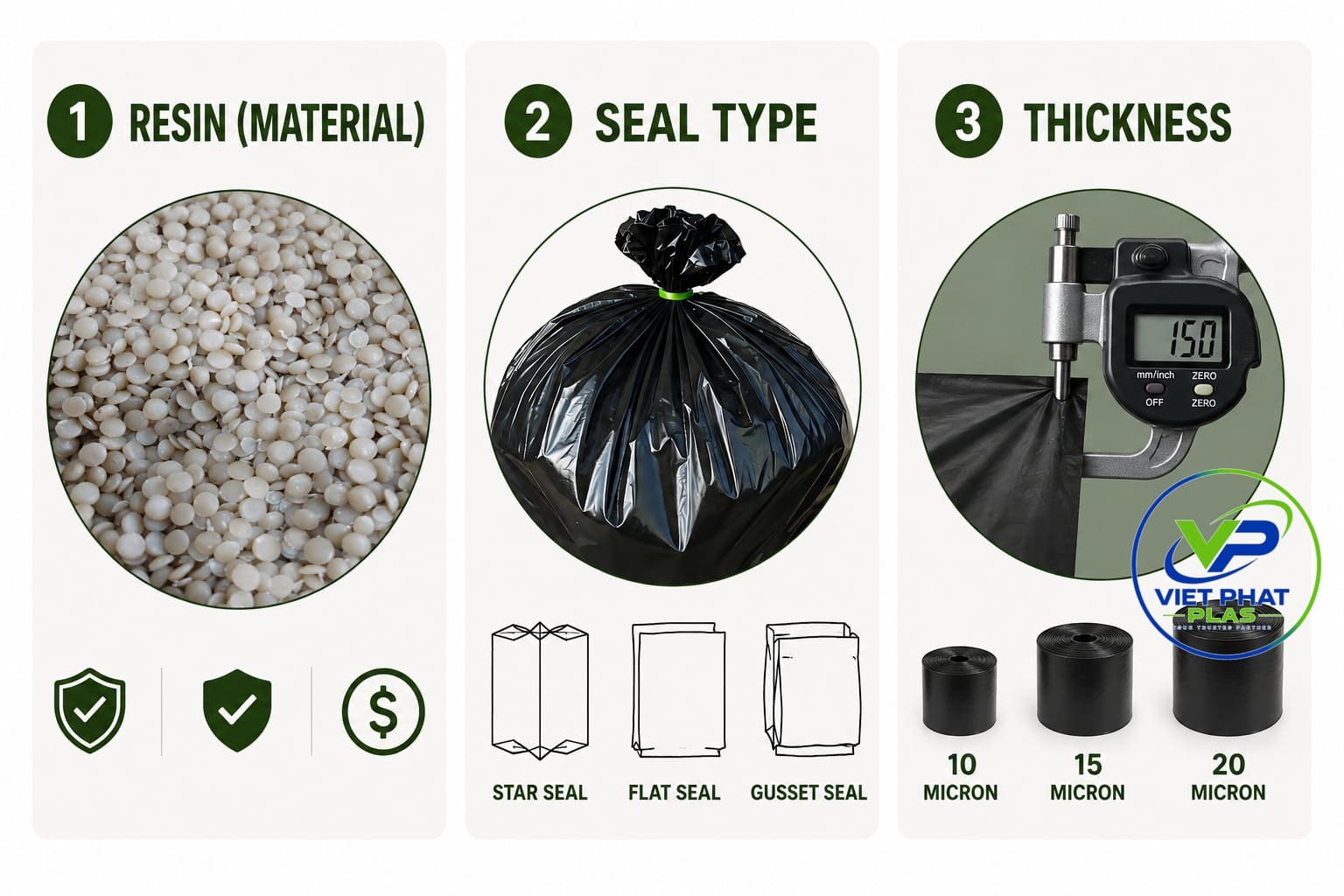
Three decisions in a trash bag buying guide: material, seal type, thickness
2. Choosing the Right Material: HDPE vs LDPE vs LLDPE vs Biodegradable
Resin choice is usually the first fork in the road, and it's the one buyers get backwards most often — assuming "thicker plastic" and "stronger resin" are the same lever. They're not; resin changes how the bag fails, thickness changes how much force it takes to make it fail.
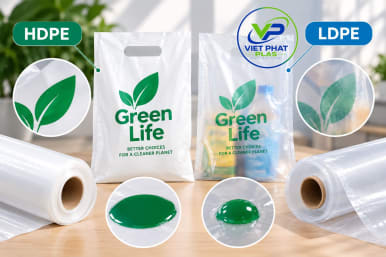
HDPE (High-Density Polyethylene). HDPE bags have a distinctive crinkly, semi-translucent feel and achieve strength through resin density rather than bulk, so they run thinner for a given load rating than LDPE — the main reason they cost less per bag. HDPE resists puncture well against sharp point-loads like broken glass or metal shavings, but it's less flexible and tends to crack rather than stretch under sudden, uneven weight. It also holds up far better in extreme cold than LDPE, retaining toughness down to roughly -148°F versus LDPE becoming brittle below about -58°F — relevant for deep-freeze or outdoor winter storage. It's the standard choice for high-volume, lower-severity waste streams (office wastebaskets, retail back-of-house, light kitchen trim).
LDPE (Low-Density Polyethylene). LDPE (and its industrial variant LLDPE) typically runs at a higher mil rating for a given weight capacity than HDPE, but trades that bulk for elasticity — it stretches rather than tears when a load shifts or drags across a rough surface, which is why it's the more common choice for wet or heavy waste where flexibility matters more than raw puncture resistance against sharp point-loads. Because of this trade-off, a 1.5 mil HDPE bag and a 3 mil LDPE bag can offer genuinely comparable load performance despite the mil numbers looking very different on paper — a supplier quoting only a mil number without naming the resin isn't giving you a complete comparison. The trade-off for LDPE's flexibility is cost: it typically runs higher per bag than HDPE at a comparable performance level.
LLDPE (Linear Low-Density Polyethylene). LLDPE offers higher tensile strength and better puncture/tear resistance than standard LDPE while staying flexible, which is why it can run at a thinner gauge than LDPE for comparable strength — and why many suppliers have shifted commercial and industrial trash bag lines toward LLDPE blends. It's worth asking a supplier directly whether their "LDPE" line is pure LDPE or an LLDPE blend, since the two perform differently even at the same mil rating.
Biodegradable and compostable options. These combine virgin resin with starch-based additives (commonly corn or cassava starch) designed to accelerate breakdown under specific conditions, rather than in a general landfill. The distinction between "biodegradable" and "compostable" is a real compliance issue, not just marketing language — compostable claims backed by ASTM D6400 or EN 13432 testing mean something specific, while an unverified "biodegradable" label does not. Buyers sourcing for markets with disclosure rules (the EU in particular) should ask for third-party test reports rather than taking a resin claim at face value. A fuller breakdown of this distinction, including how to verify a supplier's claim, is covered in the biodegradable vs compostable trash bags guide.
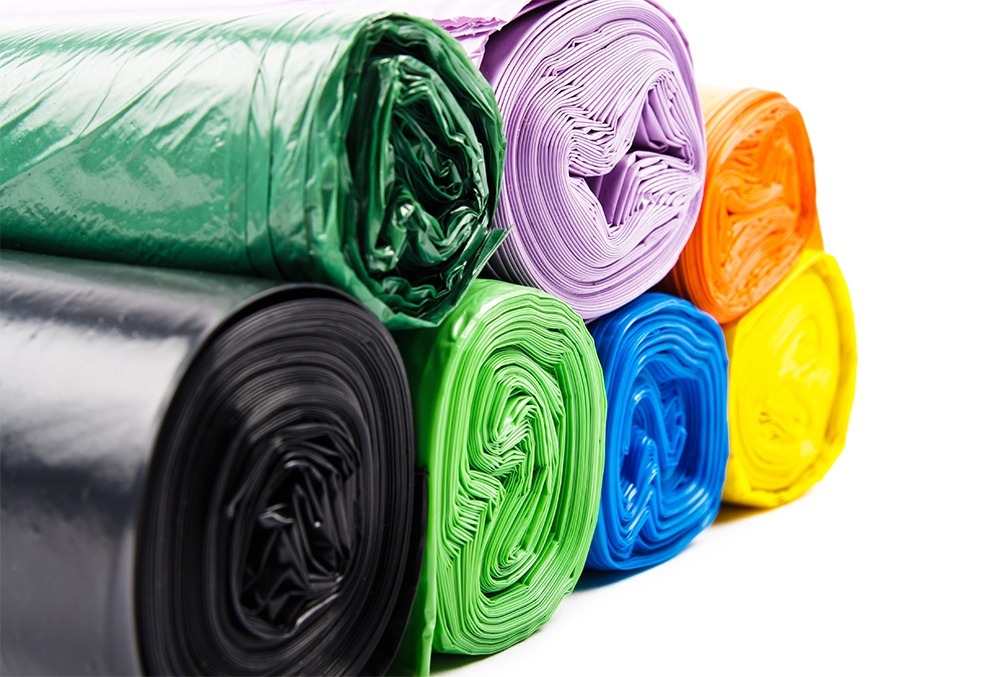
Trash Bags Made from Different Types of Plastic
3. Seal Type at a Glance: Star, Flat, and Gusset
The seal is how the bottom of the bag is closed during manufacturing, and it affects two things buyers actually notice: how much the bag can hold at the corners, and whether it leaks along the seam under a wet or heavy load.
-
Star seal folds the bag's sides inward and heat-seals them at a single point at the bottom, expanding into a star shape when filled. Because it distributes weight across several fold lines instead of concentrating it on one seam, it's the standard recommendation for wet or loose waste (food scraps, kitchen waste) — it generally offers the best leak resistance for this kind of load, since the folded base avoids the unsupported corners where liquid tends to pool.
-
Flat seal runs a single straight seam across the bottom. It performs well for dry, light waste (office bins, bathroom bins) and in square or rectangular receptacles, but leaves unsupported corners in round bins — that's where liquid or loose waste tends to pool before the bag looks full, so it's the weaker choice for wet or heavy loads.
-
Gusset seal folds the sides before sealing the bottom, a construction that's become less common on general-purpose bags but still appears on specific commercial formats.
This is intentionally a summary — the full comparison, including leak-resistance data and which seal fits which bin shape, is covered in Star Seal vs Flat Seal vs Gusset Seal Trash Bags. If seal type is the deciding factor for your order, read that guide before finalizing a spec.
4. How Thick Is Thick Enough? Matching Mil Rating to Waste Type
Mil thickness (1 mil = 0.001 inch) is where most over-speccing and under-speccing happens, because "thicker is safer" isn't free — it's the main driver of cost per bag, and doubling mil thickness roughly doubles resin cost without doubling actual load capacity, since resin type and seal also factor into failure point.
As a general orientation (not a substitute for testing against your actual waste): light office and washroom waste is typically served by bags in the low single-digit mil range; standard commercial kitchen and retail waste needs a moderate step up, particularly in HDPE; and construction, demolition, or heavy industrial debris needs the highest mil ratings, typically in LDPE or LLDPE rather than HDPE — not because LDPE resists sharp punctures better (HDPE generally has the edge against sharp point-loads like glass or metal shavings), but because LDPE's elasticity keeps it from tearing outright when a heavy, uneven, or shifting load stresses the bag, which matters more for this kind of debris than resisting the initial puncture.
The reliable way to confirm a mil claim before a bulk order is to request a sample roll and test it against your actual waste stream, not just trust the printed rating — mil claims vary in accuracy between suppliers. The full mil-by-use-case chart, including the specific HDPE-vs-LDPE-at-the-same-mil-rating comparison, lives in Trash Bag Mil Thickness Guide: How Many Mils Do You Actually Need?
5. Comparison Table: Material × Seal × Thickness × Best-Fit Use
|
Material |
Typical Strength Behavior |
Seal Choice Depends On |
Typical Mil Range* |
Best-Fit Waste Type |
|
HDPE |
Resists puncture from sharp point-loads (glass, metal); cracks rather than stretches under sudden load; performs well in extreme cold (toughness down to ~-148°F); lower cost per bag |
Flat for dry office/washroom waste; star if the same bin also gets wet kitchen scraps |
Low to moderate |
Office, washroom, light retail/kitchen, deep-freeze/cold storage |
|
LDPE |
Stretches instead of tearing under heavy or shifting loads; becomes brittle below ~-58°F; higher cost |
Star preferred — its evenly-distributed base holds up better under heavy or uneven loads than flat seal's single seam |
Moderate to high |
Construction debris, industrial waste with heavy/shifting loads |
|
LLDPE |
Similar elasticity to LDPE at a thinner gauge for comparable load performance |
Same logic as LDPE — star for heavy/uneven loads, flat only if the load is consistently dry and light |
Moderate |
Commercial/industrial where LDPE-level performance is needed at lower cost |
|
Biodegradable (starch-based) |
Comparable strength to standard PE when properly formulated; verify via test report |
Star — most biodegradable orders are for food-adjacent, wet waste streams |
Moderate |
Food-adjacent and sustainability-driven procurement |
Note: seal choice is driven by whether the waste is wet/loose or dry/light (see Section 3), not by resin type directly — the pairings above reflect what each material is typically used for, not a rule that a given resin requires a given seal.
*Mil range is directional, not a spec sheet — confirm exact mil against your waste stream and supplier sample, as described in Section 4.
6. A Buyer's Checklist Before You Request a Quote
Before sending an RFQ, it helps to have answers to these five questions ready — suppliers will ask them anyway, and having them upfront shortens the quoting cycle:
-
What is the primary waste type (general dry waste, wet/food waste, sharp/construction debris)?
-
Is there a compliance requirement driving material choice (e.g., a biodegradable/compostable claim that needs to hold up to disclosure rules)?
-
What bin or container shape and size does the bag need to fit?
-
Is corner capacity (flat seal) or leak-resistance on typical loads (star seal) the higher priority?
-
Can a sample roll be tested against actual waste before committing to a bulk order?
Bringing these five answers to a quote conversation is the fastest way to avoid a reorder.
7. FAQ
Is HDPE or LDPE better for trash bags?
Neither is universally "better" — HDPE costs less, resists puncture well against sharp point-loads like glass or metal shavings, and holds up much better in extreme cold; LDPE costs more but stretches instead of tearing under heavy or shifting loads, which is why it's the more common pick for wet or heavy waste. The right choice depends on what's going into the bag, not on a general strength ranking.
What mil thickness do I need for commercial trash bags?
It depends on both waste type and resin — the same mil rating performs differently in HDPE versus LDPE. Request a sample and test it against your actual waste before committing to a bulk order rather than relying on a mil number alone.
Does seal type actually affect leak resistance?
Yes, and the direction matters: star seal distributes weight across its folded base and is the stronger choice for wet or loose waste, while flat seal works well for dry, light waste but leaves unsupported corners — especially in round bins — where liquid tends to pool.
Are biodegradable trash bags as strong as standard PE bags?
When properly formulated, yes, comparable strength is achievable — but "biodegradable" claims vary widely in what they actually mean. Ask for third-party test reports (e.g., against ASTM D6400 or EN 13432) rather than accepting the label alone.
Can I mix material and seal type in one order to cover different waste streams at my facility?
Yes — many facilities run more than one bag spec (e.g., HDPE star-seal for office areas and LDPE flat-seal for a loading dock). It's worth specifying by area rather than standardizing on one bag for an entire facility if waste severity varies significantly between areas.
8. Conclusion
A trash bag spec that actually holds up in daily use comes from three decisions made in order — resin first, seal second, thickness third — rather than from comparing price per roll across suppliers. Use the checklist in Section 6 to prepare for a quote conversation, and the comparison table in Section 5 as a starting point for narrowing down a spec before requesting samples.
For a deeper look at any single axis of this decision — seal mechanics, mil thickness by waste type, or biodegradable material verification — the linked guides below cover each in full. For a spec matched to a specific industry rather than to general technical criteria, see the companion guide on choosing trash bags by industry use case.
Related Posts: Contractor-Grade Trash Bags: Specs, MOQ & Sourcing From Vietnam
Sources