Best Material for Custom Bag Printing: HDPE vs LDPE

Two orders can use the exact same printing method and still come out looking different — sharp and vibrant on one bag, dull or peeling on another. The difference is usually the plastic itself, not the printer. This guide covers why ink behaves differently on HDPE and LDPE, how to check a film's surface treatment before committing to a full run, and what that means for picking the right material for your design.
Finding the best material for custom bag printing means going beyond the usual "HDPE or LDPE available" list most guides settle for. The material is doing real work before the ink ever touches it — it determines whether that ink actually bonds to the surface, and whether the finished print looks bold or washed out. This guide covers why ink doesn't stick to plastic without corona treatment for plastic bags, how a quick dyne test for plastic film can confirm ink adhesion plastic film before a full run, and how HDPE and LDPE differ once properly treated — so a design that looks great on the screen doesn't come out disappointing on the bag.
Why Ink Doesn't Stick Evenly on Plastic
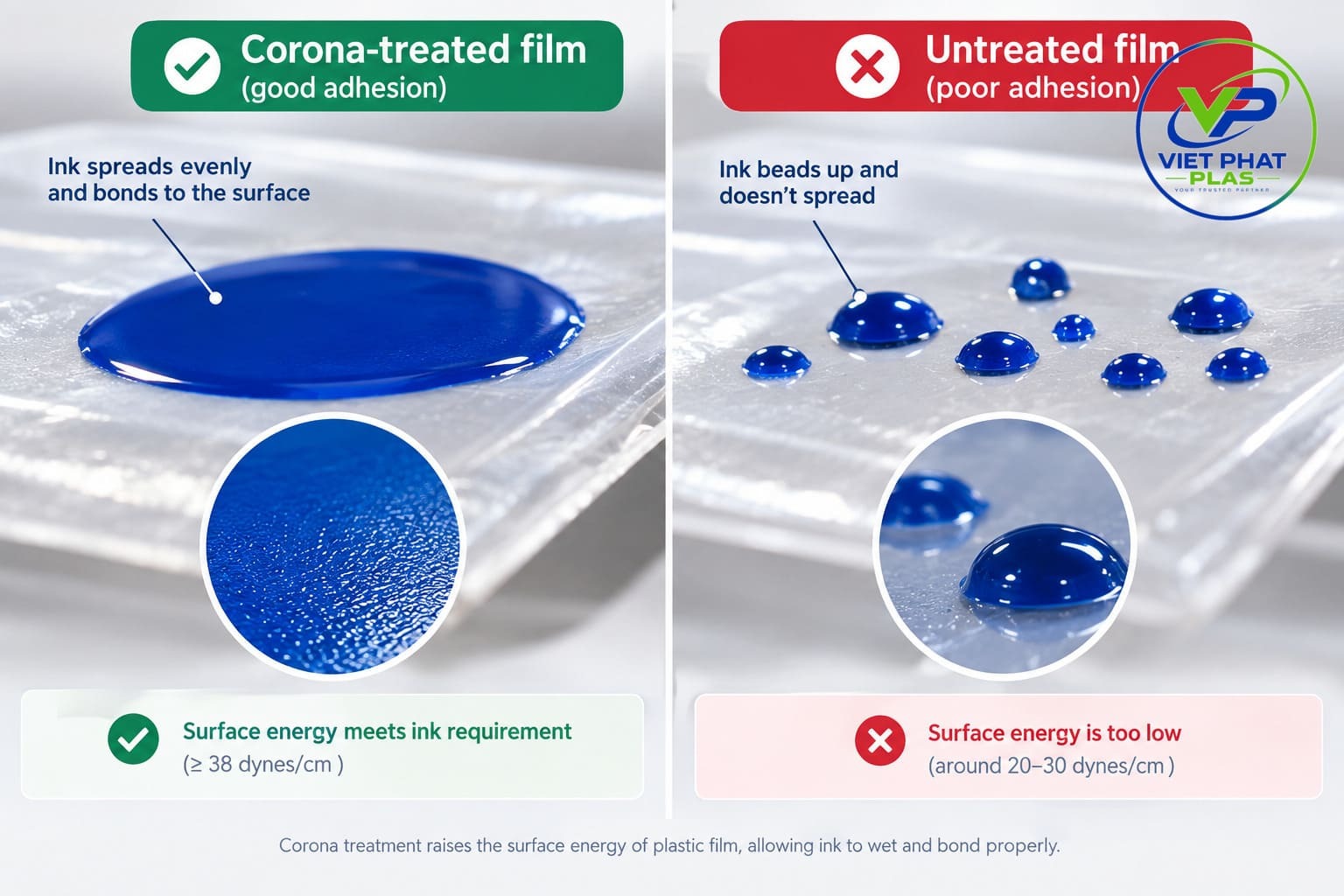
Ink droplet spreading evenly on corona-treated film vs. beading on untreated film
Plastic resins like polyethylene (HDPE, LDPE) are naturally hydrophobic, with surface energy in the roughly 20–30 dynes/cm range straight out of the extruder. Most inks need a minimum of around 38 dynes/cm to bond properly — below that, ink beads up instead of spreading, and it can rub or peel off even after it dries. That's why virtually all printed plastic bags go through corona treatment first: a controlled electrical discharge that raises the surface energy so ink actually anchors to the film.
One detail worth knowing if you're sourcing pre-printed stock or storing film before printing: corona treatment fades over time. A freshly treated film might test at 40–42 dynes/cm, but that can drop to 36–38 dynes/cm within a few weeks as the surface slowly reverts to its original low-energy state — especially with polyethylene, and faster in heat or humidity. Printing as soon as possible after treatment, and asking a supplier when treatment happened relative to printing, avoids adhesion problems that only show up after the bags are already in a customer's hands.
How to Verify Corona Treatment Before You Print
Rather than taking a supplier's word that a film is "properly treated," surface energy can be checked directly with a dyne test pen — a marker filled with a calibrated test fluid, following the industry standard ASTM D2578 (Wetting Tension of Polyethylene and Polypropylene Films). The test is simple: draw a continuous line 2–3 inches long on the film and watch it for exactly 2 seconds. If the line stays continuous and uniform, the surface energy meets or exceeds that pen's dyne level; if it breaks up, beads, or retracts within those 2 seconds, the surface energy is below it and the film isn't ready for printing.
For a B2B buyer, this is a practical way to catch a treatment problem before a full production run rather than after delivery — asking a manufacturer to dyne-test a sample in front of you, or to share their own test results, is a reasonable request and a sign of a manufacturer that takes print quality seriously.
HDPE vs. LDPE: Printability Differences
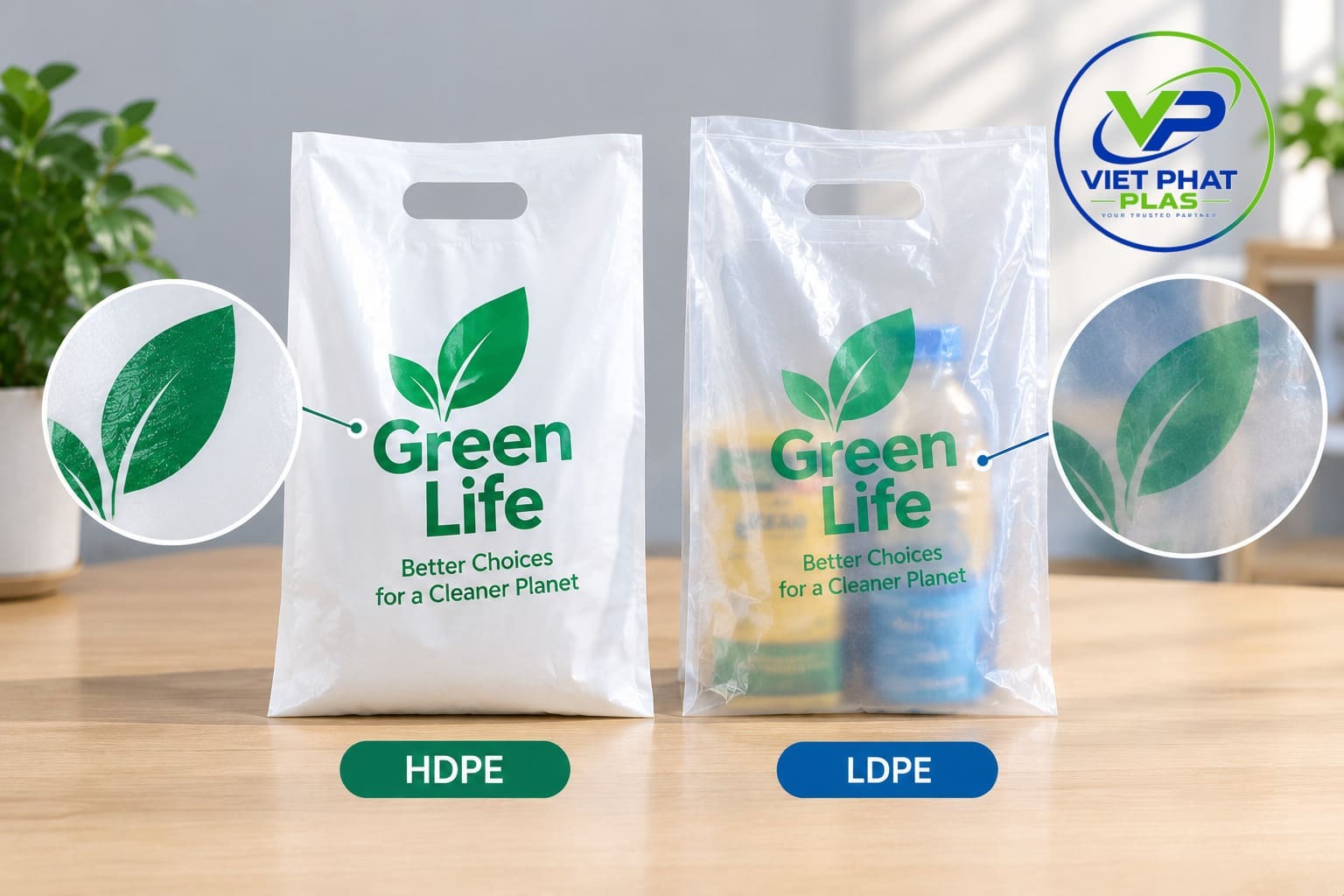
HDPE and LDPE bag samples side by side comparing opacity
HDPE is rigid and has a naturally smooth surface, which — like all polyethylene — needs corona treatment to hold ink. Its defining printability trait is opacity: HDPE's high crystallinity (roughly 70–90% crystalline structure) scatters light at the countless boundaries between crystalline and amorphous regions, which is why it looks hazy rather than clear even when treated or clarified. That opacity acts as a natural solid backing — printed colors sit against an even, opaque surface rather than showing through to the bag's contents.
LDPE is more flexible and lower in strength than HDPE, and shares the same smooth-surface, low-surface-energy printing challenge that all polyethylene has. Unlike HDPE, it's more translucent than fully opaque, giving printed designs a softer, semi-transparent look rather than HDPE's solid, even backing.
What This Means for Your Design
A bold, solid-color logo or high-contrast graphic generally reads well on HDPE, since the opaque surface gives consistent color without anything showing through from inside the bag. A design that doesn't depend on full opacity — or one where a slightly softer, semi-translucent look is acceptable or even preferred — works well on LDPE, and it's a reasonable default when there's no strong reason to need HDPE's solid backing. None of this is a hard rule the way it might sound — a good manufacturer will flag when a design's colors or contrast won't translate well to the material requested, rather than printing it as-is and letting the buyer find out at delivery.
For the printing methods themselves (flexo vs. gravure vs. screen) and how to vet a manufacturer's certifications and proofing process, see Custom Plastic Bag Manufacturer: Printing Methods Guide. For non-printing material properties (strength, flexibility, typical use cases), see LDPE vs. HDPE Plastic Bags: B2B Buyer Guide. For pricing factors and how to request an accurate quote, see Wholesale Plastic Bag Pricing.
At a Glance
|
Material |
Clarity |
Corona treatment need |
Best suited to |
|
HDPE |
Opaque (high crystallinity) |
Standard PE treatment level |
Bold, high-contrast graphics; solid color backing |
|
LDPE |
Translucent |
Standard PE treatment level |
General-purpose designs without a strong opacity need |
FAQ
Why does printed plastic need corona treatment?
Untreated plastic film has low surface energy (around 20–30 dynes/cm), well below the roughly 38 dynes/cm most inks need to bond. Corona treatment raises the surface energy so ink adheres instead of beading up and peeling off.
Does HDPE or LDPE print better?
Neither is universally "better" — HDPE's opacity gives a solid, consistent backing for bold designs, while LDPE's translucency suits designs that don't need a fully opaque background. The right choice depends on the design, not a fixed ranking.
Can corona-treated film lose its ability to hold ink?
Yes. Treatment fades over time as the film's surface slowly reverts to its original low-energy state, faster in heat or humidity. Printing soon after treatment, or confirming treatment timing with a supplier, avoids adhesion issues.
How can I check a film's surface treatment myself before committing to an order?
A dyne test pen (per ASTM D2578) is a quick, low-cost way to check: draw a line on the film and watch it for 2 seconds — a continuous line means the surface energy is adequate, while beading or retracting means it isn't. Asking a manufacturer to run this test on a sample is a reasonable request before a full production run.
Is LDPE a safe default if I'm not sure which material fits my design?
It's a reasonable option when a design doesn't specifically call for HDPE's full opacity, though it's still worth confirming with a sample print rather than assuming.
Conclusion
Getting a print to look right starts before the printing method is even chosen — it starts with finding the best material for custom bag printing that matches what the design actually needs, and confirming the film is properly treated before committing to a full run: HDPE's opacity for bold solid graphics, or LDPE's translucency as a general-purpose option. With extensive manufacturing experience and a strong reputation for quality, VietPhatPlas is a B2B manufacturer supplying custom-printed plastic bags to distributors and importers worldwide. Contact VietPhatPlas to discuss which material fits your design.
Sources
-
Cloudflex Film — Corona Treatment on Plastic Film: The Definitive Guide
-
Shobeir Shimi — Can HDPE Be Clear? The Science of Hazy Plastic