Star Seal vs Flat Seal vs Gusset Seal Trash Bags: Which Seal Type Fits Your Operation?

Star seal is marketed as the leak-resistant option, so most buyers assume it also holds more — it doesn't. This guide leads with the two facts that actually affect a purchase order: flat seal bags hold roughly 30% more rated volume than star seal at the same dimensions, and seal type has nothing to do with how a bag closes at the top, then covers construction and bin-matching by industry.
Star seal vs flat seal vs gusset seal is usually framed as a simple "which one is strongest" question, but that framing gets bulk buyers into trouble. The two facts that actually change a purchase order — that flat seal bags hold more volume than star seal bags of the same size, and that seal type has nothing to do with how a bag closes at the top — rarely make it into a supplier's product description. This guide leads with those two facts, then covers construction and bin-matching second, because that's the order in which they actually save a facility money.
Why Seal Type Decisions Go Wrong for Bulk Buyers
Procurement teams evaluating a bulk garbage bags supplier tend to compare mil thickness and price per case, and treat the bottom seal as a minor spec — something to note, not something to decide on. That's backwards. The bottom seal is where a bag concentrates stress under load, and it directly determines two things a spec sheet rarely states plainly: how much a bag actually holds once it's fitted to a real bin, and whether it leaks.
Two assumptions cause most of the sourcing mistakes in this category. The first is that a star seal bag, because it's marketed as the leak-resistant option, must also be the higher-capacity option — it isn't. The second is that "drawstring" and "star seal" describe the same feature, or that choosing one tells you anything about the other — they don't. Both assumptions are common enough that they're worth addressing before getting into how each seal is built.
The Capacity Myth: Why Flat Seal Actually Holds More Than Star Seal
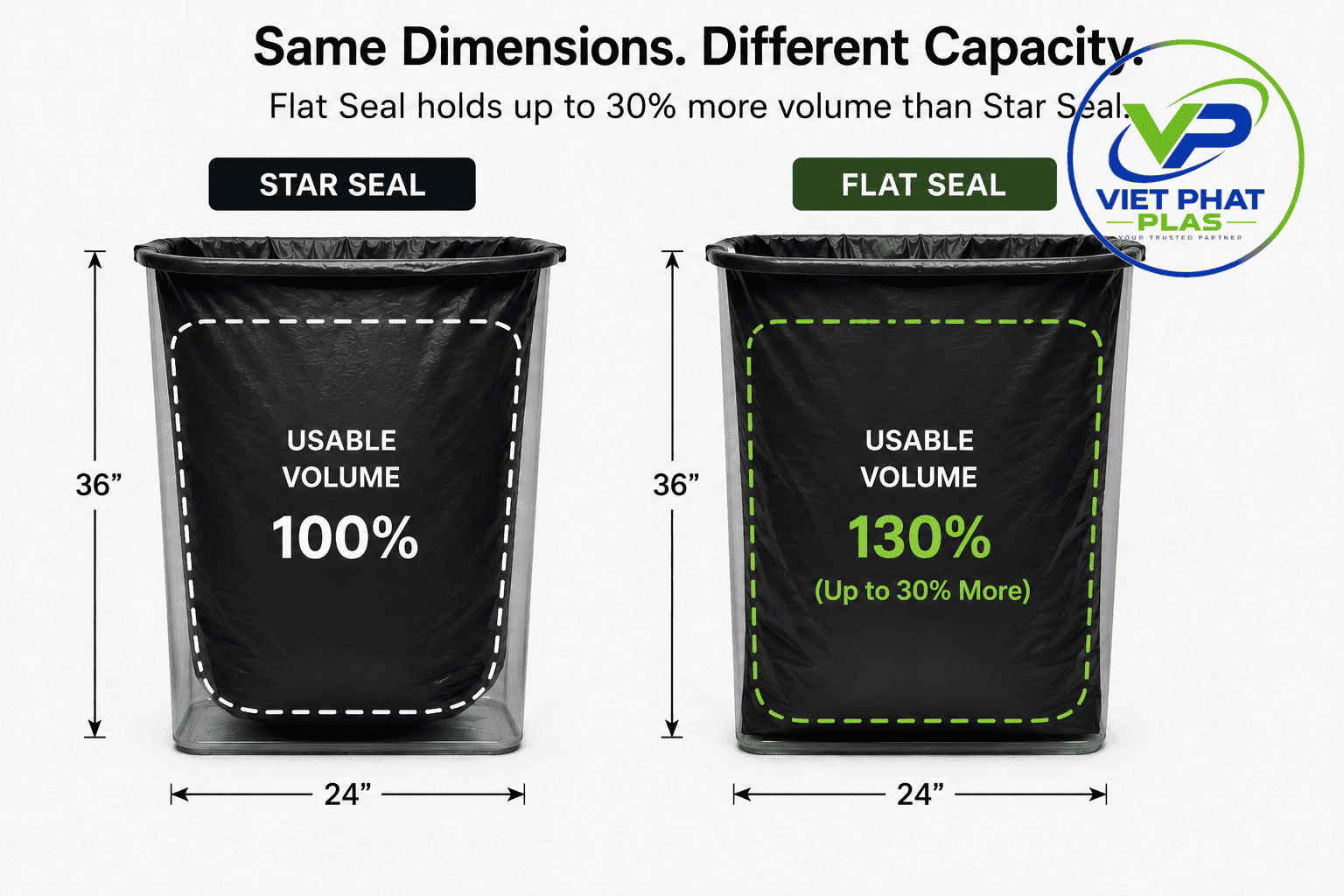
Side-by-side capacity comparison of star seal and flat seal trash bags at the same dimensions
Here's the number that surprises most buyers: a flat seal bag typically holds roughly 30% more rated volume than a star seal bag of identical overall dimensions. That runs directly against the assumption that star seal, being the "premium" leak-resistant option, must also carry more.
The reason is straightforward once you see how a star seal is made. Folding the bag's sides inward to a single sealed point at the bottom consumes material to create that star-shaped base — material that, in a flat seal bag, would instead be usable interior volume. To reach the same usable capacity as a flat seal bag, a star seal bag has to be cut longer, which is why two bags marketed at the "same size" by gallon rating can behave very differently once filled.
This doesn't make flat seal the better choice — it makes the comparison more complicated than a single capacity number suggests. A flat seal bag's extra rated volume is only fully usable in a bin shape that supports it. In a round container, a flat seal bag's square corners leave dead space the bag can't actually use, while a star seal bag's folded base conforms to the round shape and uses more of its (smaller) rated volume in practice. In a square or rectangular bin, that dead space disappears, and the flat seal bag's capacity advantage becomes fully real. Buyers who only compare the number on the box, without checking it against their bin's actual shape, are comparing numbers that don't mean what they think they mean.
Star, Flat, and Gusset Seal: A Quick Construction Reference
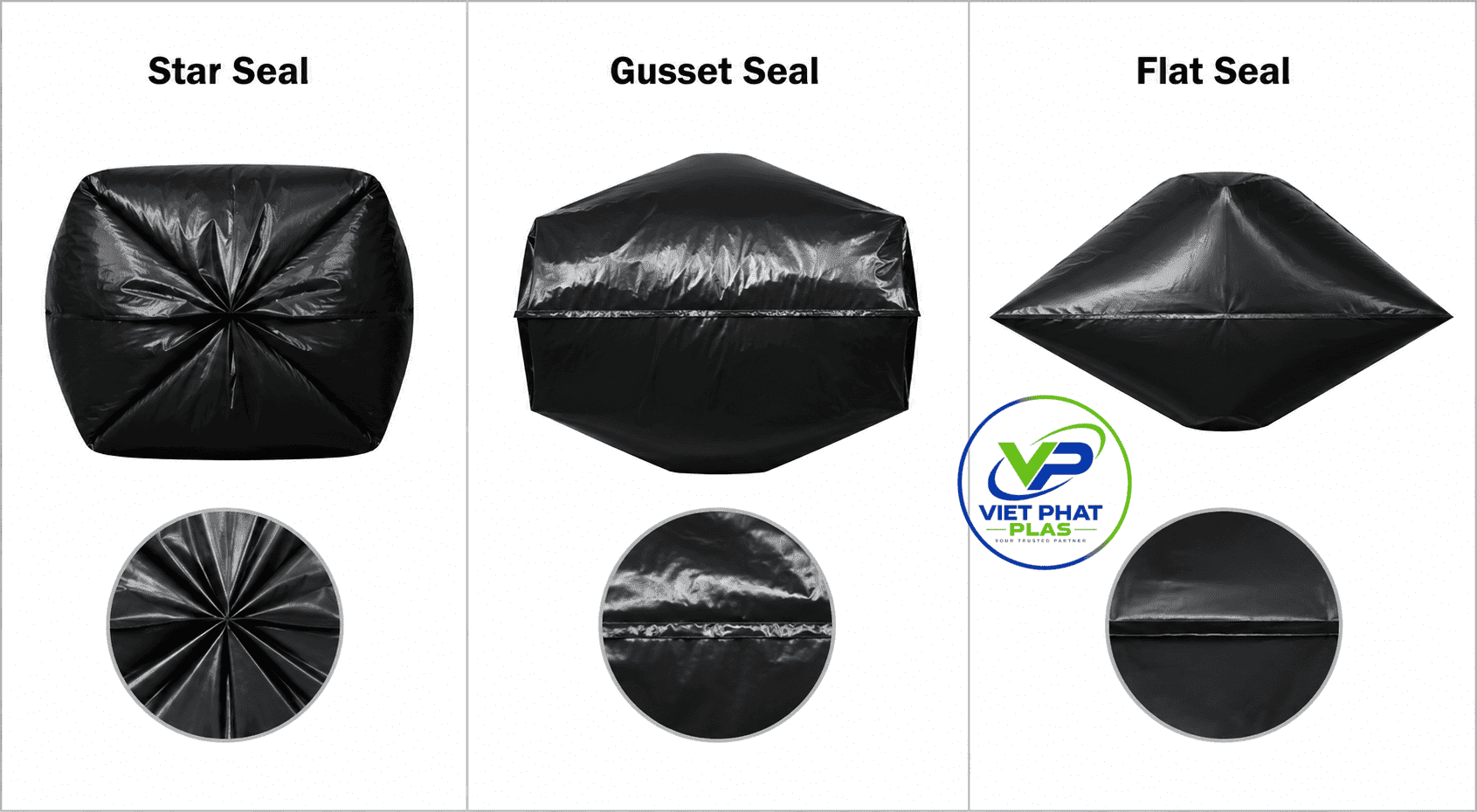
Close-up comparison of star seal, flat seal, and gusset seal bag bottoms
For reference, here's how each is actually built:
Star seal (X-seal) folds the bag's sides inward and heat-seals them at a single point at the bottom, expanding into a star shape when filled. It distributes weight across several fold lines rather than concentrating it on one seam, which is why it's the standard recommendation for wet or loose waste.
Flat seal is a straight, two-dimensional seam across the bottom — the simplest and least expensive construction. It performs well in square or rectangular receptacles but leaves unsupported corners in round ones, where liquid and loose waste tend to pool before the bag looks full.
Gusset seal folds the sides into expandable pleats over a flat bottom seam, allowing the bag to widen for bulky or irregular loads. It has become less common as a standard commercial catalog item — mostly reserved now for landscaping debris or bulky recyclables rather than general waste — so confirm with a supplier whether it's stocked or a custom order.
Seal Type vs Closure Type: The Mix-Up That Ruins Reorders
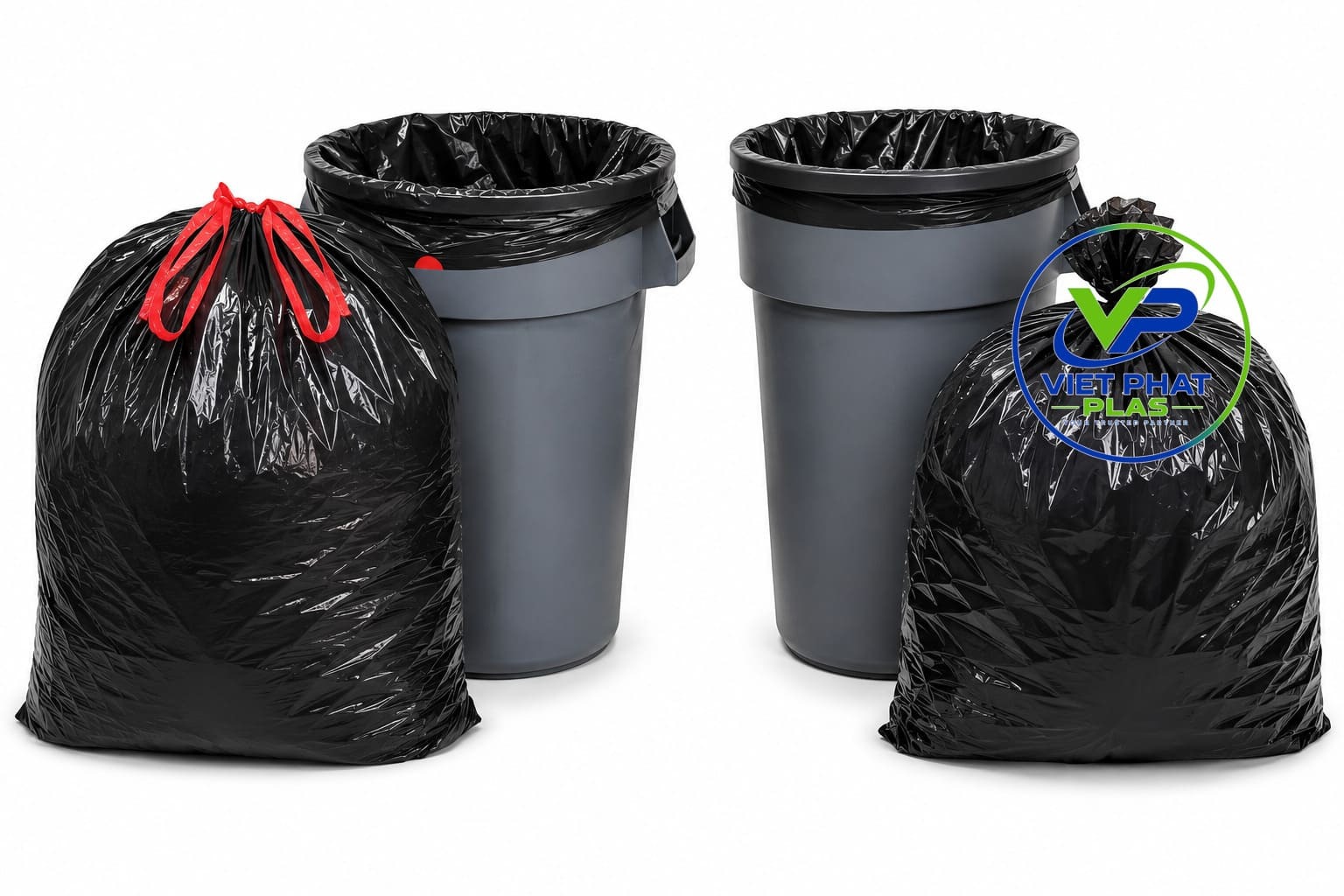
Comparison of drawstring closure and plain-top trash bag, separate from bottom seal construction
This is the second assumption worth correcting, and it causes more reorder mismatches than the capacity myth does. Seal type and closure type are two independent specs, but supplier listings — and buyers reading them — routinely treat them as one thing.
Seal type is about the bottom of the bag: flat, star, or gusset, as covered above. Closure type is about the top: most commonly a drawstring, where a cord is built into a reinforced rim, versus a plain open top that requires a manual tie. A supplier's "drawstring trash bags" listing says nothing about how that bag's bottom is sealed — a drawstring closure can sit on top of a flat seal bottom just as easily as a star seal bottom.
The practical failure mode looks like this: a buyer reorders "the same drawstring bags as last time" from a different supplier, gets a batch with a different bottom seal than the previous order, and the new batch performs differently in the same bins — not because the drawstring changed, but because the seal did, and nobody asked. Comparing quotes on both specs independently — bottom seal for leak resistance and bin fit, closure type for how the bag is tied and carried — avoids this entirely.
Matching Seal Type to Your Bins by Industry
Seal choice is really a function of two variables — bin shape and waste type — and those variables cluster predictably by industry:
Healthcare and food service typically run round bins with wet, loose, or biohazard-adjacent waste. Star seal is the standard recommendation here: the conforming base and even weight distribution reduce leak risk in exactly the conditions where a leak is most costly to clean up or most compliance-sensitive.
Hospitality and janitorial services often mix round and rectangular receptacles across a single property — guest rooms, back-of-house, banquet kitchens — which is a genuine argument for stocking both star and flat seal rather than standardizing on one across every bin.
Offices and retail back rooms generally run rectangular or square bins with dry, light waste, where flat seal's cost and capacity advantage is fully usable, since there's no round-bin dead space eating into that rated volume.
Waste hauling and municipal collection deal with high volume and mixed bin types across many customer sites — this is where confirming seal type per contract, rather than assuming a single default, prevents the leak complaints that come from a mismatched batch showing up at the wrong stop.
Construction and landscaping are where gusset seal still earns its place, for bulky debris that a standard flat or star seal bag wasn't shaped to hold.
Comparison Table by Leak Resistance & Capacity
Comparison chart of star seal, flat seal, and gusset seal trash bags by real-world capacity and leak resistance
|
Factor |
Star Seal (X-Seal) |
Flat Seal |
Gusset Seal |
|
Rated capacity (same dimensions) |
Lower — ~30% less than flat seal |
Highest of the three |
Higher than flat, variable by fold |
|
Usable capacity in round bins |
High — base conforms to shape |
Lower — corners leave dead space |
Moderate |
|
Usable capacity in square/rectangular bins |
Moderate |
High — full rated volume usable |
Moderate to high |
|
Leak resistance |
Highest — even weight distribution |
Moderate — can pool at corners |
Moderate — depends on fold quality |
|
Manufacturing cost |
Moderate |
Lowest |
Higher |
|
Best fit |
Round bins, wet/loose waste |
Square/rectangular bins, dry waste |
Bulky, irregular waste |
Actual performance varies by film thickness, resin, and manufacturing quality — request a sample against your specific bin and waste stream before a bulk commitment.
VietPhatPlas supplies trash bags and garbage bags across all three seal constructions, so facilities running mixed bin types can source star, flat, and gusseted bags from a single supplier. For mil thickness and resin selection alongside seal type, see the industrial vs commercial trash bags guide. If you're sizing bags by container dimensions rather than seal type alone, the trash bag size and load guide covers how to measure round and rectangular bins before placing an order.
FAQ
Does flat seal really hold more than star seal? Yes — a flat seal bag typically holds roughly 30% more rated volume than a star seal bag of the same dimensions, since the star seal's folded base uses material to form its shape. That advantage is only fully usable in square or rectangular bins; in round bins, star seal's conforming shape often makes better use of its smaller rated capacity.
Are seal type and drawstring closure the same thing? No. Seal type refers to the bottom of the bag (flat, star, or gusset); closure type refers to how the top is secured (drawstring versus manual tie). A supplier can pair a drawstring closure with any bottom seal, so confirm both specs separately when comparing or reordering.
Which seal type is best for wet or heavy waste? Star seal generally offers the best leak resistance for wet or loose waste, since its folded base distributes weight evenly and avoids the unsupported corners where flat seal bags tend to pool liquid.
Is gusset seal still commonly available? It's become less common as a standard commercial catalog item, used mostly now for bulky or irregular waste. Confirm with your supplier whether it's stocked or a custom order before planning lead times.
Which seal type fits round trash cans better? Star seal generally conforms better to round receptacles, since the folded base flexes to match a round shape rather than sitting as a flat rectangle inside a round opening.
Conclusion
The seal-type decision that actually affects cost and performance isn't "which one is strongest" — it's recognizing that flat seal's capacity advantage only pays off in the right bin shape, and that seal type and closure type need to be specified separately to avoid a reorder that doesn't match what worked before. Buyers who apply both corrections before writing a purchase order tend to see fewer leaks, less wasted rated capacity, and fewer mismatched reorders.
If you're sourcing bulk trash bags or garbage bags for a facility, hospital, food service operation, or waste management contract, VietPhatPlas supplies all three seal constructions as a garbage bags manufacturer based in Vietnam. Contact VietPhatPlas to discuss your bin types and waste stream for a spec-matched quote.
Related Posts:
Sources:
-
Garbage Bag Market — Fortune Business Insights