Slider Ziplock Bags vs Zipper Bags: Choosing the Right Closure for Food Storage Packaging

Slider ziplock bags and press-to-close zipper bags look interchangeable on a spec sheet, but they perform differently once a bag gets opened and reclosed dozens of times. This guide breaks down how each closure mechanism actually works, where reseal strength, cost, and production tooling diverge, and how to match the right closure type to a specific food product and packing line.
Procurement teams sourcing resealable food packaging eventually land on the same decision point: slider ziplock bags vs zipper bags. Both close a bag without heat or an extra label, both open and reclose hundreds of times over a product's shelf life, and both look interchangeable on a spec sheet until you actually run them on a packing line or hand them to an end user for the tenth time. The difference is in the mechanism — a plastic slider that pulls two interlocking profiles shut in one motion, versus a press-to-close zipper bag that a user seals by pinching the track between thumb and finger from one end to the other.
This guide breaks down how each closure works, where the real performance gap shows up after repeated opening and closing, and how to match food storage bag closure types to a specific product, packing line, and price target.
Two Closure Mechanisms, Two Different Trade-offs
Both closure types rely on the same underlying principle: two interlocking plastic profiles, extruded into the bag film, that press together to form a seal. What differs is how the user engages that seal.
A press-to-close zipper bag asks the user to do the work by hand — pinching the track and dragging their fingers along its full length, ideally from one edge of the bag to the other. A slider ziplock bag adds a small plastic carriage that rides along the track. Pulling the carriage across the bag forces the two profiles together (or apart) in a single, controlled pass. The mechanism is simple, but it changes who is responsible for sealing the bag correctly: the user's technique, in the case of a press-to-close zipper, or the slider itself, which cannot skip a section of track the way a rushed hand sometimes can.
At VietPhatPlas, both closure styles are manufactured from the same base film families used across our food bags and zipper bags lines — virgin HDPE, LDPE, and LLDPE — so the choice between them is rarely about material. It's about matching the closure mechanism to how the bag will actually be opened, closed, and reopened in the field.
Slider Ziplock Bags: How the Slider Track Works and Where It Wins
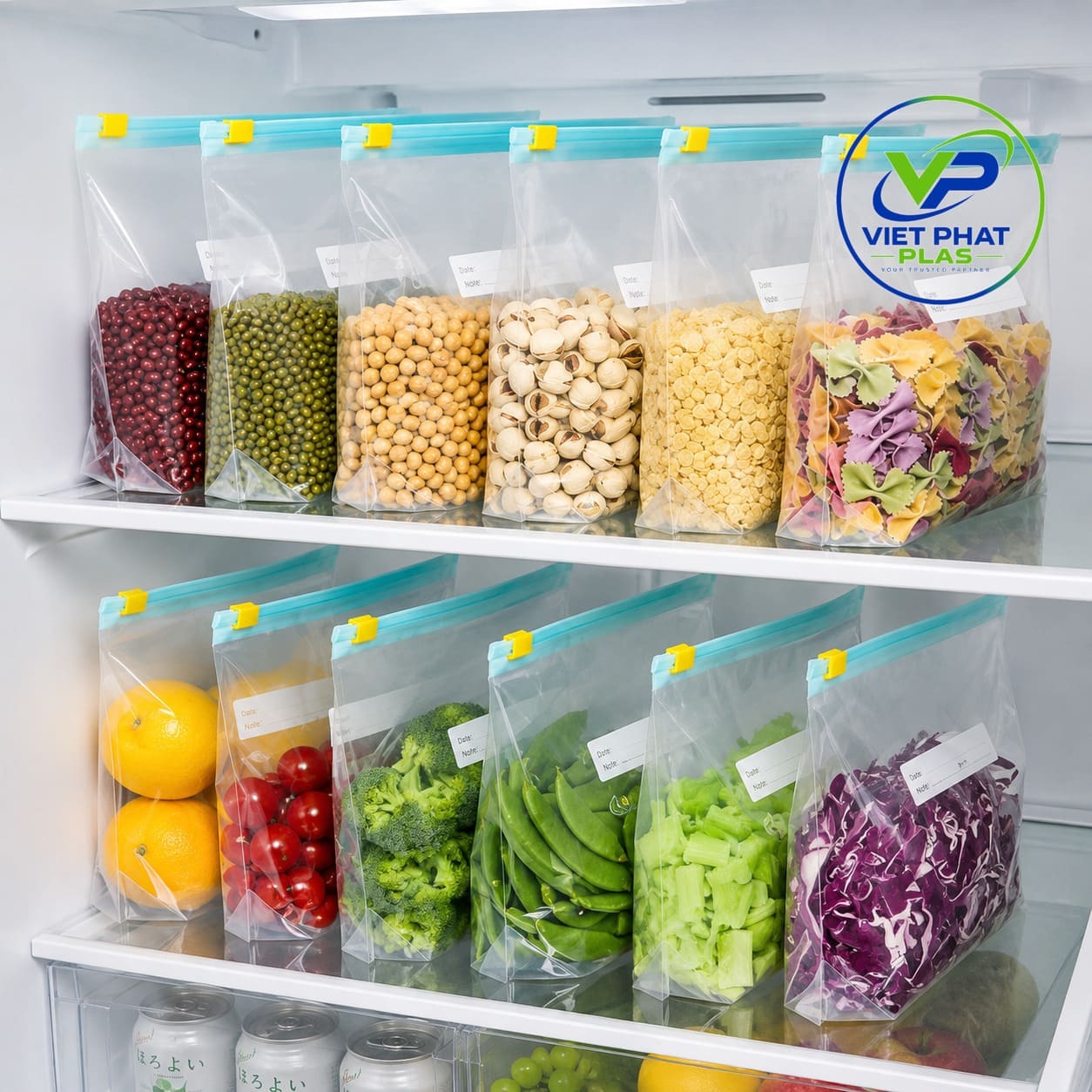
Transparent zipper slider bag with a convenient sliding zipper closure, used for packaging food/goods.
Our Slider ziplock bags are produced in virgin HDPE, LDPE, or LLDPE, in customized sizes, at a thickness range of 40–250 microns, in white or transparent film. That thickness range sits noticeably higher than our standard press-to-close zipper film, which reflects how slider bags are typically specified: the slider carriage adds weight and mechanical stress to the top edge of the bag, so buyers commonly pair it with a heavier-gauge film to keep the bag from stretching or tearing at the track over repeated use.
The mechanical advantage of a slider is straightforward. Because the carriage physically rides the full width of the track in one pull, it closes the bag edge-to-edge every time — there is no equivalent to a user starting from the middle and leaving the corners unsealed, which is one of the more common failure points with a hand-pressed zipper. This also makes slider bags easier to operate one-handed, which matters for packaging aimed at older users, younger users, or anyone handling the bag while doing something else, like cooking or restocking a shelf.
Where slider ziplock bags tend to win: bulk or family-size packaging that gets opened and reclosed many times before the contents are used up (frozen produce, snack multipacks, pet food, bakery ingredients); products where a fast, one-hand close matters at the point of use; and any packaging positioned as a premium or private-label SKU, where the tactile "click" of a slider closing reads as a more finished, considered package compared to a plain zipper top.
Press-to-Close Zipper Bags: Seal Strength and Where It Wins
The comparison isn't one-directional. Our Food Packaging Zipper Bags — the standard press-to-close zipper bag in the food bags range — run virgin HDPE, LDPE, or LLDPE at 35–120 microns, and our Zipper/slider bag line runs 100% virgin LDPE at 10–60 microns, offered with either a zipper or ziplock top depending on the order. That thinner, lighter film is exactly what makes press-to-close zippers the default choice for smaller, high-volume bags — snack pouches, single-serving portions, small parts and hardware bags — where minimizing material cost per unit matters more than the added convenience of a slider carriage.
A properly seated press-to-close zipper, run by hand along its full length, forms a seal that is mechanically no weaker than a slider track — the interlocking profile geometry is the same closure technology underneath. The gap between the two only opens up when the seal depends on technique: a user who presses only the middle of the track, or presses too lightly, leaves gaps a slider would have closed automatically. For controlled environments — internal food prep, staff-packed retail bags, or products where the same trained operator closes every bag — a press-to-close zipper performs close to parity with a slider at a meaningfully lower cost per bag.
Press-to-close zipper bags also tend to win on tooling simplicity. The zipper profile is a single continuous extrusion with no moving part to attach, align, or QC-check on the production line, which keeps unit cost down and makes this closure the practical default for buyers running high SKU counts or frequent size changes.
Reseal Cycles: Which Closure Holds Up Longer with Repeated Use
For a buyer sourcing packaging that a consumer will open and close dozens of times before the product is finished — a bag of coffee, a family-size bag of frozen vegetables, a refillable pantry bag — slider bag reseal strength over the life of the package matters more than the strength of any single seal.
Two variables drive how well a closure holds up over repeated cycles, and neither is unique to slider or zipper: film thickness and track material quality. A thicker film resists the stretching and micro-tearing that eventually causes a track to lose its grip, which is why our heavier-gauge slider ziplock bags (40–250 mic) are positioned for repeat-use, bulk-format packaging, while the thinner 10–60 mic zipper/slider film is built for lower-cycle, single-session use cases like a snack bag that's opened once or twice before it's empty.
Within that framework, the slider carriage does carry one structural advantage for high-cycle use: because it mechanically guides the closure shut every time, it removes user technique as a variable. A press-to-close zipper's performance over many reseals depends on the user consistently pressing the full track correctly — which is a reasonable assumption for a single trained operator, but a less reliable one for a retail product that will be opened by many different end consumers with varying habits. Buyers packing granular or crumbly food products (cereal, snack mixes, ground coffee) should also confirm whether the slider design plows debris out of the track as it closes — a detail worth specifying and sampling, since fine particles trapped in the track are one of the more common causes of a seal that looks closed but isn't fully engaged.
Comparison Table: Speed, Seal Strength, Cost per Bag
|
Factor |
Slider Ziplock Bags |
Press-to-Close Zipper Bags |
|
Closing speed |
Fast — one continuous pull, one-handed |
Slower — requires pressing full track by hand |
|
Seal reliability across users |
High — mechanism closes track edge-to-edge every time |
Depends on user technique; strong when done correctly |
|
Typical film thickness (VietPhatPlas) |
40–250 mic (Slider ziplock bags) |
10–60 mic (Zipper/slider bag) / 35–120 mic (Food Packaging Zipper Bags) |
|
Best-fit format |
Bulk, family-size, repeat-open packaging |
Small-format, single-session, high-SKU packaging |
|
Cost per bag |
Higher — added slider component and typically heavier film |
Lower — single extrusion, no added part |
|
Automated packing line fit |
Requires slider pre-attached to film before bag forming |
Simpler to run on standard zipper bag-making equipment |
Matching Closure Type to Your Food Product and Packaging Line
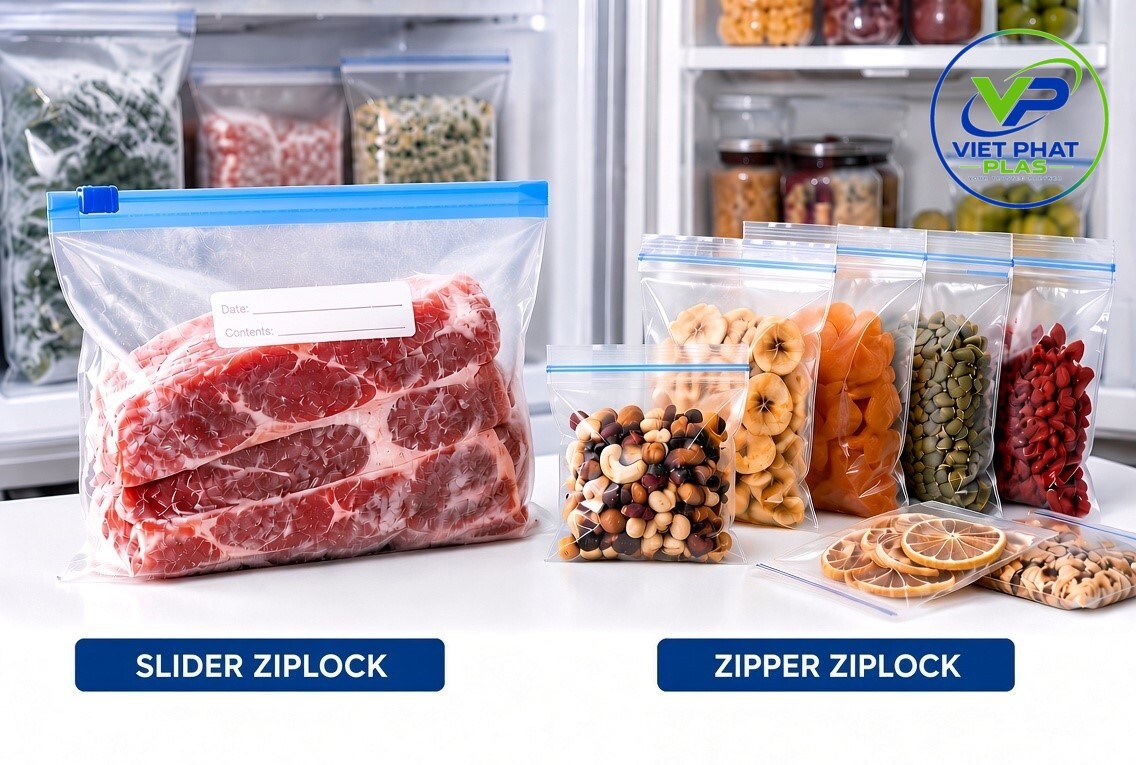
Large slider ziplock bag for frozen food next to a small press-to-close zipper snack bag
The ziplock vs press seal bag decision comes down to three questions worth answering before requesting a quote.
First, how many times will the bag realistically be opened before it's empty? A single-serving snack or a small parts bag that's opened once doesn't need the reseal durability a slider offers — a press-to-close zipper at a lighter gauge, like our 35–120 mic Food Packaging Zipper Bags, does the job at lower cost. A bulk or family-size bag that stays in a pantry or freezer for weeks, reopened dozens of times, is where the added cost of a slider pays for itself in fewer torn tracks and fewer customer complaints.
Second, who is closing the bag? If it's a trained packing-line operator closing every unit the same way, a press-to-close zipper performs close to a slider at a lower price point. If it's an end consumer — potentially older, potentially in a hurry, potentially one-handed while holding a child or a phone — the slider's built-in consistency removes a variable you can't control after the product leaves the factory.
Third, what does the packing line actually support? Our Multipurpose Zipper Storage Bags and Freezer bag lines are both built around a standard zip-top closure that runs on conventional zipper bag-forming equipment, which keeps changeover simple for buyers running multiple SKUs. A slider system needs to be pre-attached to the film before the bag is formed, which is a straightforward spec for VietPhatPlas to produce but worth confirming against your target volumes and lead time before locking in a size.
For buyers who aren't sure which closure their product needs, custom plastic bag production from VietPhatPlas can run either mechanism at the size, thickness, and print specification the application calls for — including side-by-side samples of both closures on the same bag size, so the reseal difference can be tested against the actual product rather than decided on paper.
On order volume, our zipper bags line publishes reference figures worth knowing before requesting a quote: Multipurpose Zipper Storage Bags run at a 1,000,000-piece MOQ with a 15–20 day lead time in a 20GP container (20–25 days for a 40GP) after sample approval, while Freezer bag runs at a 500,000-piece MOQ with a 12–15 day lead time after sample approval. Slider ziplock bags and the other food-bags-category items are quoted per order based on size, thickness, color, and quantity — send your target volume for an exact MOQ and lead time.
FAQ
Is a slider ziplock bag more airtight than a standard zipper bag? Mechanically, both use the same type of interlocking track, so their maximum seal tightness is roughly equivalent. The difference is in consistency of use: a slider always closes the full length of the track in one pull, while a standard zipper bag depends on the user pressing evenly and completely along the track. For products consumers open and close repeatedly themselves, a slider bag tends to deliver a more consistently tight seal in practice.
Which closure holds up better over repeated opening and closing? Durability over many open/close cycles depends mainly on film thickness and track quality rather than the closure type alone. VietPhatPlas's Slider ziplock bags run 40–250 microns — noticeably thicker than the 10–60 micron Zipper/slider bag line — which makes them better suited to family-size or bulk packaging that gets reopened many times. The slider's mechanical advantage is that it removes the user's technique from the equation.
Is a slider bag suitable for automated packing lines? Yes, but the slider needs to be pre-attached to the film before the bag is formed, so this should be confirmed with the manufacturer early in the process. A press-to-close zipper bag is simpler to run on standard zipper bag-making equipment and is typically the default choice when sizes or formats change frequently.
Does a slider bag cost more than a standard zipper bag? Usually, yes. A slider bag requires an added plastic component attached to the track, plus it typically runs on heavier film, so the per-bag cost is higher than a standard press-to-close zipper bag. The exact difference depends on size, thickness, and order quantity.
Conclusion
Neither closure is universally "better" — a slider ziplock bag and a press-to-close zipper bag are two engineering answers to the same problem, optimized for different use patterns. The slider trades a small cost premium for consistent, one-handed sealing across many reseal cycles and many different users, which is why it fits bulk and family-size food packaging particularly well. The press-to-close zipper trades that convenience for a lower cost per bag and simpler production tooling, which keeps it the practical default for smaller-format, single-session, or high-SKU packaging runs.
VietPhatPlas is a Vietnam-based manufacturer producing both closure types across our food bags and zipper bags ranges for B2B buyers across export markets, in virgin HDPE, LDPE, and LLDPE film, at the thickness and size a buyer's product actually requires — with quality control on seal integrity and track alignment carried through from raw material to finished carton before export. Request a quotation with both closure options and a target volume, and we can advise on which fits the packing line and reseal profile the product needs.