Machine Stretch Film vs Hand Stretch Film: Choosing the Right Pallet Wrap for Your Warehouse

Two suppliers can quote the same "gauge" for pallet wrap and mean physically different film thicknesses — one of several traps buyers hit when comparing hand stretch film against machine-grade film. This guide breaks down true vs equivalent gauge, roll and core compatibility, and when automation actually pays off, so buyers can spec an order correctly instead of comparing quotes that aren't measuring the same thing.
Machine stretch film vs hand stretch film is a comparison a warehouse manager usually runs into while comparing quotes for pallet wrap: two suppliers quote different "gauge" numbers for what looks like the same film, and a hand-wrap roll that seemed cheap per unit ends up costing more per pallet than the machine stretch film next to it on the shelf. This isn't just about who's doing the wrapping — it's a question of film formulation, roll compatibility, and where the real cost per pallet is coming from.
This guide covers the practical differences between hand-applied and machine-grade stretch film — thickness, gauge terminology, roll width, and load containment — so a warehouse or logistics buyer can spec an order correctly, whether the facility still wraps by hand or is evaluating automation. It's written for operations managers and procurement buyers deciding between continued hand-wrap purchases or investing in wrapping equipment.
Hand Stretch Film vs Machine Stretch Film: Core Differences
Warehouse worker hand-wrapping a pallet with stretch film
Hand and machine stretch film are both LLDPE-based film designed to cling to itself and compress a load onto a pallet, but they're formulated and packaged differently because the equipment applying them works differently.
Hand stretch film comes on narrow rolls, usually with a built-in core and sometimes a handle attachment, sized for one operator to walk around a pallet while unwinding film under manual tension. Because a person can't apply perfectly consistent pulling force, hand film is generally formulated with higher cling and a moderate pre-stretch built into the film itself to compensate.
Machine stretch film runs through a wrapping machine's pre-stretch carriage, which applies force far more consistently — and at a much higher stretch ratio — than a human arm can. This lets machine film use less raw material per pallet for the same containment, since the machine stretches (and thins) the film further before applying it. Machine film also comes on much larger rolls.
The practical distinction isn't "which film is stronger" — comparable-quality hand and machine film can both hold a load securely. The real difference is cost efficiency and consistency: machine-applied film generally uses less material per pallet at a more consistent stretch ratio, while hand-applied film trades that efficiency for low equipment investment, which matters for lower or inconsistent pallet volume.
When Automation Actually Pays Off
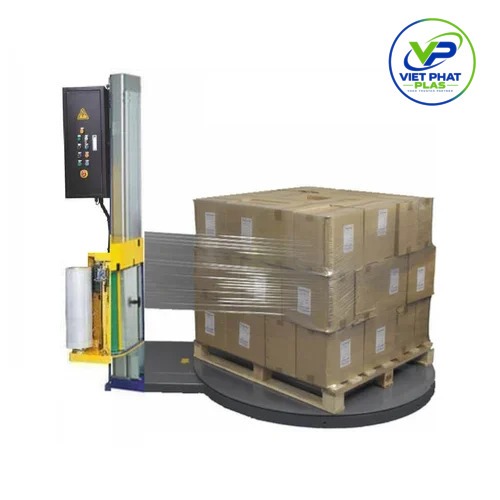
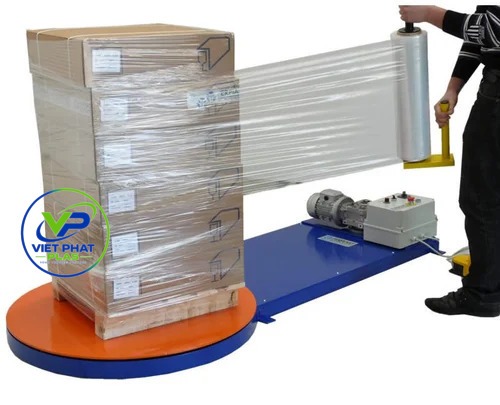
Automatic stretch wrapping machine wrapping a pallet in a warehouse
Deciding when to move from hand wrap to automation isn't purely about pallet count — it's the combination of volume, labor cost, and film savings per pallet.
Industry data suggests automatic wrapping machines now account for more than 62% of new equipment installations, while semi-automatic and manual wrapping still serve roughly 38% of businesses — typically smaller operations or facilities with lower or seasonal pallet throughput where equipment cost doesn't clear a reasonable payback period.
A rough way to evaluate the switch: calculate current film cost per pallet under hand-wrap, add the labor time a machine would eliminate, and compare that against the amortized machine cost plus machine-grade film cost per pallet. Facilities wrapping under roughly 20–30 pallets per day often find hand wrap still more cost-effective once financing and maintenance are factored in; facilities above that range, or running multiple shifts, tend to see automation break even within one to two years.
Automation doesn't have to mean a fully automatic line — semi-automatic turntable wrappers, which still require a person to load the pallet but automate the wrap cycle, are a common middle step for moderate-volume facilities.
True Gauge vs Equivalent Gauge — Why It Affects Your Real Cost
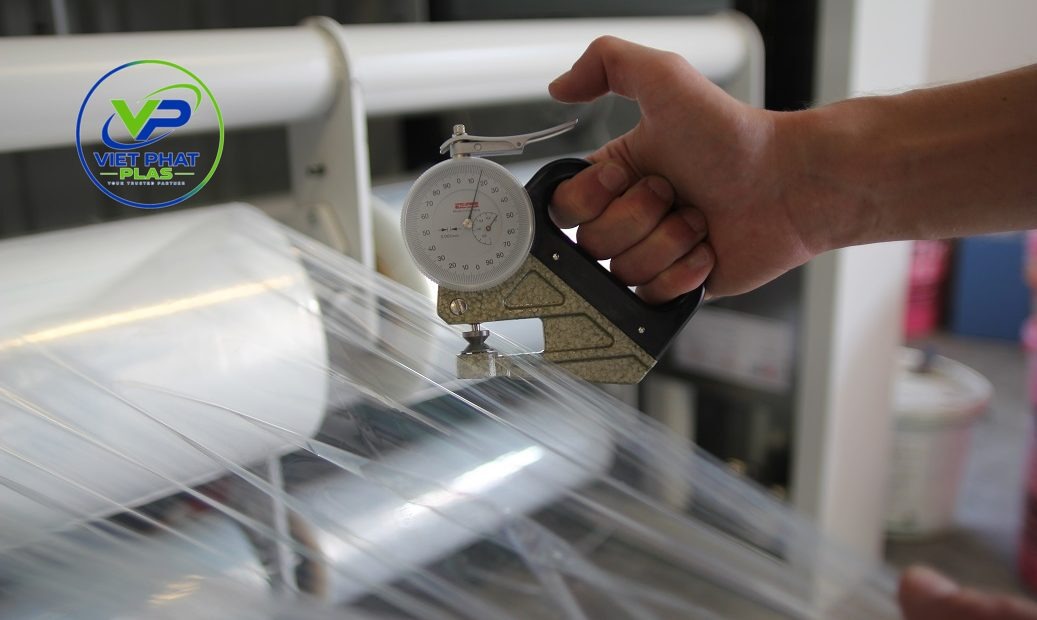
Measuring stretch film thickness with a micrometer gauge
This is where buyers most often get quietly overcharged, and it directly drives hand wrap vs machine wrap cost comparisons that don't hold up once the film is tested.
"True gauge" is a thickness measurement taken directly with a micrometer on standard LLDPE resin — a straightforward, verifiable number. "Equivalent gauge" is a figure some suppliers use when a film is manufactured with different resin blends or additives that let a physically thinner film perform like a thicker true-gauge film. It's a performance claim, not a direct measurement.
Two suppliers might both quote "80 gauge" and mean genuinely different physical thicknesses if one is quoting true gauge and the other equivalent gauge. A buyer who doesn't ask which measurement is being used can end up comparing prices on numbers that aren't actually equivalent.
The fix: ask the supplier directly whether the quoted gauge is true or equivalent, and request a sample to verify thickness with a micrometer before committing to a bulk order — this single question resolves most confusion when comparing stretch wrapper film specs across suppliers.
Roll Width & Core Size Compatibility with Wrapping Machines
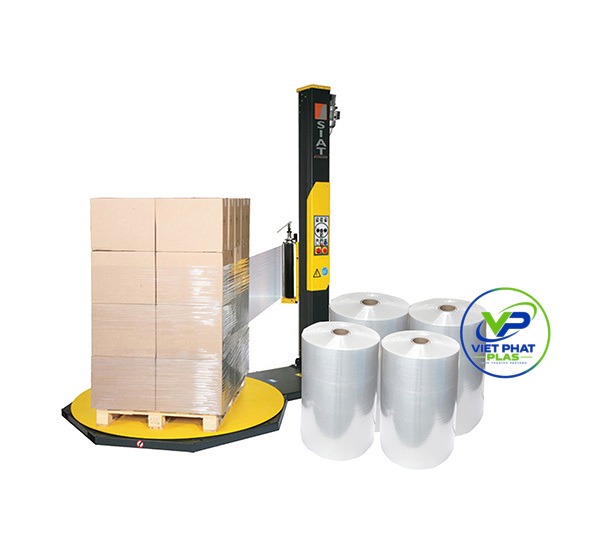
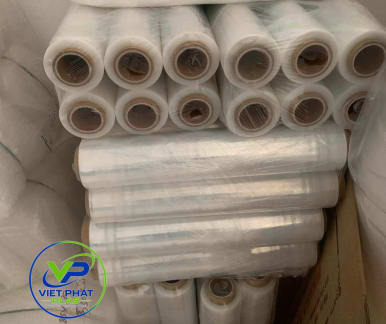
Large machine-grade stretch film roll for automatic pallet wrapping
Roll width and core diameter seem minor until a roll physically doesn't fit the equipment on the line.
Hand stretch film is typically sold in narrower widths — commonly 12", 18", or 20" — sized for a person to walk around a pallet. Machine-grade film is produced in much wider rolls, generally 20" up to 60", matched to the wrapping machine's carriage width.
Core size matters just as much. Wrapping machines are built around a specific core diameter (commonly 3", though some equipment differs), and a roll with the wrong core diameter won't seat correctly on the spindle regardless of film quality. Buyers should confirm both roll width and core diameter against their equipment specs before ordering — a mismatch means downtime sourcing a replacement, or wasted film that doesn't run properly through the carriage.
Load Containment Force Explained
Load containment force is the measurable holding force a wrapped film exerts on a load, and it matters more than mil thickness or gauge alone — a thinner, well-engineered film applied correctly can contain a load as effectively as a thicker film applied loosely.
Containment force depends on the film's inherent cling and elasticity, the number of wrap rotations, and the tension (pre-stretch percentage) at application. This is why comparing two films purely by mil or gauge, without accounting for how they're applied, doesn't reliably predict which pallet arrives intact.
Hand-wrapped containment is limited by how consistently an operator applies tension — one reason hand film carries more built-in cling. Machine-wrapped pallets benefit from a programmable, repeatable containment force across every load, which is part of why high-volume facilities see more consistent transit outcomes after automating. Buyers should ask whether containment force has been tested (in pounds of force) rather than relying on mil thickness as a stand-in.
Comparison Table: Hand vs Machine Film Specs
Comparison chart of hand stretch film versus machine stretch film specifications
|
Spec |
Hand Stretch Film |
Machine Stretch Film |
|
Typical thickness |
60–120 gauge (~15–30 micron) |
47–90 gauge (~12–23 micron), often engineered thinner |
|
Roll width |
12" / 18" / 20" |
20"–60" |
|
Core diameter |
Usually 3", handle-mounted core common |
Matched to wrapper spindle, commonly 3" |
|
Applied tension |
Manual, operator-dependent |
Machine pre-stretch carriage, consistent |
|
Typical pre-stretch |
Low to moderate, built into film |
High (150%–300%+), applied mechanically |
|
Best fit |
Lower volume, irregular loads |
Higher volume, standardized pallets |
|
Cost driver |
Price per roll, cling performance |
Cost per pallet (film yield), equipment amortization |
Actual figures vary by manufacturer and resin formulation, so confirm true gauge, roll width, and core size directly with a supplier rather than assuming standardization across brands.
How to Spec an Order for Your Facility
Ordering the right pallet wrap comes down to specifying a few details clearly before requesting a quote:
Application method. State whether the film is for hand application or a specific wrapping machine model — this determines roll width, core size, and expected pre-stretch.
Gauge, true or equivalent. This one clarification prevents comparing quotes on numbers that aren't measuring the same thing.
Roll width and core diameter. Confirm both against equipment specs, or operator handling preference for hand film.
Load type and containment requirement. A pallet of shrink-wrapped cartons has different needs than an irregular load — flag this so a supplier can recommend the right cling and pre-stretch range.
MOQ and packaging format. Bulk stretch film MOQ can vary by roll width and formulation, so confirm early.
VietPhatPlas supplies both pallet film and broader stretch film lines, covering hand-wrap rolls and machine-compatible widths from a single supplier. See also what stretch film is and its practical applications and the pallet film types guide.
FAQ
When should a facility switch from hand wrap to machine wrap? There's no fixed pallet count that applies universally, but facilities wrapping roughly 20–30 pallets per day or more often clear the equipment cost within one to two years through labor savings and reduced film waste. Lower or seasonal volume may still favor hand wrap.
What's the difference between true gauge and equivalent gauge? True gauge is a directly measured thickness on standard resin film. Equivalent gauge is a performance claim for engineered films that are physically thinner but formulated to perform like a thicker true-gauge film — always ask which one a supplier is quoting.
What roll widths are common for machine-grade stretch film? Generally 20" up to 60", matched to the wrapping machine's carriage. Hand stretch film is narrower — around 12", 18", or 20".
How does pre-stretch percentage affect cost? Higher pre-stretch means more film length per pound of resin, lowering film needed per pallet — but very high settings need to be balanced against load containment, since over-stretching can reduce holding strength on some loads.
What's the MOQ for machine-grade stretch film? MOQ varies by roll width, gauge, and custom formulation. Standard catalog widths generally carry lower MOQs than custom widths or specialty cling formulations — confirm directly with your supplier.
Conclusion
Choosing between machine stretch film and hand stretch film isn't about which is inherently better — it's about matching gauge, roll width, and application method to your facility's pallet volume and equipment. Buyers who confirm true vs equivalent gauge, verify roll and core compatibility, and evaluate load containment force rather than relying on mil or gauge numbers alone get more consistent results and avoid paying for performance they don't need.
If you're sourcing pallet wrap for a warehouse, distribution center, or manufacturing facility, VietPhatPlas supplies both hand-wrap and machine-compatible stretch film across the gauge and width ranges covered here. Contact VietPhatPlas to discuss your pallet volume and equipment specs for a spec-matched quote.
Sources:
-
Stretch Wrap Market — Fortune Business Insights
-
Stretch Films Market — Future Market Insights