Commercial Trash Bags by Industry Use Case: Hospitality, Healthcare, Municipal & Industrial

Commercial trash bags look interchangeable until you compare what a hotel housekeeping cart, a hospital nursing station, a city park bin, and a warehouse floor actually need from one. This guide breaks down the real requirements behind four industries — hospitality, healthcare, municipal, and industrial — covering color, thickness, and seal considerations specific to each, so buyers can spec the right bag instead of defaulting to whatever is cheapest per case.
Commercial trash bags get sourced the same way in most procurement processes — by size and price per case — even though the bag a hotel housekeeper pulls from a cart, the bag a hospital ward bins regulated waste into, the bag a city empties from a park can, and the bag a warehouse crew fills with metal shavings are being asked to do four very different jobs. Treating all four as one purchasing decision is how buyers end up either overpaying for strength nobody needs or under-speccing a bag that tears, leaks, or fails a compliance check.
This guide is written for facilities managers, procurement teams, and distributors sourcing trash bags across hospitality, healthcare, municipal, and industrial settings, focused specifically on what changes between those four environments. For the underlying material, seal type, and thickness fundamentals that apply across all of them, see VietPhatPlas's companion guide, Kinds of Trash Bags: Why Choosing the Right One Matters.
Why One Commercial Trash Bag Spec Doesn't Fit Every Industry
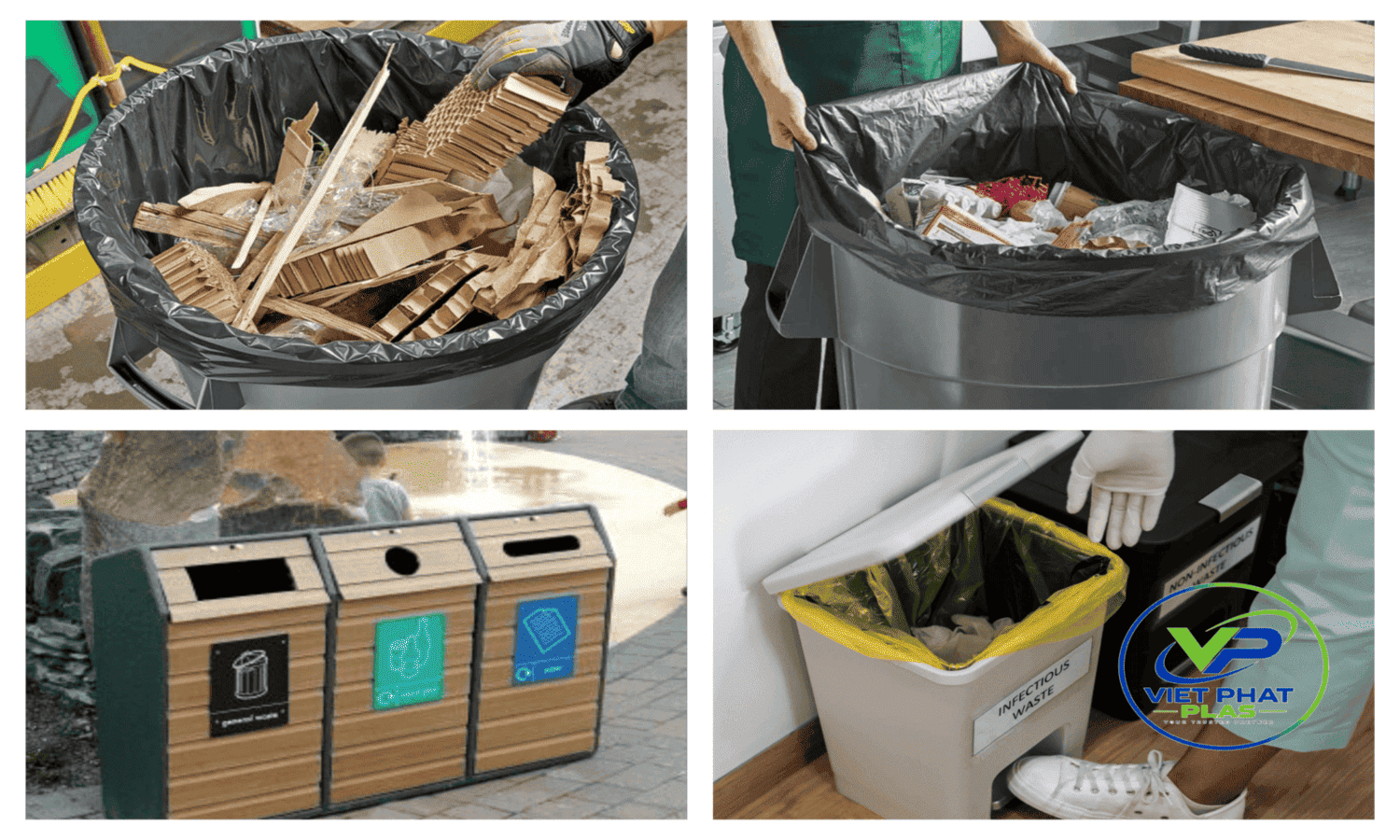
Four commercial trash bag use cases: hospitality, healthcare, municipal, and industrial
The variables that matter most for a commercial trash bag are the same four regardless of industry — material, mil thickness, seal type, and color — but the weighting between them shifts sharply depending on who is using the bag and what's going into it. A hotel cares most about volume and tear resistance during fast housekeeping turns. A hospital cares most about color and labeling for regulated waste streams. A city cares about weather exposure and multi-bin sorting. A warehouse cares about puncture resistance against sharp or heavy debris. Buying the same generic bag for all four is rarely the cheapest option once you count torn bags, failed inspections, or bags that don't hold up outdoors.
Hospitality: High-Turnover Bags for Guest Rooms and Back-of-House
Hospitality is a volume business for trash bags — housekeeping teams change liners in every guest room, every stay, on top of back-of-house kitchen and banquet waste that runs at a completely different scale. That volume is why most hotels standardize on two liner sizes rather than one: a smaller liner sized to guest room and bathroom bins, and a larger, heavier liner for kitchen, banquet, and loading-dock waste, where food waste adds weight and moisture that a thin guest-room liner isn't built to hold.
Seal type matters more in hospitality than buyers often expect, since housekeeping staff are tying off bags dozens of times a shift — a star-seal or flat-seal bag that ties quickly without needing two hands free is a real efficiency factor at that volume, which is covered in more depth in the seal-type comparison in VietPhatPlas's material and seal guide linked above. Odor control is the other hospitality-specific consideration: back-of-house kitchen and banquet liners benefit from a thicker gauge partly for strength and partly because a thicker film holds odor better than a thin one during the hours between pickups.
Healthcare: Color Coding and Regulated Medical Waste
Healthcare is the one setting on this list where trash bag color isn't a branding choice — it's tied to regulated waste handling. In the United States, OSHA's Bloodborne Pathogens Standard (29 CFR 1910.1030) requires that regulated medical waste be marked with a biohazard symbol label in a contrasting color against a fluorescent orange or orange-red background, and OSHA has confirmed that "a red container may be substituted for the biohazard label" — which is why red bags are the de facto standard for regulated medical waste in most US healthcare facilities, even though the underlying requirement is about labeling, not the color itself. Facilities outside general regulated waste — ordinary office and patient-area trash that isn't contaminated waste — don't need this treatment and can run on standard commercial liners instead.
For buyers sourcing at the manufacturer level, this means specifying color and any labeling requirements clearly at the quote stage rather than assuming a "hospital bag" is a standard catalog item — color is a customizable specification on VietPhatPlas's garbage bags rather than a fixed stock option, so a healthcare buyer needing a specific red or labeled bag should confirm color, mil thickness, and any labeling needs directly with the manufacturer before ordering, and separately confirm with their own compliance team that a given bag and labeling setup satisfies their local regulated-waste requirements.
Municipal and Institutional: Multi-Stream Sorting and Outdoor Durability
Municipal and institutional buyers — city parks departments, public buildings, universities, transit systems — increasingly run multi-stream waste programs, commonly a black or gray bag for general trash, a blue bag for recyclables, and a green bag for organics or yard waste, though the exact color scheme varies by city and program. Beyond color, the outdoor half of municipal waste — park bins, street receptacles, transit stops — puts different stress on a bag than an indoor office bin does: UV exposure, temperature swings, and contact with wildlife or rodents all favor a thicker, more puncture-resistant film than an equivalent indoor trash bag would need.
Municipal and institutional buyers also tend to procure through longer contract cycles and larger standing orders than a single hotel or clinic, which makes consistent thickness and sizing across a large order more important than it is for a smaller buyer — a batch that runs thinner than spec shows up as a real complaint volume once it's distributed across hundreds of bins citywide.
Industrial: Heavy-Duty Bags for Debris and Sharp Waste
Industrial waste is where mil thickness matters most, since the contents themselves — metal shavings, construction debris, broken glass, packaging scrap — are the primary cause of bag failure rather than volume or weather. As a general reference point for poly film gauges, 3-4 mil is typically positioned as heavy-duty for parts, tools, and industrial materials, with 5-6 mil reserved for extra-heavy-duty use with bulk products or sharp objects — a lighter 1-2 mil bag suited to office or household waste has no place on an industrial floor handling that kind of debris. Chemical exposure is a separate consideration from puncture resistance: a bag that's thick enough to resist tearing isn't automatically resistant to solvents or oils, so industrial buyers dealing with chemical waste should confirm resin compatibility with a supplier rather than assuming thickness alone solves for it.
Comparison Table: Bag Requirements by Industry
|
Industry |
Primary Requirement |
Typical Thickness Range |
Color/Labeling Need |
|
Hospitality |
Volume, fast-tie seal, odor control (back-of-house) |
Standard for guest rooms; heavier for kitchen/banquet |
Usually none — branding-driven at most |
|
Healthcare |
Regulated-waste labeling and color |
Buyer-specified per facility policy |
Red or biohazard-labeled for regulated medical waste (OSHA 29 CFR 1910.1030) |
|
Municipal/Institutional |
Weather resistance, multi-stream sorting |
Heavier than indoor-equivalent bags |
Program-specific (e.g., black/blue/green streams) |
|
Industrial |
Puncture and chemical resistance |
3-4 mil heavy-duty; 5-6 mil extra-heavy-duty for sharp/bulk waste |
Rarely color-coded; safety marking case-by-case |
FAQ
Are healthcare facilities legally required to use red trash bags?
Not exactly — OSHA's requirement is that regulated medical waste be marked with a biohazard label or a red container as a substitute for that label. Red has become the de facto standard because it's the simpler compliance path, but the underlying rule is about labeling regulated waste, not the color of every bag in a facility.
What mil thickness is recommended for industrial or construction-site trash bags?
3-4 mil is a common heavy-duty range for parts, tools, and general industrial debris, with 5-6 mil used for extra-heavy-duty applications involving bulk waste or sharp objects. The right choice depends on what's actually going into the bag, not a single fixed number.
What makes a hospitality trash bag different from a standard household one?
Mainly seal type and sizing strategy — hospitality buyers typically standardize on two sizes (guest-room and back-of-house) and favor a fast-tie seal for housekeeping efficiency, plus a heavier gauge for kitchen and banquet waste than a guest-room liner needs.
Can commercial trash bag color and thickness be customized per industry at wholesale?
Yes, at the manufacturer level — color and film gauge are typically customizable specifications rather than fixed catalog options, so buyers should confirm their exact color, thickness, and sizing needs directly with the supplier at the quote stage.
Does choosing the wrong trash bag type actually affect cost?
Yes, though the effect shows up indirectly — through torn bags needing replacement, staff time spent double-bagging, failed inspections in regulated settings, or bags that don't hold up outdoors and need earlier replacement — rather than as a single fixed percentage that applies to every buyer.
Conclusion
Commercial trash bags stop being a commodity purchase once you look at what hospitality, healthcare, municipal, and industrial buyers are actually asking a bag to do — fast-tie volume, regulated-waste labeling, weather resistance, or puncture and chemical resistance are four different jobs, not one. Matching the bag to the industry, rather than defaulting to whatever is cheapest per case, is what keeps the spec from turning into a hidden cost later.
VietPhatPlas is a Vietnam-based manufacturer producing custom HDPE trash bags with buyer-specified size, thickness, and color for hospitality, healthcare, municipal, and industrial customers. Contact VietPhatPlas to specify the bag requirements for your industry before your next order.
Author Bio: Written by the VietPhatPlas content team, drawing on production practices from VietPhatPlas's own trash bag manufacturing line, produced at its 8,000 m² facility in Vietnam.
Related Posts & Products: Garbage Bags (product page)
Sources