Biodegradable vs Compostable Trash Bags: A B2B Sourcing and Compliance Guide

"Biodegradable" and "compostable" get used interchangeably in trash bag marketing, but only one of them has an enforceable technical standard behind it. This guide breaks down what BPI certification and ASTM D6400 actually verify, why unqualified biodegradable claims carry real regulatory risk, and how recycled-content mandates are a separate compliance track buyers need to track alongside eco-labels.
Biodegradable vs compostable trash bags is a comparison most buyers think they already understand — until a supplier's data sheet uses both terms for the same product, or a retail customer asks for proof behind an "eco-friendly" label. The two terms are not interchangeable: one describes a vague, largely unregulated property that almost any organic-based plastic technically has over a long enough timescale, and the other refers to a specific, testable technical standard with numeric pass/fail criteria.
That gap matters more than it sounds like it should. Buyers who treat "biodegradable" and "compostable" as marketing synonyms end up exposed on two fronts: regulatory risk from unsubstantiated environmental claims, and wasted spend on certification a product's actual disposal environment can't use anyway. This guide is written for procurement teams, private-label brands, and distributors sourcing trash and garbage bags — the same buyers who compare industrial trash bags against commercial garbage bags on mil thickness and seal type — who now need to know what eco-labels actually verify before they show up on a retail package.
Biodegradable vs Compostable: What Separates Them
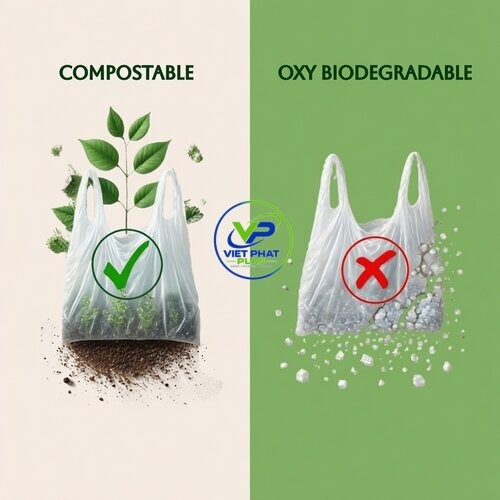
Side-by-side comparison of biodegradable and compostable trash bags
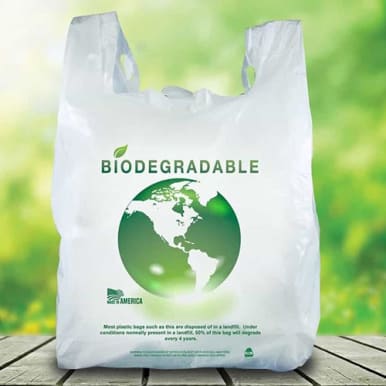
"Biodegradable" describes a material that microorganisms can eventually break down into simpler substances. Standard, untreated polyethylene technically qualifies too, just over a timescale of decades to centuries. Plastic formulated with biodegradation-accelerating additives — the kind commonly marketed as "biodegradable bags" — can break down considerably faster, often cited in the range of several months to a few years, but that figure is only meaningful once it's tied to a specific disposal environment (soil exposure, UV, moisture, managed composting) and a testing method. Without that context, the same product can be quoted anywhere from a few months to several years depending on conditions, which is precisely why the bare term "biodegradable" tells a buyer almost nothing actionable on its own.
"Compostable" is narrower and testable. In the US, the reference standard is ASTM D6400, which requires a product to reach at least 90% biodegradation within 180 days under industrial composting conditions, disintegrate into fragments smaller than 2mm, and leave no residue that's toxic to plant growth. The EU equivalent, EN 13432, sets comparable thresholds. Both standards specify an industrial composting environment — sustained temperatures of roughly 50–60°C, controlled moisture, and active aeration — conditions a landfill or an unmanaged backyard compost pile typically doesn't provide.
This confusion isn't limited to small suppliers cutting corners. Larger brands have run into the same problem by using "biodegradable" and "compostable" as loosely interchangeable marketing language across a product line, only to find that one SKU passed lab testing under ASTM D6400 and another, made from a different resin blend, did not — despite both carrying the same packaging copy. That's the practical risk for a buyer sourcing private-label trash bags: a claim that's accurate for one formulation isn't automatically accurate for a near-identical one from the same supplier.
The practical takeaway: "compostable" is a claim a lab can verify against a published number, tied to a specific formulation and batch. "Biodegradable," used alone, is not — which is exactly where the regulatory exposure in the next section comes from.
Why "Biodegradable" Claims Carry Regulatory Risk
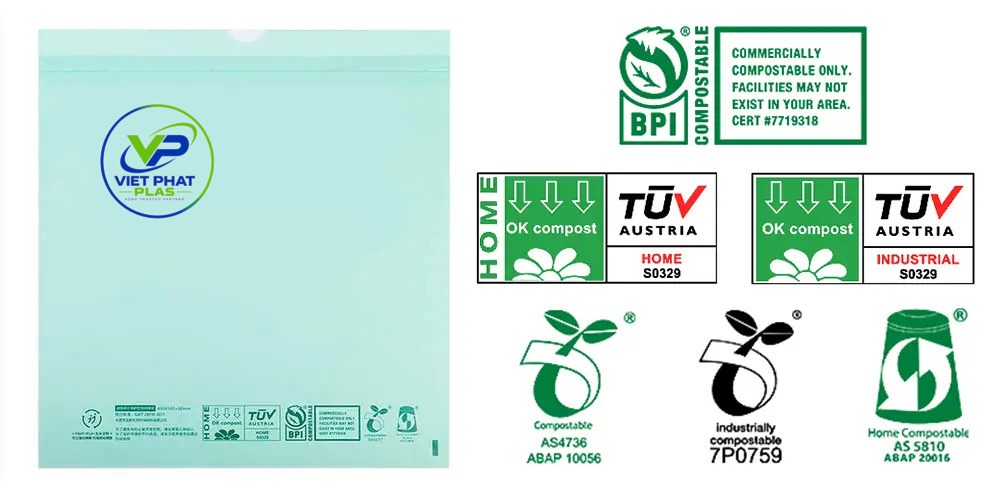
Close-up of certification and claim labeling on trash bag packaging
Regulators treat unqualified biodegradability claims as a specific risk category, not a minor labeling nuance. Under the FTC's Green Guides, an unqualified "biodegradable" claim requires the marketer to have competent and reliable scientific evidence that the entire product will completely decompose into elements found in nature within one year after customary disposal — and customary disposal, for most trash bags, means a landfill, incinerator, or recycling stream. Landfills in particular lack the oxygen, moisture, and microbial activity that biodegradation depends on, so an unqualified claim on a landfill-bound product is presumed misleading unless a supplier can actually substantiate it.
This isn't a theoretical risk. In FTC v. ECM BioFilms — upheld on appeal by the Sixth Circuit in 2017 — the agency found that a plastics additive manufacturer had deceptively marketed its product as making plastic "fully biodegrade" in nine months to five years without adequate scientific support, and barred the claim absent real evidence. Buyers relying on a supplier's own biodegradability marketing, without an independent test report behind it, are inheriting that same exposure if the claim ever gets challenged.
Qualified claims are the defensible path: a message like "breaks down under industrial composting conditions within 180 days, tested to ASTM D6400" describes a specific, verifiable outcome. A bare "biodegradable" printed on a bag destined for a municipal landfill does not, and the exposure sits with whoever's name is on the label — which, for a private-label buyer, is often the buyer's own brand rather than the manufacturer that supplied the resin.
BPI Certification and What It Verifies
BPI (the Biodegradable Products Institute) doesn't write its own compostability standard — it's a third-party certification body that verifies a product's compliance with ASTM D6400 for plastics or D6868 for paper-backed packaging through independent laboratory testing. Getting certified means testing at a BPI-approved lab, disclosing 100% of the product's additives and colorants, and going through a process that typically takes 90 to 180 days.
For a buyer, the BPI logo functions as a check most private "compostable" claims don't have: it means an independent party tested the actual product formulation against a numeric standard, rather than a supplier asserting compostability based on the resin family alone. Asking for the BPI certificate number — checkable against BPI's own public certification database — is a meaningfully stronger verification step than accepting a supplier's compostable logo at face value.
One limitation worth flagging to buyers directly: BPI/ASTM D6400 certification verifies performance specifically in industrial composting facilities. It says nothing about how the same bag performs in a home compost bin or an ordinary landfill. A certified-compostable bag sold into a market where end users don't have access to industrial composting infrastructure may be technically compliant but practically indistinguishable from any other bag at the point of disposal — a gap worth raising with a supplier before a certification claim goes on packaging.
Worth noting for buyers evaluating a manufacturer directly: not every supplier holds BPI certification in-house, and that isn't automatically disqualifying — what matters is whether the supplier can produce independent test documentation. VietPhatPlas does not hold BPI or ASTM D6400 certification in-house; instead, VietPhatPlas provides third-party test reports from independent labs such as SGS for each production batch shipped. The distinction to look for in any supplier conversation is the same either way: a real, batch-specific lab report from an independent tester, not a logo on a spec sheet.
Recycled-Content Mandates Buyers Should Track
Recycled-content requirements are a separate compliance track from biodegradable and compostable claims, and buyers who conflate the two miss real exposure. Washington State's RCW 70A.245.020, enacted under SB 5022 in 2021, sets minimum postconsumer recycled content (PCRC) thresholds specifically for plastic trash bags sold in the state: 10% by 2023, rising to 20% by 2027. The state has already issued fines to companies that failed to meet the threshold, so this isn't a dormant rule — other states have introduced comparable recycled-content bills since, and buyers shipping into multiple US markets should expect the list to grow.
The important distinction for sourcing: a compostable bag, built from bio-based resin designed to break down, typically contains 0% postconsumer recycled content — the two properties don't usually coexist in the same product. A PCR trash bag, built from reprocessed conventional plastic, is generally not compostable. Buyers selling into jurisdictions with recycled-content mandates need documented PCR percentages, not a general "eco-friendly" claim, and buyers' marketing compostability need to be clear that the product isn't simultaneously satisfying a recycled-content requirement. VietPhatPlas, as a garbage bag manufacturer supplying export markets, provides an independent third-party test report — for example from SGS — for each production batch, giving buyers documented PCR percentage and compostability status per shipment rather than a self-reported figure.
For buyers distributing across multiple US states, the practical complication is that recycled-content thresholds aren't uniform — a percentage that clears one state's minimum this year may fall short of a different state's requirement, or the same state's requirement a few years later as thresholds step up. Treating recycled content as a fixed spec rather than a moving compliance target is a common sourcing mistake, particularly for buyers who lock in a supplier contract for multiple years without revisiting the requirement.
Comparison Table: Biodegradable vs Compostable vs PCR
Comparison chart of decomposition lifecycle for biodegradable, compostable, and PCR trash bags
|
Factor |
Biodegradable (unqualified) |
Compostable (BPI/ASTM D6400) |
PCR (Recycled Content) |
|
What it describes |
Eventual breakdown by microorganisms, no defined timeframe |
Breakdown into non-toxic biomass within a tested, defined period |
Percentage of the plastic sourced from reprocessed material |
|
Governing standard |
None enforceable on its own |
ASTM D6400 (US) / EN 13432 (EU) |
State-level mandates, e.g. RCW 70A.245.020 |
|
Environment required |
Unspecified — often assumed, rarely verified |
Industrial composting facility (~50–60°C, controlled moisture/aeration) |
N/A — a material-sourcing metric, not a disposal claim |
|
Third-party certification available |
No standard certifier |
Yes — BPI |
Documentation via mill certificate / lab report |
|
Regulatory exposure if unsubstantiated |
High — FTC Green Guides violation risk |
Low, if genuinely certified |
Fines for non-compliance with state minimums |
|
Typical PCR content |
Not applicable |
Usually 0% (virgin bio-based resin) |
10–20%+ depending on jurisdiction and year |
A product can be compostable or PCR — rarely both at once with current material technology. Buyers should treat these as two different sourcing questions, not one.
How to Vet a Supplier's Eco Claims
A short checklist turns a supplier's marketing claim into something a buyer can actually defend downstream:
Ask for the certificate itself, not the logo. A BPI certificate has a lookup number checkable against BPI's public database, tied to a specific product and manufacturer — a supplier that can't produce one isn't BPI-certified, regardless of what's printed on a spec sheet or packaging mockup.
Confirm which standard is being tested against. ASTM D6400 (US) and EN 13432 (EU) are the two most common, but they're not interchangeable for regulatory purposes in different markets — a supplier citing EN 13432 test results for a US-bound order is citing the wrong standard for US retail claims, even if the underlying resin performs similarly.
Request PCR percentage as a documented figure, not a verbal estimate. A mill certificate or independent lab report showing actual recycled content is the only version of this claim that holds up if a state regulator asks for it later, and it's worth requesting per production batch rather than assuming one certificate covers every shipment indefinitely.
Ask what disposal environment the claim assumes. "Compostable" only means something if the end market actually has industrial composting infrastructure — confirm this matches your distribution footprint before it becomes a customer-facing claim, since a technically accurate certification can still mislead an end consumer who has no access to industrial composting.
Review the exact retail packaging wording before it ships. A supplier's internal test data might support a narrow, qualified claim, but marketing copy has a way of dropping the qualifiers somewhere between the lab report and the printed bag — get the final label language reviewed against what's actually certified, not against what sounds best on shelf.
Ask whether certification is held in-house or documented through an independent lab per batch. Both are legitimate, but a buyer should know which one they're getting. A manufacturer without its own BPI certificate can still provide a defensible claim if it supplies a batch-specific test report from an independent third party such as SGS — the report's credibility comes from the testing lab's independence, not from whether the manufacturer holds the certification itself.
FAQ
How is biodegradable different from compostable for trash bags? Biodegradable means microorganisms will eventually break the material down, with no required timeframe or environment. Compostable means the product meets a tested standard — ASTM D6400 in the US — requiring 90% biodegradation within 180 days under industrial composting conditions, with no toxic residue.
Is BPI certification legally required to sell compostable trash bags? No single federal law mandates BPI certification specifically, but making an unsubstantiated "compostable" or "biodegradable" claim exposes a seller to FTC Green Guides enforcement risk. BPI certification is the most widely recognized way to have that claim independently verified rather than self-asserted.
Will a biodegradable trash bag actually break down in a normal landfill? Not reliably, and regulators treat that gap as the core issue. Landfills typically lack the oxygen, moisture, and sustained heat that biodegradation depends on, which is why the FTC requires scientific substantiation before an unqualified biodegradable claim can be made for landfill-bound products.
Does a compostable trash bag also count toward recycled-content requirements? Generally no. Compostable bags are usually made from virgin bio-based resin with 0% postconsumer recycled content, while recycled-content mandates like Washington's RCW 70A.245.020 require a documented PCR percentage — they're separate compliance tracks that don't typically overlap in the same product.
What should a buyer ask before trusting an "eco-friendly" trash bag label? Ask for the actual certificate number (not just a logo), which standard it was tested against, documented PCR percentage if recycled content is claimed, and whether the disposal environment the claim assumes actually matches where the product will be used. "Eco-friendly" itself isn't a defined technical term under any standard — treat it as a signal to ask more specific questions, not as a claim to repeat on your own packaging without qualification.
Can a trash bag be both compostable and made with recycled content? It's technically possible but uncommon with current material technology, since compostable bags are generally built from virgin bio-based resin and recycled content typically comes from reprocessed conventional plastic that isn't designed to break down. If a supplier claims both properties in the same product, ask for separate test documentation for each claim rather than assuming one certification covers both.
Conclusion
Biodegradable vs compostable trash bags isn't a wording preference — it's the difference between an unenforceable marketing term and a claim backed by a testable standard, and treating them as synonyms creates real regulatory exposure for the party putting the label on the package. That exposure lands on the buyer's brand as often as it does on the manufacturer, particularly for private-label programs where the retailer's name — not the factory's — is the one printed next to the claim.
Buyers who ask for the certificate number, confirm the standard, request documented PCR percentages instead of verbal assurances, and understand that recycled content and compostability are separate tracks entirely are the ones who can actually stand behind what's printed on their packaging when a regulator, retailer, or customer asks for proof.
VietPhatPlas manufactures trash bags and garbage bags for B2B buyers who need documented specifications rather than unverified eco-claims. VietPhatPlas does not hold BPI or ASTM D6400 certification in-house; instead, each production batch ships with an independent third-party test report, such as from SGS, so buyers get verifiable documentation without relying on a self-issued claim. Contact VietPhatPlas to discuss your material, batch testing, and compliance requirements before your next bulk order.
Sources:
-
Trash Bags Market — Mordor Intelligence