Biodegradable Food Bags: Material, Decomposition Time, and What Buyers Should Verify Before Ordering

Biodegradable food bags are marketed with a wide range of decomposition claims, and not all of them mean the same thing. This guide breaks down what starch-based additives actually do to a PE bag, how that differs from banned oxo-degradable technology, what the realistic decomposition timeline looks like, and the specific questions a B2B buyer should ask before placing a bulk order.
Biodegradable food bags have moved from a niche request to a standard line item on RFQs for produce packers, bakeries, deli counters, and takeaway brands — but the term itself covers a wider range of actual performance than most buyers realize. Pouches and bags are already the leading format in the wider biodegradable food packaging market, holding an estimated 28.2% share in 2026 according to Persistence Market Research, which values the global market at US$241.7 billion in 2026 and projects growth to US$353.9 billion by 2033 at a 5.6% CAGR. That growth is pulling in suppliers using very different technologies under the same marketing word, which is exactly the problem this guide addresses.
This article focuses specifically on food-contact bags — flat bags, T-shirt-style carriers, and roll-packed liners used for produce, bakery, deli, and takeout — which raises different questions than a related but separate category: general-purpose biodegradable trash and garbage bags, covered in VietPhatPlas's guide to biodegradable vs compostable trash bags, where direct food contact, clarity, and light gauge aren't part of the buying decision. If you're sourcing waste bags rather than food bags, the compostability certification and recycled-content questions are similar, but the food-safety verification step covered here does not apply in the same way. For readers comparing plastic bag materials more broadly, VietPhatPlas's plastic bag materials guide covers PE, HDPE, and LDPE selection outside the biodegradable category.
Biodegradable Food Bags: What the Term Actually Means
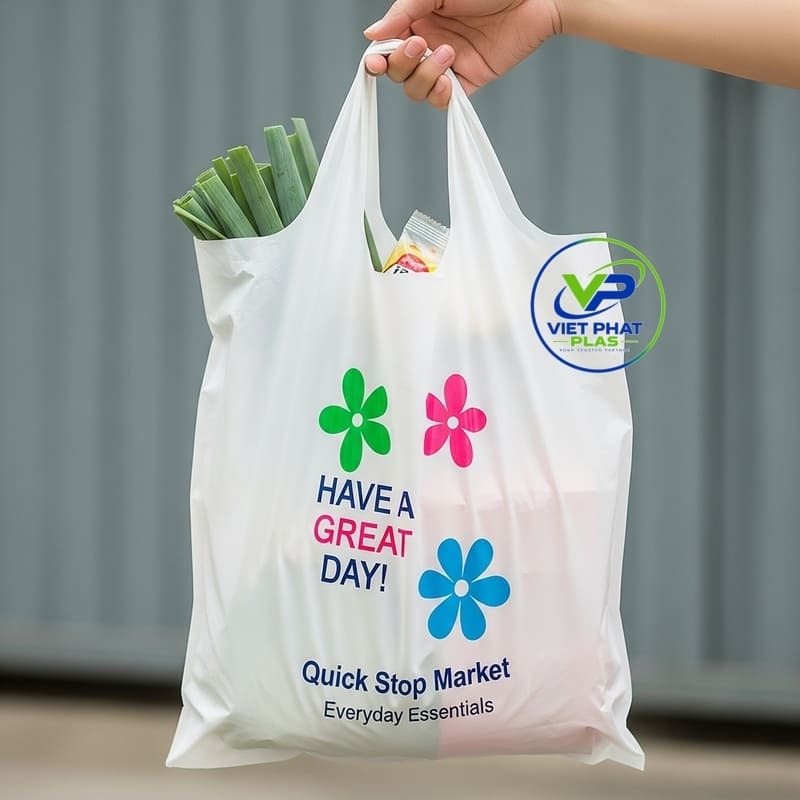 Biodegradable food bag holding fresh food
Every plastic bag is technically "biodegradable" over a long enough timeline — standard polyethylene breaks down eventually too, just over decades to centuries under normal disposal conditions. What buyers actually mean when they ask for biodegradable food bags is a bag formulated to break down meaningfully faster than that, using additives that make the polymer matrix accessible to microbial activity well before a standard PE bag would even begin to fragment.
That distinction matters more for food bags specifically than it does for most other bag categories, for two reasons. First, food bags are overwhelmingly single-use — a produce bag, deli liner, or takeout bag is typically used once and discarded within hours or days, so the disposal-speed argument that drives demand for biodegradable trash bags applies here too, but compounded by volume: food retail and foodservice generate enormous numbers of single-use bags relative to their size. Second, because these bags touch food directly, any additive package has to be evaluated on two separate axes — how it affects decomposition, and whether it's safe for food contact — which is a compliance question biodegradability certification alone doesn't answer, covered in more detail later in this guide.
"Biodegradable" is also frequently confused with "compostable," and the two aren't interchangeable. Compostable is the narrower, testable claim: in the US, ASTM D6400 requires a product to reach at least 90% biodegradation within 180 days under industrial composting conditions, disintegrate into fragments smaller than 2mm, and leave no plant-toxic residue; EN 13432 sets comparable thresholds in the EU. "Biodegradable" on its own, without a named standard and test result behind it, describes a general property rather than a verified outcome — which is precisely why the FTC's Green Guides treat an unqualified biodegradable claim as requiring scientific substantiation that the product will fully decompose within one year of customary disposal, not an assumption a supplier can make on a resin family's reputation alone.
The Material: Virgin Resin Plus Starch-Based Additives
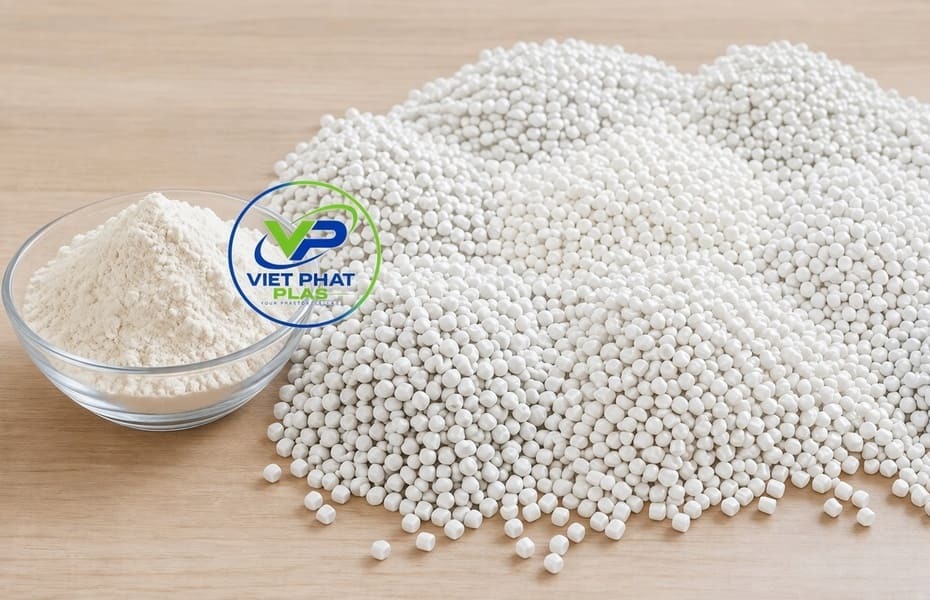
PE resin pellets and starch-based additive material before extrusion into food bags
The most common technical route to a biodegradable food bag starts with a conventional PE resin base — the same polyethylene used in standard flat bags and T-shirt bags — blended with a starch-based biodegradable bag additive, typically derived from corn or tapioca starch. The starch component gives soil and composting microorganisms something to feed on, which breaks down the structural integrity of the plastic matrix from the inside out rather than relying purely on UV and oxygen exposure the way untreated PE does.
This is a meaningfully different mechanism from oxo-degradable plastic, which uses pro-oxidant metal-salt additives to accelerate fragmentation through oxidation rather than microbial digestion. That distinction isn't just academic: the EU's Single-Use Plastics Directive (2019/904) bans oxo-degradable plastic products from the EU market outright, specifically because independent research found the fragmentation process produces persistent microplastic fragments rather than genuine biodegradation, with biodegradation in open environments, landfill, and marine settings assessed as low to non-existent. A buyer asking for a starch-based biodegradable bag and receiving an oxo-degradable product instead isn't just getting a technical substitution — for any shipment bound for the EU, it's a regulatory compliance problem.
In practical production terms, biodegradable food bags built on this starch-additive route are manufactured the same way standard PE food bags are — flat bag on roll or T-shirt bag on roll formats, in the same thin gauges typically used for produce and deli packaging, with the same option for spot-color printing. The additive changes what happens to the bag after disposal; it doesn't require a different manufacturing process or add meaningful cost to the base film structure, which is one reason biodegradable food bags have become a realistic private-label option rather than a premium niche product.
Decomposition Timeline: Months to Years, Not Centuries
The realistic answer to "how long does this take" is a range, not a single number, and any supplier quoting one exact figure without naming a test method should be asked to substantiate it. Biodegradable bag decomposition time for starch-additive PE typically falls somewhere between several months and a few years, depending heavily on the specific disposal environment: soil exposure with active microbial life decomposes the material considerably faster than a sealed landfill, and warmer, more humid conditions accelerate the process compared to cool, dry storage.
The fastest, most rigorously defined end of that range belongs to compostable-certified products specifically: a bag independently tested and certified to ASTM D6400 or EN 13432 has a documented pathway — 90% biodegradation within 180 days under sustained industrial composting conditions (roughly 50–60°C, controlled moisture, active aeration). A biodegradable food bag that hasn't gone through that certification process can still break down meaningfully faster than standard PE, but without a named test method and result, the figure a supplier quotes is a general estimate rather than a verified number — which is exactly the substantiation gap the FTC's Green Guides are designed to catch when an unqualified claim ends up on retail packaging.
For B2B buyers, the practical takeaway is to treat "biodegradable" and a specific timeframe as two separate questions during supplier vetting: ask what conditions the quoted decomposition window assumes, and ask whether that figure comes from an independent lab test or from the additive manufacturer's own marketing material, since the two are not equally defensible if a retail customer or regulator asks for proof later.
Strength Trade-offs: Does Biodegradable Mean Weaker?
This is one of the most common hesitations buyers raise before switching a food-bag line to a biodegradable format, and the honest answer is: it depends on the additive ratio, not on the biodegradable claim itself. Independent formulation research on starch-based bioplastic films shows that outcomes vary considerably by blend — some starch-plasticizer-filler combinations actually improve tensile strength and stiffness over an unmodified base film, while formulations that push starch and glycerol content higher to accelerate biodegradation can reduce baseline tensile strength if the ratio isn't compensated with reinforcing fillers. In other words, biodegradable food packaging strength is a formulation variable that a manufacturer tunes, not an automatic penalty that comes with the word "biodegradable."
For the light gauges typically used in food bag applications — flat bags and T-shirt-style carriers in the thin-film range common to produce, bakery, and deli packaging — a properly formulated starch-additive PE bag can hold comparable load to a standard PE bag of the same thickness for short-term, single-use food handling. Where buyers should be more cautious is with heavier or wetter loads — chilled, oily, or liquid-heavy products that stress the seal and the film simultaneously — where the specific formulation's real-world load performance should be confirmed with a physical sample and a load test on the actual product, not assumed from a generic biodegradable-bag spec sheet.
The practical sourcing move here is the same one experienced buyers already use for any new film formulation: request a sample run at production thickness, load it with the actual product at the actual weight and temperature it will ship at, and check seal integrity after handling — not just after the bag is filled, but after a realistic transport and shelf cycle.
Comparison Table: Biodegradable vs Oxo-Biodegradable vs Standard PE
The oxo-biodegradable vs true biodegradable distinction is the one most likely to create a compliance problem if a buyer doesn't catch it before an order ships, particularly for EU-bound shipments.
|
Factor |
Starch-Based Biodegradable |
Oxo-Degradable |
Standard PE |
|
Breakdown mechanism |
Microbial digestion of starch component weakens polymer matrix |
Pro-oxidant additive triggers oxidative fragmentation |
UV/oxygen exposure only, no accelerant |
|
Typical decomposition timeframe |
Several months to a few years, condition-dependent |
Fragments into microplastics; full biodegradation low to non-existent in most environments |
Decades to centuries |
|
End result |
Fragmentation followed by microbial assimilation |
Small persistent plastic fragments (microplastics) |
Slow fragmentation, long persistence |
|
EU market status |
Permitted, subject to substantiated claims |
Banned from EU market under Directive (EU) 2019/904 |
Permitted, standard commodity film |
|
Independent certification available |
Possible via ASTM D6400/EN 13432 if formulation qualifies |
No recognized compostability standard applies |
Not applicable |
|
Typical food-bag use case |
Produce, bakery, deli, takeout bags seeking faster breakdown |
Not recommended for food-contact bags marketed as eco-friendly |
General-purpose food packaging, no end-of-life claim |
The practical rule for buyers: if a supplier's "biodegradable" bag relies on a pro-oxidant/oxo-degradable additive rather than a starch-based one, that's not a minor formulation detail — it changes both the actual environmental outcome and the shipment's legal status in EU markets.
Questions Buyers Should Ask Before Placing a Bulk Order
A short set of direct questions turns a supplier's biodegradable claim into something a buyer can actually stand behind downstream:
What additive technology is actually used? Ask by name — starch-based, PLA-based, or oxo-degradable — rather than accepting "biodegradable" as a complete answer. The mechanism determines both decomposition behavior and, for EU-bound orders, legal eligibility.
What decomposition timeframe and test conditions does the claim assume? A defensible answer names a specific range and the environment it applies to (industrial composting, soil exposure, landfill), ideally backed by an independent lab result rather than the additive supplier's marketing figure.
Is the bag separately verified safe for food contact? Compostability testing under ASTM D6400 or EN 13432 evaluates ecotoxicity in a soil medium — it does not test for food-contact migration. Food-contact safety is a separate compliance question, typically documented against food contact substance regulations such as FDA 21 CFR or the EU's food-contact material framework, and buyers should request that documentation separately rather than assume a compostability claim covers it.
What does independent batch testing look like? VietPhatPlas does not hold BPI, ASTM, or FDA certification in-house; instead, each production batch ships with an independent third-party test report — for example from SGS — giving buyers documented, batch-specific verification rather than a self-issued claim.
What are the realistic MOQ, thickness range, and lead time? Biodegradable food bags from VietPhatPlas's compostable bags product line are produced as flat bag on roll or T-shirt bag on roll formats, in thin gauges suited to produce, bakery, and deli use, with 1–4 color printing available — buyers should confirm current MOQ and production lead time against their specific thickness and print requirements before finalizing a purchase order, since these vary by specification. For a full RFQ workflow covering specs, sampling, and quality checkpoints, VietPhatPlas's B2B plastic bag sourcing guide walks through the process end to end.
FAQ
What's the difference between biodegradable and compostable food bags? Biodegradable describes a general property — the material will eventually break down — without a required timeframe or test method attached. Compostable is a specific, testable claim: in the US, ASTM D6400 requires 90% biodegradation within 180 days under industrial composting conditions with no toxic residue left behind. A bag can be genuinely biodegradable without meeting the stricter compostable standard.
Are biodegradable food bags weaker than standard PE bags? Not automatically. Tensile strength depends on the specific starch-additive formulation and ratio, not on the biodegradable claim itself — some formulations match or exceed standard PE film strength at the same thickness, while others trade some strength for faster breakdown. Buyers should confirm load performance with a physical sample rather than assuming either outcome.
How can a buyer verify a bag is genuinely biodegradable and not just labeled that way? Ask for the specific additive technology by name, the test standard and conditions behind any decomposition timeframe claim, and independent batch-level test documentation from a third-party lab rather than a self-issued supplier statement. A defensible claim names a mechanism and a source; a vague one doesn't.
Can biodegradable food bags be custom printed with a logo? Yes. Biodegradable food bags built on a starch-additive PE base are manufactured the same way standard PE food bags are, which means the same spot-color printing options — typically 1 to 4 colors — are available without a separate production process.
Are biodegradable food bags safe for direct food contact? Compostability certification and food-contact safety are two separate compliance questions. ASTM D6400 and EN 13432 test ecotoxicity in a soil medium, not migration into food, so buyers should request food-contact compliance documentation — referencing standards such as FDA 21 CFR or the equivalent EU food-contact material framework — as a distinct item from any compostability or biodegradability certificate.
What MOQ and lead time should buyers expect for biodegradable food bags? MOQ and lead time depend on thickness, print requirements, and packing format, and generally track similarly to standard PE food bags produced on the same equipment. Buyers should request current MOQ and lead time against their specific specification rather than assuming a flat figure, since printed and custom-thickness orders typically carry different minimums than unprinted stock runs.
Conclusion
Biodegradable food bags aren't a single, uniform product — the term covers formulations with genuinely different breakdown mechanisms, timelines, and regulatory standing, and the gap between a starch-based additive and an oxo-degradable one is wide enough to affect whether a shipment is even legal to sell in some markets. Buyers who ask for the additive technology by name, request a defined decomposition timeframe tied to a real test condition, and separate the food-contact safety question from the compostability question are the ones who can actually stand behind the claim once it's printed on their own packaging.
VietPhatPlas is a Vietnam-based manufacturer supplying food bags and biodegradable food packaging to B2B buyers across export markets, with production formats including flat bag on roll and T-shirt bag on roll in custom thickness and print options. VietPhatPlas does not hold BPI, ASTM, or FDA certification in-house; each production batch instead ships with an independent third-party test report, such as from SGS, so buyers receive verifiable documentation rather than a self-issued claim. Contact VietPhatPlas to discuss material formulation, batch testing, and specifications for your next bulk order.
Sources:
-
Biodegradable Food Packaging Market — Persistence Market Research