Questions to Ask a Plastic Bag Manufacturer
Most plastic bag manufacturer pages describe themselves with the same words — trusted, premium, certified — without anything behind them. This guide breaks down five questions worth asking instead of taking those claims on faith, and what a straight answer to each one actually looks like.
Questions to ask a plastic bag manufacturer are more useful than a list of claims to read, because a specific question forces a specific answer while a claim like reliable plastic bag manufacturer costs nothing to say on its own. Knowing how to vet a plastic bag manufacturer means asking about plastic bag factory capability you can verify rather than take on faith, and quality control in plastic bag manufacturing you can request documentation for — not just trusting the adjectives on a homepage. This guide breaks down five questions worth asking before you order, and what a real answer to each one looks like.
Why the Right Questions Beat Vague Claims
"Reliable" is one of the most overused words on a manufacturer's own website, precisely because it costs nothing to write and nothing to prove. For a B2B buyer placing a recurring order — not a one-time purchase — the useful move is to replace that adjective with five specific questions, each one checkable on its own: how much the factory can actually produce, what materials and customization it genuinely offers, how its quality control works, what its real export history looks like, and whether it backs its answers with documents rather than reassurance. These aren't hypothetical: they're the same five questions VietPhatPlas's own export team hears most often from new B2B buyers before a first order is placed, which is why this guide is built around them instead of around marketing adjectives. The next five sections walk through each one.
Question #1: How Much Can You Actually Produce?
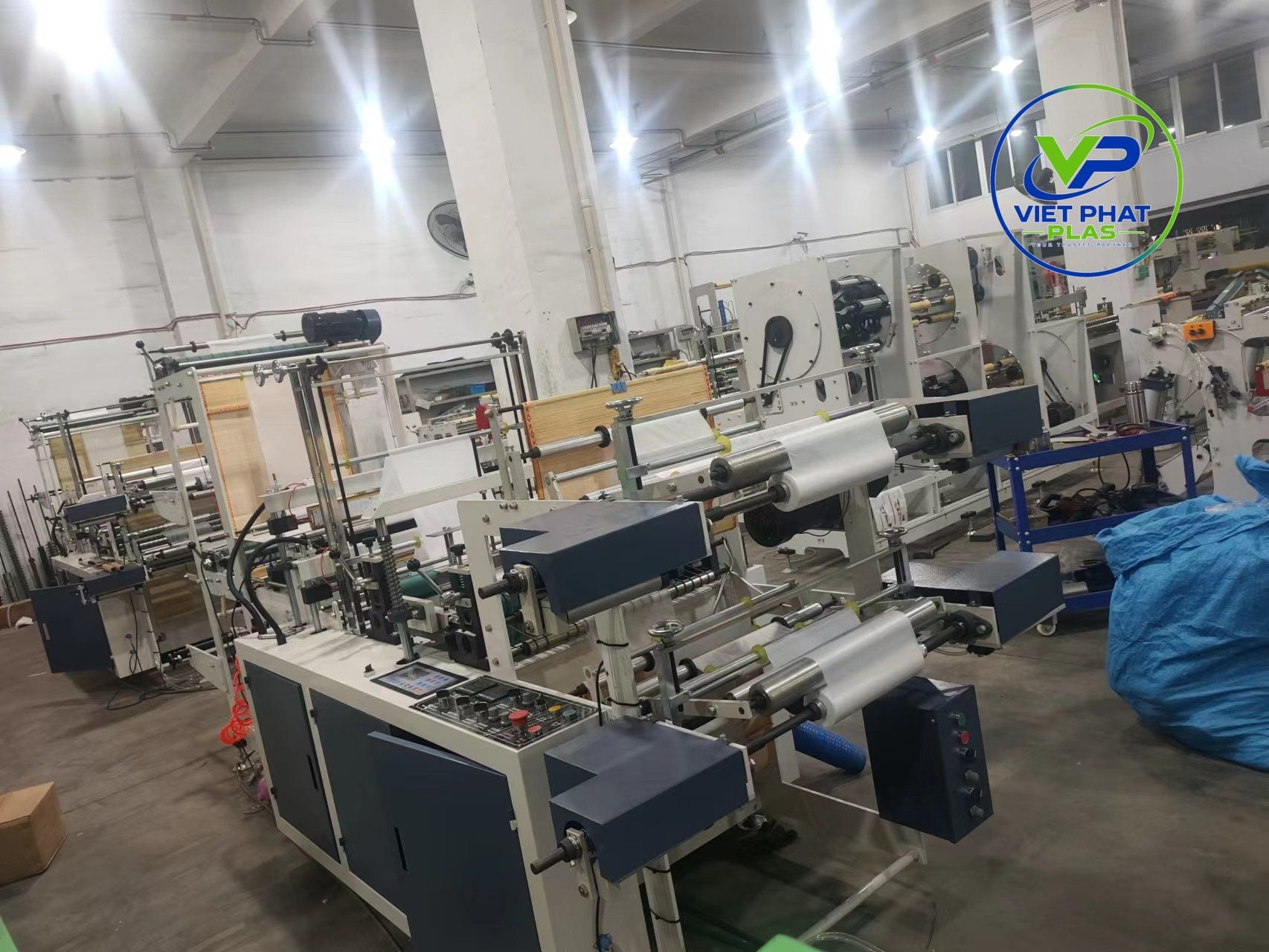
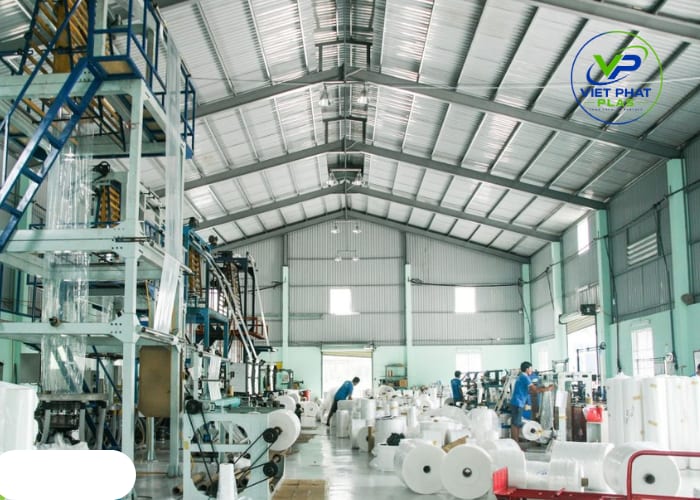
Plastic bag factory production floor with extrusion
Capacity numbers are some of the easiest claims to inflate and some of the hardest for a buyer to check from a distance, which is exactly why they're worth asking about directly rather than accepting from a homepage. A buying guide from Alibaba's own sourcing resource center points to two concrete, checkable signals instead of a single headline number: film gauge tolerance (consistency within roughly ±5% across a production batch) and the type of extrusion equipment in use, since modern co-extrusion lines produce more uniform film layers and fewer defects than older single-layer setups.
VietPhatPlas's own published production data puts this in real terms: an 8,000 m² factory with production capacity of up to 500 tons per month, covering film extrusion, printing, and bag-making in one facility rather than splitting the process across subcontractors. A buyer evaluating any manufacturer — not just VietPhatPlas — should expect a straight answer on floor area, active production lines, and monthly output in tons, not just an adjective like "large-scale."
Question #2: What Materials and Customization Do You Offer?
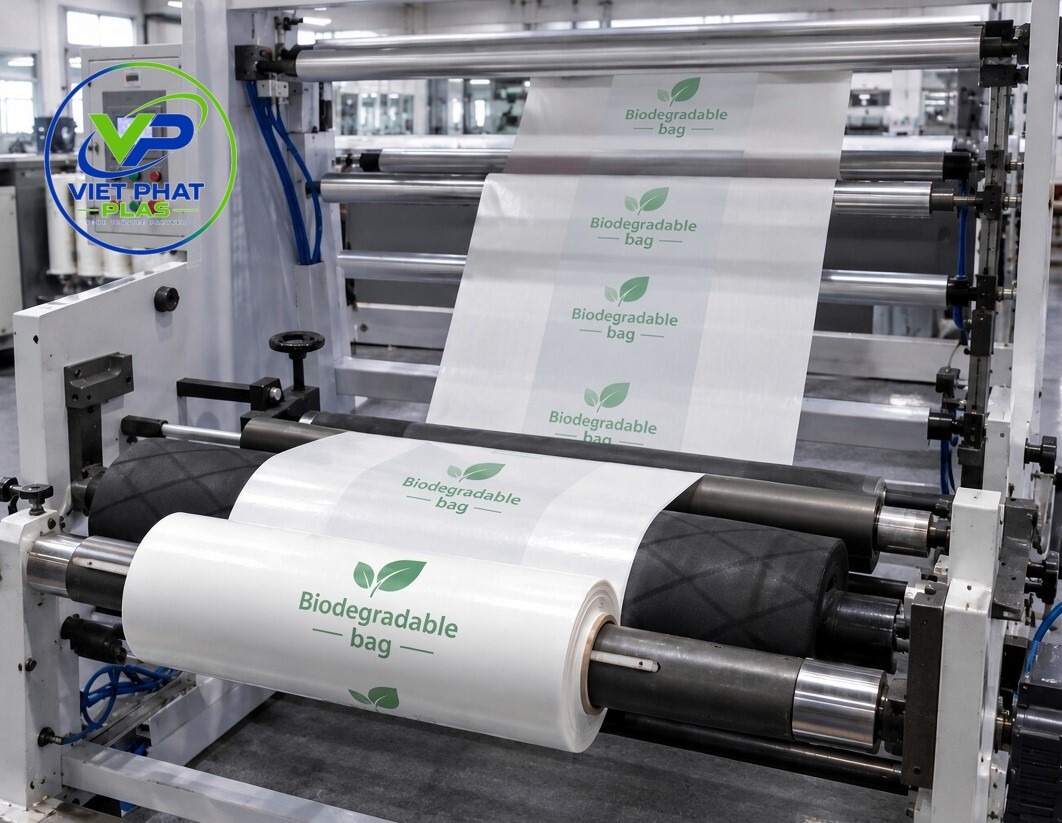
Biodegradable bag production
A manufacturer that only offers one material is really only solving one kind of packaging problem. VietPhatPlas produces across HDPE, LDPE, LLDPE, and MDPE, plus biodegradable film, and customizes bag size, thickness, and printing to the order rather than offering a fixed catalog. Which material actually prints best is its own question — covered separately in Best Material for Custom Bag Printing: HDPE vs LDPE — and which printing method fits a given order volume is covered in Custom Plastic Bag Manufacturer: Printing Methods Guide. This section is specifically about range: can the manufacturer actually make what your product needs, or only what's easiest for them to produce.
Question #3: How Is Quality Actually Checked?
"ISO 9001 certified" and "SGS-tested batch" sound similar but mean two different things, and mixing them up is one of the most common ways a buyer ends up trusting a claim that isn't quite what it appears to be. An ISO 9001 certification says a company follows a documented quality management system across its operations in general. A batch test report from an independent inspection body — SGS, Bureau Veritas, Intertek — verifies one specific production run, the one that's actually shipping, at the point it was tested. It's a narrower document, but it's the one that speaks directly to the order in front of you.
A detailed vetting checklist from Bakka Bags recommends asking for the full report rather than a logo, and checking that it states an Acceptable Quality Level (AQL) threshold — the guide flags 2.5 or tighter for critical defects as the standard to look for, and calls an AQL of 4.0 "far too permissive." The same Alibaba sourcing guide referenced above suggests requesting a certificate of analysis for the specific shipment, including measurements like melt flow index and tensile strength, and notes that a commonly quoted acceptable defect-rate benchmark in the industry sits at 2% or below — worth asking about directly rather than assuming.
VietPhatPlas's own quality control follows the batch-report model: independent third-party SGS test reports are available on request for a given order, rather than a blanket certification claim. That's a deliberate choice to only state what can actually be backed by a document — not a claim to hold ISO 9001 or any other management-system certification the company hasn't published.
Question #4: What's Your Real Export Track Record?
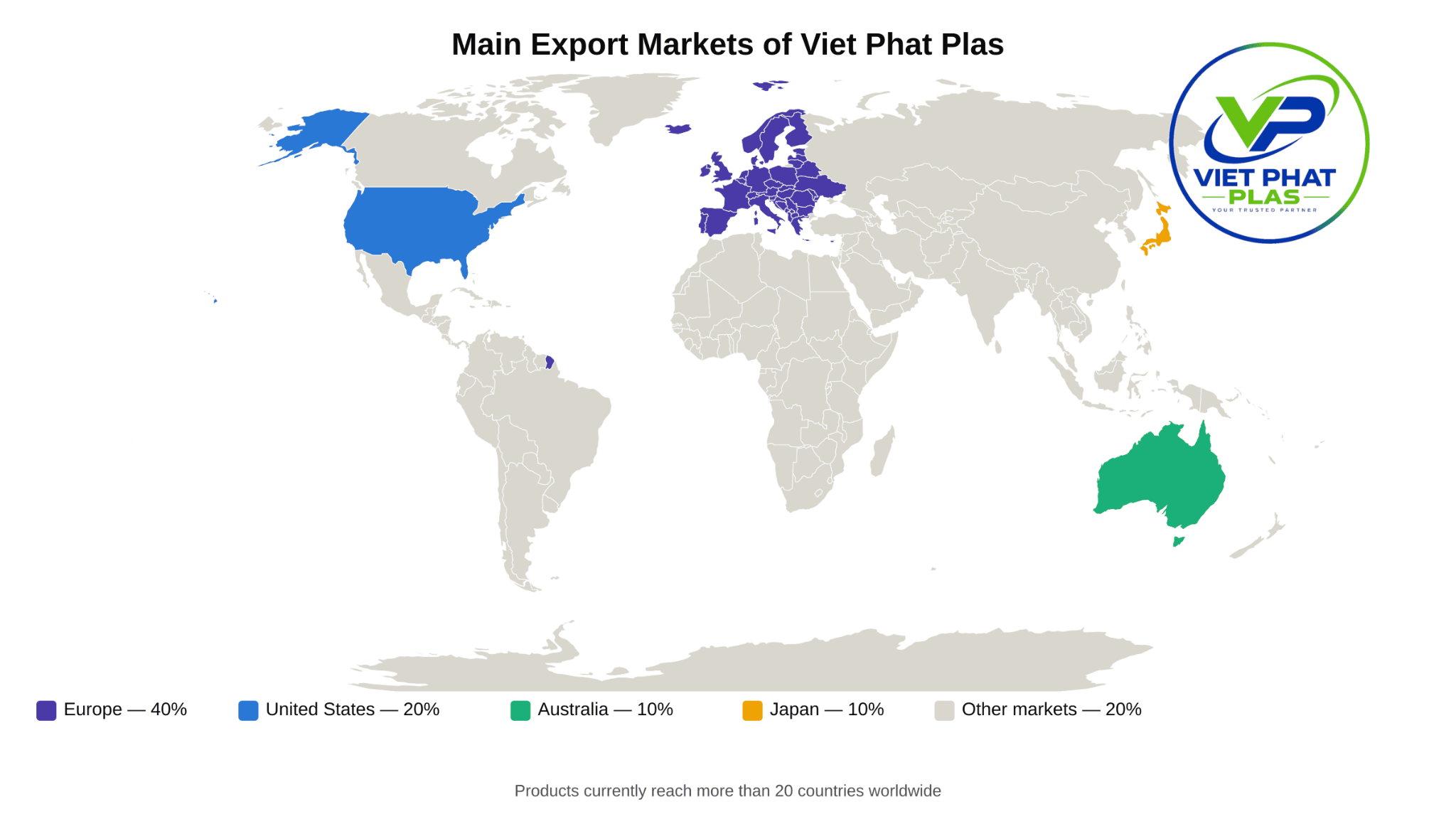
World map showing export destinations with a shipping container at port
A manufacturer that has genuinely exported for years builds compliance documentation into its process as a matter of course, because a shipment that gets held at customs over missing paperwork is expensive for everyone involved. A manufacturer new to export, or one that mostly serves local buyers, may not have that muscle memory yet — which isn't automatically disqualifying, but it's a real difference worth asking about.
VietPhatPlas has 10+ years of experience manufacturing plastic bags and has shipped to 20+ countries, operating as a B2B manufacturer supplying distributors and importers rather than serving domestic retail directly — see About VietPhatPlas for the full production and export profile. For a buyer, the useful question isn't "do you export?" — almost every manufacturer will say yes — it's how many countries a manufacturer has actually shipped to recently, and whether their typical customer looks like a business placing recurring wholesale orders or a one-off local buyer.
Question #5: Can You Back That Up With a Document?
The thread running through the first four questions is the same: a reliable manufacturer answers a specific question with a specific document, not a reassurance. The Bakka Bags checklist referenced earlier flags a useful red flag in the opposite direction — a factory that refuses third-party inspection, or gives a vague answer about what percentage of production actually happens in-house versus at a subcontractor, is signaling something worth taking seriously.
In practice, that means a short list of questions to ask a plastic bag manufacturer is often more useful than a long list of claims to read:
-
Can you share a current batch test report for an order similar to mine — not just a certification logo?
-
What percentage of the process — extrusion, printing, bag-making — happens in your own facility versus a subcontractor?
-
How many countries have you actually shipped to in the past two years?
-
What's your stated defect-rate threshold, and how is a shipment checked against it?
For a broader look at the criteria to weigh when narrowing down a shortlist, see Choosing a Plastic Bag Manufacturer in Vietnam; once a manufacturer checks out, Wholesale Plastic Bag Pricing covers what typically drives cost from there.
Why Businesses Choose VietPhatPlas
VietPhatPlas operates an 8,000 m² facility with production capacity of up to 500 tons per month, covering extrusion, printing, and bag-making across HDPE, LDPE, LLDPE, MDPE, and biodegradable materials. With 10+ years of experience and shipments to 20+ countries, VietPhatPlas supplies custom-printed plastic bags to B2B distributors and importers, with independent third-party SGS batch test reports available on request for a given order.
At a Glance
|
Question |
What a real answer looks like |
Red flag |
|
How much can you actually produce? |
Facility size, active production lines, monthly output in tons |
A single capacity number with no facility detail behind it |
|
What materials and customization do you offer? |
Actual materials offered, size/thickness/printing options |
"We can do anything" with no specific material list |
|
How is quality actually checked? |
Batch test reports vs. general certification claims |
A certification named but no document offered on request |
|
What's your real export track record? |
Years actively exporting, real country count, customer type (B2B vs. retail) |
"We export worldwide" with no specifics |
|
Can you back that up with a document? |
Specific answers to specific questions |
Marketing adjectives in place of documents |
FAQ
What's the difference between an ISO certification and a batch test report?
An ISO certification (like ISO 9001) says a company follows a documented quality management system across its operations generally. A batch test report from an independent inspector (SGS, Bureau Veritas, Intertek) verifies one specific production run before it ships — a narrower but more directly relevant document for the order in front of you.
How much production capacity should a reliable plastic bag manufacturer have?
There's no single correct number — it depends on your order volume — but a reliable manufacturer should be able to state facility size, active production lines, and monthly output in tons specifically, rather than offering only a single impressive-sounding figure with no detail behind it.
What questions should I ask before choosing a plastic bag manufacturer?
Ask for a current batch test report for a similar order, what percentage of production happens in-house versus at a subcontractor, how many countries they've actually shipped to recently, and their stated defect-rate threshold.
Does VietPhatPlas provide third-party quality documentation?
Yes — independent third-party SGS batch test reports are available on request for a given order, rather than a general certification claim.
Conclusion
Questions to ask a plastic bag manufacturer are worth working through before the first order is placed, not after a shipment arrives short of what was promised. The five above — production capability, material range, quality control, export history, and documentation — turn a page full of adjectives into a short list of things a buyer can actually verify. A manufacturer willing to answer all five with a specific document rather than a reassurance is usually the one worth placing a recurring order with. Contact VietPhatPlas to see how we'd answer them for your own order.
Author Bio: Written by the VietPhatPlas content team, based on independently verified industry sourcing guides on manufacturer vetting and quality control, and VietPhatPlas's own verified production data.
Sources
-
Bakka Bags — How to Vet a Bag Manufacturer: The Ultimate 20-Point B2B Checklist
-
Alibaba Smart Buy — How to Choose a Plastic Bag Factory: A Complete Buying Guide
-
Ninghow Apparel — Using Third-Party Inspection Services (SGS, Intertek, QIMA)
-
Rutan — What Makes a Reliable Plastic Bag Manufacturer in the US?